



Bitcoin’s price movements often dominate crypto headlines, but a much bigger story may be developing.
A growing number of institutions, corporations, ETFs, and even crypto exchanges are accumulating Bitcoin at an accelerating pace — while the available liquid supply continues shrinking.
The result could be the early stages of a silent Bitcoin supply crisis.
Unlike previous market cycles driven mainly by retail speculation, the current environment is increasingly shaped by long-term holders and institutional capital absorbing BTC faster than new supply enters the market.
Bitcoin Supply Is Becoming Increasingly Illiquid
Bitcoin’s maximum supply has always been capped at 21 million coins. But the truly important number may be far lower.
Millions of BTC are believed to be:
- permanently lost,
- held in long-term cold storage,
- locked in corporate treasuries,
- controlled by ETFs,
- or sitting inactive for years.
At the same time, newly mined Bitcoin issuance continues declining after each halving cycle.
This creates a market structure where liquid, actively traded BTC becomes increasingly scarce over time.
Spot Bitcoin ETFs Are Absorbing Massive Supply
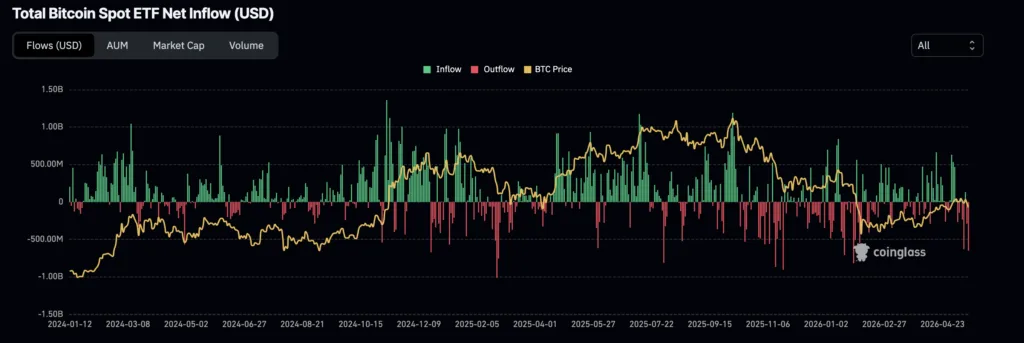
One of the biggest structural changes in the market has been the rapid growth of spot Bitcoin ETFs.
Major financial firms such as BlackRock, Fidelity Investments, and other institutional asset managers continue attracting billions of dollars into regulated Bitcoin investment products.
Unlike speculative retail traders, ETF issuers typically acquire and hold Bitcoin for long-term exposure.
That means large amounts of BTC are steadily moving off the liquid market and into institutional custody structures.
This trend has significantly changed Bitcoin’s supply dynamics compared to previous cycles.

Exchanges Are Quietly Accumulating Bitcoin Too
The ETF narrative is only part of the story.
Crypto exchanges themselves are increasingly becoming strategic Bitcoin holders.
Recently, MEXC announced plans to acquire 1,000 BTC while expanding its Guardian Fund to $500 million as part of a broader reserve strategy.
This reflects a wider shift across the industry where exchanges increasingly prioritize:
- reserve strength,
- transparency,
- treasury stability,
- and institutional credibility.
Instead of viewing Bitcoin solely as a trading asset, exchanges are beginning to treat BTC as strategic reserve capital.
This trend could further reduce circulating market supply over time.
Long-Term Holders Continue Refusing to Sell
Another major factor tightening supply is the behavior of long-term Bitcoin holders.
Many investors who accumulated BTC during previous cycles continue holding despite price volatility and macroeconomic uncertainty.
On-chain data increasingly shows large portions of Bitcoin supply remaining dormant for extended periods.
This creates a unique market structure:
- institutions are buying,
- ETFs are accumulating,
- exchanges are strengthening reserves,
- but existing holders are not selling aggressively.
As a result, fewer coins remain actively available on exchanges.

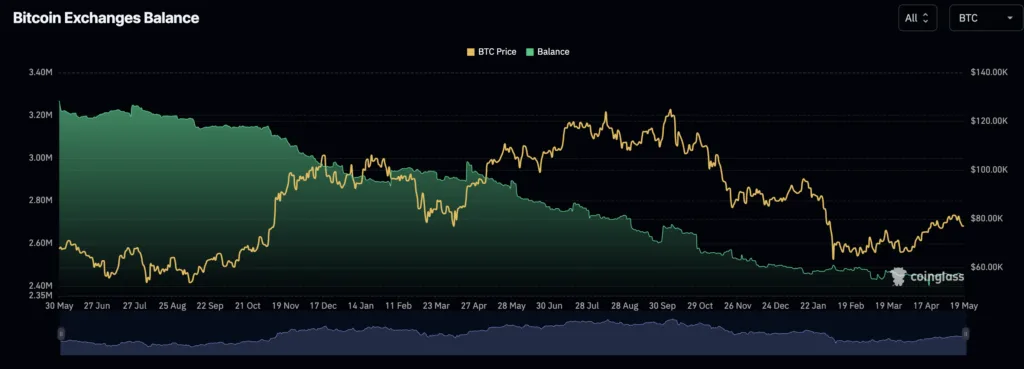
Bitcoin’s Supply Dynamics Are Changing
Historically, Bitcoin experienced major bull runs when demand surged faster than available supply.
But the current cycle may be structurally different.
In previous eras:
- retail speculation dominated,
- leverage drove volatility,
- and large amounts of BTC remained actively tradable.
Today:
- ETFs absorb supply continuously,
- corporations hold BTC as treasury assets,
- exchanges accumulate reserves,
- and institutional investors increasingly treat Bitcoin as digital gold.
Meanwhile, Bitcoin issuance continues slowing after halvings.
This combination could create sustained long-term supply pressure if demand continues increasing globally.
Corporations Are Also Expanding Bitcoin Exposure
Corporate treasury adoption remains another important driver.
Public companies increasingly view Bitcoin as:
- a hedge against currency debasement,
- a treasury diversification tool,
- and a long-term reserve asset.
The success of early Bitcoin treasury strategies has encouraged more firms to explore digital asset exposure as part of broader balance sheet management.
As institutional legitimacy grows, corporate demand could become a much larger factor in future supply dynamics.
Why This Matters for the Market
If Bitcoin demand continues accelerating while liquid supply keeps shrinking, the market could eventually face severe supply-side pressure.
This does not necessarily mean immediate price explosions or guaranteed volatility.
However, it does suggest that Bitcoin’s market structure is becoming increasingly constrained compared to previous cycles.
The long-term implications could include:
- stronger price floors,
- reduced circulating liquidity,
- intensified competition for BTC exposure,
- and greater institutional influence over market flows.
A Structural Shift May Already Be Underway
For years, Bitcoin’s scarcity narrative was largely theoretical.
In 2026, it may be becoming measurable.
Between:
- ETF accumulation,
- exchange reserve growth,
- corporate treasury adoption,
- and dormant long-term holdings,
a growing share of Bitcoin supply is quietly disappearing from the actively traded market.
The result could be the beginning of a silent Bitcoin supply crisis — one that may reshape the crypto market over the coming years.