


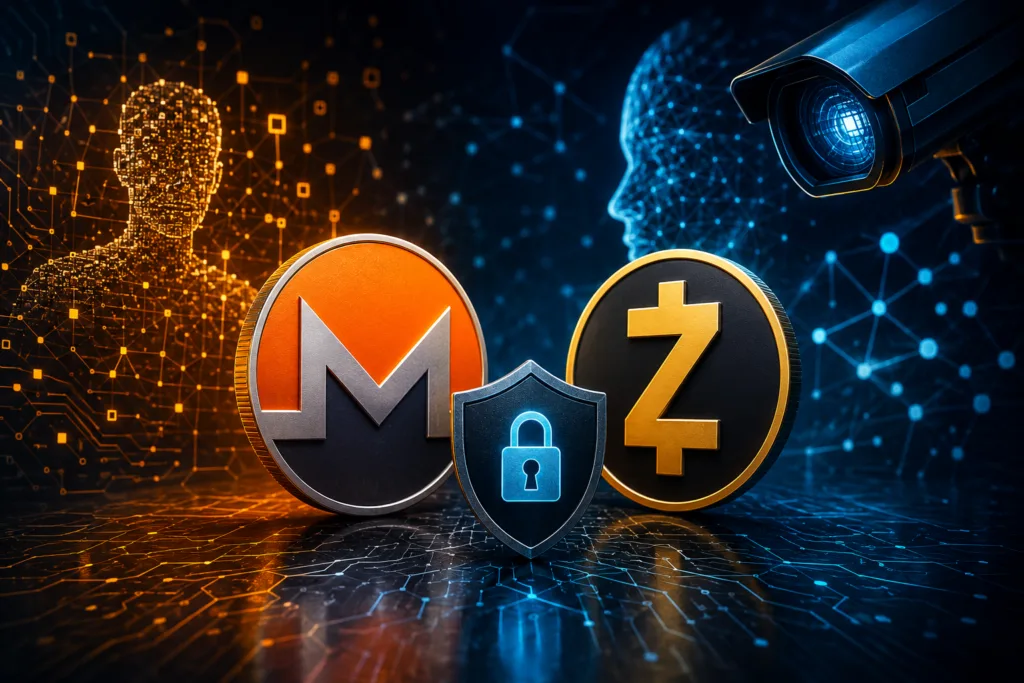
For years, privacy coins have lived in the shadow of Bitcoin, Ethereum, and the latest wave of meme coins. Regulatory pressure, exchange delistings, and concerns over illicit activity pushed projects like Monero (XMR) and Zcash (ZEC) out of the mainstream conversation.
But in 2026, the narrative is beginning to change.
Ironically, it is not a breakthrough in privacy technology that is driving renewed interest—it’s artificial intelligence.
As AI becomes increasingly capable of analyzing blockchain data, identifying wallet owners, and tracking the movement of digital assets, many investors are asking a simple question: Is blockchain becoming too transparent?
That question could make privacy coins relevant again.
Public Blockchains Were Never Truly Anonymous
One of Bitcoin’s biggest misconceptions is that it is anonymous.
In reality, Bitcoin, Ethereum, Solana, and most major blockchains are public ledgers. Every transaction can be viewed by anyone. While wallet addresses do not display personal names, blockchain analytics companies have become remarkably effective at linking addresses to individuals and organizations.
Once a wallet is connected to an exchange account, business, or public identity, years of transaction history can often be analyzed.
This level of transparency has helped regulators combat financial crime and recover stolen funds. However, it has also created concerns among users who believe financial privacy should remain a fundamental right.
AI Is Blockchain Surveillance
Blockchain analysis is not new, but artificial intelligence is making it significantly more powerful.
Modern AI systems can process enormous amounts of blockchain data in seconds, identifying transaction patterns that would have taken human investigators weeks or months to uncover. Combined with machine learning, these systems can detect relationships between wallets, identify laundering techniques, and even predict suspicious transaction behavior.
For governments and law enforcement, this is a major advantage.
For everyday users, it raises a different question.
If every payment, investment, or wallet transfer can eventually be analyzed by increasingly sophisticated AI systems, how much financial privacy actually remains?
That debate is becoming more relevant as AI continues to improve.
Why Monero Still Leads in Privacy
Among privacy-focused cryptocurrencies, Monero remains the industry’s benchmark.
Unlike Bitcoin, Monero hides the sender, recipient, and transaction amount through technologies such as ring signatures, stealth addresses, and confidential transactions.
The result is a blockchain where transaction histories cannot be easily traced by outside observers.
Supporters argue this provides digital cash that closely resembles physical cash—private by default.
Critics, however, argue that the same privacy features can make investigations into criminal activity more difficult.
That ongoing debate has kept Monero at the center of discussions surrounding financial privacy for years.
Zcash Takes a Different Approach
Zcash approaches privacy differently.
Instead of making every transaction private by default, users can choose between transparent and shielded transactions.
Its zero-knowledge proof technology allows transactions to be verified without revealing sensitive financial information.
This optional approach has attracted developers interested in balancing regulatory compliance with user privacy.
Recent network improvements and ongoing development have also renewed attention on the project as institutions and developers continue exploring privacy-preserving technologies.
The Narrative Around Privacy Is Changing
For much of the past decade, privacy coins were often discussed alongside enforcement actions and exchange delistings.
Today, the conversation is becoming broader.
Artificial intelligence, digital identity systems, central bank digital currencies (CBDCs), and increasingly sophisticated blockchain analytics have shifted the focus toward an important question:
Should financial privacy disappear simply because technology makes surveillance easier?
This is no longer a debate limited to cryptocurrency enthusiasts.
Businesses handling sensitive payments, journalists working in restrictive environments, political activists, charities, and ordinary individuals all have legitimate reasons to value confidential financial transactions.
As AI expands into more aspects of everyday life, financial privacy is becoming part of a much larger discussion about digital rights.
Regulation Remains the Biggest Challenge
Despite renewed interest, privacy coins still face significant obstacles.
Several major exchanges have removed privacy coins from certain jurisdictions due to regulatory requirements, while governments continue strengthening anti-money laundering (AML) and know-your-customer (KYC) rules.
These policies are unlikely to disappear.
Instead, the industry may increasingly focus on developing privacy technologies that satisfy both user expectations and regulatory standards.
Whether that balance can be achieved remains one of crypto’s biggest unanswered questions.
Could Privacy Become Crypto’s Next Major Narrative?
The cryptocurrency market has historically moved through narratives.
Decentralized finance dominated one cycle.
Non-fungible tokens defined another.
Then came real-world asset tokenization, AI tokens, stablecoins, and institutional Bitcoin adoption.
Privacy may now be quietly re-entering that conversation.
This does not necessarily mean privacy coins will become the next bull market leaders. However, as artificial intelligence makes blockchain surveillance faster, cheaper, and more sophisticated, demand for stronger financial privacy tools could continue to grow.
Rather than disappearing, privacy may be evolving into one of crypto’s most important long-term themes.
But…
Artificial intelligence is transforming nearly every industry, including blockchain analytics.
The same technology helping investigators detect fraud and improve compliance is also highlighting a fundamental trade-off between transparency and privacy.
For years, Monero and Zcash were viewed primarily through the lens of regulation.
Today, they are increasingly being discussed through the lens of digital rights and financial freedom.
Whether privacy coins ultimately return to the mainstream remains uncertain. But one thing is becoming increasingly clear: as AI makes public blockchains easier to analyze, the conversation around financial privacy is only just beginning.