


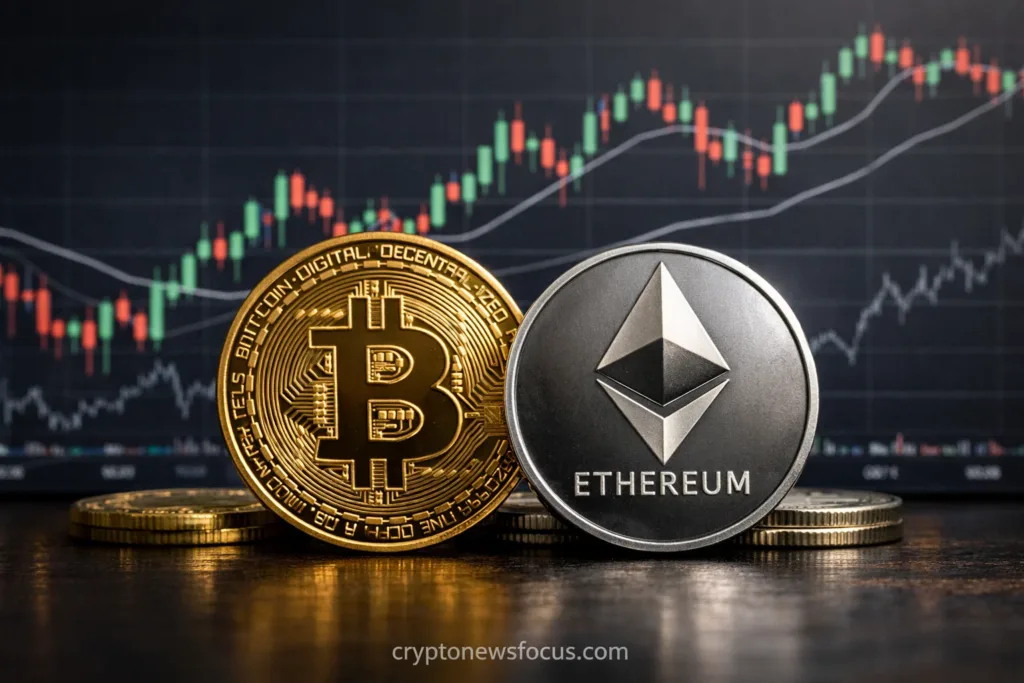
Bitcoin and Ethereum traded lower on Thursday as escalating geopolitical tensions weighed on investor sentiment, triggering a broader sell-off across risk assets.
The decline comes as markets reacted to renewed military tensions involving the United States and Iran, prompting investors to shift capital toward traditional safe-haven assets such as gold and the U.S. dollar. While cryptocurrencies have increasingly matured as an asset class, they continue to experience heightened volatility during periods of geopolitical uncertainty.
Bitcoin Falls Below Key Resistance
Bitcoin briefly retreated as traders reduced exposure to risk assets following reports of increased geopolitical instability.
Although the world’s largest cryptocurrency has demonstrated resilience throughout 2026, analysts say short-term price action remains heavily influenced by macroeconomic events rather than crypto-specific developments.
The sell-off also triggered liquidations across leveraged futures positions, adding further downward pressure on Bitcoin’s price.
Despite the decline, Bitcoin continues to trade comfortably above levels seen earlier this year, suggesting long-term market sentiment remains constructive.
Ethereum Mirrors Bitcoin’s Decline
Ethereum followed Bitcoin lower as investors moved away from higher-risk assets.
The second-largest cryptocurrency has outperformed much of the broader market over recent months, supported by continued institutional adoption, growing tokenization activity, and increasing stablecoin usage on Ethereum’s network.
However, geopolitical uncertainty often causes investors to reduce exposure across the entire digital asset market rather than targeting individual cryptocurrencies.
Why Geopolitics Matters to Crypto
Historically, cryptocurrencies have produced mixed reactions during global conflicts.
Some investors view Bitcoin as “digital gold” that can preserve value during periods of uncertainty. Others still classify cryptocurrencies as speculative assets that tend to decline alongside equities when global risk increases.
The latest market reaction highlights that Bitcoin’s role as a safe-haven asset remains a topic of debate.
Analysts note that while gold typically benefits immediately from geopolitical crises, Bitcoin’s response often depends on broader market liquidity, interest rate expectations, and investor risk appetite.
Markets Watching the Federal Reserve
Beyond geopolitical developments, investors remain focused on upcoming U.S. economic data and potential Federal Reserve policy decisions.
Interest rate expectations continue to influence capital flows into both equities and cryptocurrencies.
Should inflation continue easing and the Fed signal future rate cuts, risk assets including Bitcoin and Ethereum could regain momentum once geopolitical concerns subside.
Stablecoins See Increased Demand
Periods of heightened volatility often drive traders toward stablecoins such as USDT and USDC, allowing investors to remain within the crypto ecosystem while reducing market exposure.
Trading volumes for dollar-backed stablecoins typically increase during uncertain market conditions as investors wait for clearer market direction.
Institutional Adoption Continues
Despite short-term volatility, institutional interest in digital assets remains strong.
Spot Bitcoin and Ethereum investment products continue attracting long-term capital, while banks, payment companies, and asset managers are expanding blockchain initiatives and tokenized financial products.
Many analysts believe these structural developments provide stronger long-term support for the crypto market than short-term geopolitical events.
While geopolitical headlines are likely to keep markets volatile in the near term, analysts say investors should monitor broader macroeconomic trends rather than reacting solely to daily news cycles.
Bitcoin and Ethereum have historically recovered from periods of geopolitical uncertainty, particularly when supported by improving economic conditions and continued institutional adoption.
As global markets digest both geopolitical developments and upcoming economic data, traders are likely to remain cautious while watching for the next major catalyst.