



- Bitcoin is recovering as institutional demand strengthens.
- Continued ETF inflows could determine whether the rebound lasts.
Bitcoin has recovered after sharp pullbacks before, but its latest rebound is facing a different market setup. At press time BTC is trading around $77,700 after briefly falling below $77,000, while recent ETF flows show that institutional demand remains active.

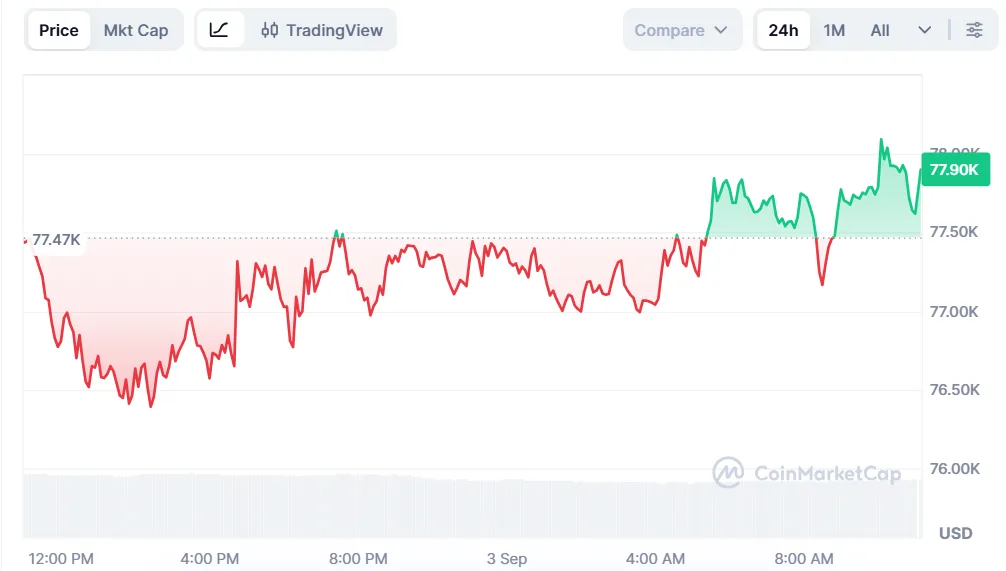
Bitcoin also gained about 25% in August, making the current recovery one of the strongest monthly moves of 2026. The question now is whether buyers can keep the recovery intact as September brings fresh market risks.
Bitcoin Has Recovered From Sharp Pullbacks Before
Bitcoin has bounced back from major sell-offs several times, but those recoveries have not always followed the same path. Price stabilization usually came first, followed by stronger buying as investors became more confident that the worst of the decline had passed.
The latest rebound is developing in a market that has a much stronger institutional presence. Spot Bitcoin ETFs have created a new source of demand, allowing traditional investors to increase their BTC exposure through regulated investment products.
This makes the current recovery different from earlier cycles. ETF flows can now offer a clearer view of whether investors are using price declines to accumulate Bitcoin or reducing their exposure as prices recover.
If inflows remain strong while Bitcoin holds its recent gains, the rebound could have stronger support than a typical short-term bounce. However, renewed outflows would suggest that investors remain cautious and could limit the recovery.
What Is Different About Bitcoin’s Current Recovery?
Recent ETF flows show that investors are still willing to buy Bitcoin despite sharp swings in sentiment. U.S. spot Bitcoin ETFs recorded $216.7 million in net inflows on August 31, followed by $236.5 million in outflows on September 1. Inflows then returned with $101.1 million on September 2.
The rapid shift between inflows and outflows suggests that buying interest remains present, but investors are not committing capital consistently. That makes the current recovery less convincing than one supported by several consecutive sessions of strong inflows.
Still, the ETF market gives Bitcoin a source of demand that was not available during earlier recovery cycles. Institutional investors can now respond to price declines through regulated products, potentially providing support when selling pressure increases.
The key question is whether this demand can remain consistent. If ETF inflows continue while Bitcoin holds higher price levels, the recovery could have a stronger foundation. If outflows return, the recent rebound could prove to be another short-term bounce rather than the beginning of a sustained recovery.
Can Bitcoin Hold Its Recovery?
Bitcoin’s ability to remain above key support levels could determine whether the latest rebound develops further.
BTC recently fell below $77,000 before recovering toward $78,000. The $80,000 area now stands out as an important level because Bitcoin has struggled to move decisively above it.
A sustained move above $80,000 could strengthen confidence in the recovery. However, another break below recent support could show that sellers still have significant control.
ETF flows will also remain important. Continued inflows would provide evidence that institutional buyers are willing to support Bitcoin at current prices.
Is This Bitcoin Recovery Different?
There are clear differences between the current rebound and earlier Bitcoin recoveries. ETF access has expanded institutional participation, while recent flows show that demand can return quickly after periods of selling.
Still, the recovery has not been fully confirmed. Bitcoin needs to hold its recent gains and push through resistance near $80,000 before the rebound can be viewed as more than a short-term recovery.
For now, Bitcoin has reasons for optimism, but the next move will depend on whether buyers can maintain their interest through September.
ALSO READ: VeChain Is Moving Into AI Agents — And It Could Change What the Blockchain Is For
DISCLAIMER:
This article reflects the author’s views and is provided for informational purposes only. While we strive for accuracy, the publisher does not guarantee that all information is complete or current. Readers should verify important information and consult appropriate sources before making decisions based on this content.