


- Bitcoin fell below $71,000 after US-Iran peace talks failed, increasing fears of higher oil prices and inflation.
- Investors are now watching whether the $70,000 support level can hold as market uncertainty grows.
Bitcoin has come under renewed pressure after diplomatic talks between the United States and Iran failed to produce a breakthrough. The latest developments have raised concerns about escalating geopolitical tensions, pushing investors toward safer assets and away from risk-sensitive markets such as cryptocurrencies.
BTC has dropped sharply over the past week, with traders closely watching whether the important $70,000 support level can hold.
Bitcoin Falls as Market Sentiment Weakens
Bitcoin’s recent decline accelerated after reports emerged that negotiations between the US and Iran had once again stalled. The situation has increased fears of further disruptions in global energy markets, especially after concerns resurfaced around the Strait of Hormuz, one of the world’s most important oil shipping routes.
The uncertainty triggered a broader risk-off mood across financial markets. As a result, Bitcoin fell to an intraday low of $70,147 before finding temporary support near the $70,000 level.

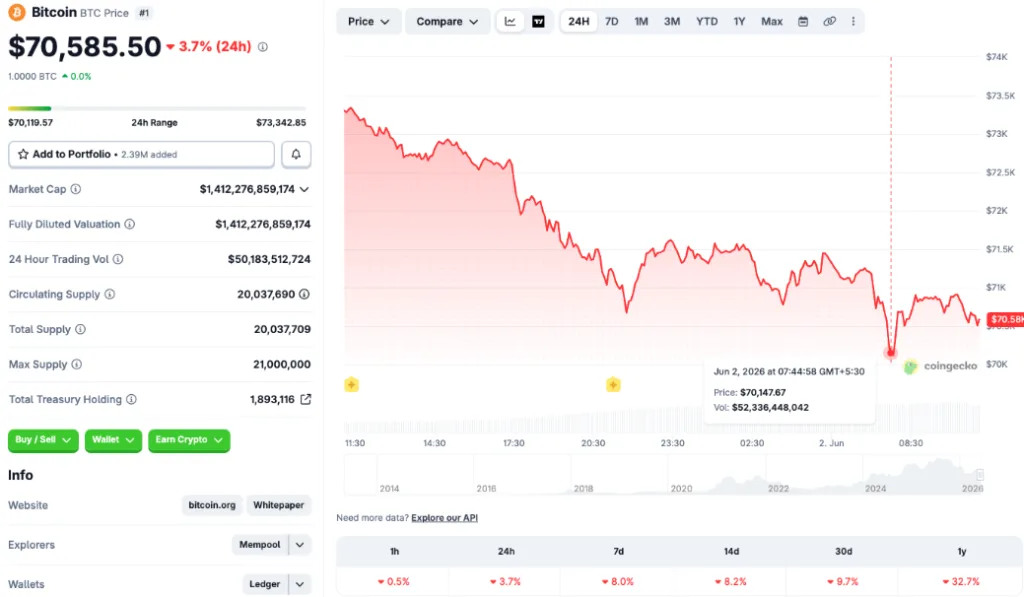
The coin is now down more than 8% over the past 7 days, reflecting growing investor caution.
Rising Oil Prices Could Create More Problems for Bitcoin
One of the biggest concerns for financial markets is the potential impact on oil prices. Any prolonged disruption in the Middle East could lead to higher crude oil costs, which may add further inflationary pressure to the global economy.
Higher inflation has already become a challenge for investors. Recent US inflation data came in above expectations, reducing hopes that the Federal Reserve would cut interest rates soon.
If inflation continues to rise, policymakers may decide to keep rates elevated for longer. In a more aggressive scenario, additional rate hikes could even return to the discussion.
Higher interest rates typically reduce demand for risk assets, including Bitcoin and the broader cryptocurrency market. This is because investors often shift capital toward safer investments that offer more predictable returns.
Questions Emerge About Bitcoin’s Safe-Haven Status
Bitcoin has often been promoted as a hedge against economic uncertainty. However, its performance during recent market stress has raised questions about that narrative.
Despite ongoing geopolitical tensions and inflation concerns, Bitcoin has struggled to attract strong safe-haven demand. Instead, the asset has moved lower alongside other risk-sensitive investments.
This trend has led some investors to reassess their positions. Reports indicate that billionaire investor Mark Cuban recently reduced most of his Bitcoin holdings, highlighting concerns about the asset’s ability to protect wealth during periods of economic uncertainty.
If market conditions continue to deteriorate, more investors could choose to reduce exposure to cryptocurrencies.
Could the CLARITY Act Help Bitcoin Recover?
While short-term sentiment remains fragile, some analysts see a potential catalyst that could improve market confidence.
The proposed CLARITY Act has attracted attention within the cryptocurrency industry because it aims to provide greater regulatory clarity for digital assets in the United States.
Supporters believe that clearer rules could encourage institutional participation and reduce uncertainty for investors. If the legislation advances and is approved, it may boost market sentiment and support a recovery in Bitcoin’s price.
What Happens Next?
Bitcoin remains at a critical technical and psychological level near $70,000. A successful defense of this support zone could help stabilize prices and attract buyers looking for value after the recent decline. However, further deterioration in US-Iran relations, rising oil prices, or additional inflation concerns could place more pressure on the cryptocurrency market.
For now, traders will be watching both geopolitical developments and economic data closely, as these factors are likely to determine Bitcoin’s next major move.
DISCLAIMER:
The views and opinions expressed herein are solely those of the author or advertiser and do not necessarily reflect the views of the publisher. The publisher does not endorse or guarantee the accuracy of any information presented in this article. Readers are encouraged to conduct further research and consult additional sources before making any decisions based on the content provided.