



- Bitcoin fell below $84,000 as profit-taking, ETF outflows and stronger US yields pressured the market.
- BTC now needs to hold $82,538 to avoid a deeper pullback toward $79,430.
Bitcoin slipped below $84,000 on Wednesday as profit-taking and weaker macroeconomic conditions put pressure on its recent recovery. BTC was trading around $84,151 after failing to reclaim the $85,000 level and remained well below its recent high near $87,000.
The pullback comes as institutional demand shows mixed signals. US spot Bitcoin ETFs recorded consecutive net outflows at the start of the week, while Strategy continued adding Bitcoin to its corporate treasury. At the same time, higher Treasury yields and a stronger US dollar have created additional headwinds for risk assets.
Bitcoin ETF Outflows Raise Near-Term Pressure
US spot Bitcoin ETFs recorded $89.90 million in net outflows on Monday, followed by another $3.13 million on Tuesday, according to SoSoValue. The withdrawals suggest that ETF investors have become more cautious following Bitcoin’s recent advance.
Two days of outflows do not necessarily signal a lasting change in institutional demand. However, continued withdrawals could make it harder for Bitcoin to stabilize, especially if holders continue taking profits around current levels.
The recent ETF weakness contrasts with continued corporate buying from Strategy, which has maintained its aggressive Bitcoin accumulation strategy.
Strategy Continues to Accumulate Bitcoin
Strategy executive chairman Michael Saylor announced Monday that the company had purchased another 334 BTC during the previous week. The acquisition extended Strategy’s buying streak to three consecutive weeks, following purchases of 1,665 BTC and 950 BTC.
The company now holds 848,000 BTC, while its reported US dollar reserves stand at about $5.70 billion.
Strategy’s continued accumulation provides a positive signal for Bitcoin’s longer-term demand. However, the buying has yet to offset the immediate selling pressure created by ETF withdrawals and profit-taking across the market.
Higher Treasury Yields Put Bitcoin Under Pressure
Bitcoin is also facing a less supportive macroeconomic backdrop. The US 10-year Treasury yield climbed to roughly 5.35% on Monday before settling near 5.28%, while the US Dollar Index reached an intraday high of 102.53.
Higher Treasury yields can make traditional fixed-income investments more attractive, increasing the opportunity cost of holding Bitcoin, which does not provide a contractual yield. A stronger dollar can also weigh on risk-sensitive assets such as cryptocurrencies.
Although expectations around monetary policy and continued institutional interest have provided some support for the crypto market, elevated yields, dollar strength and persistent inflation concerns have limited Bitcoin’s ability to extend its recovery above $85,000.
Bitcoin Holders Increase Profit-Taking
On-chain data provides another indication that selling pressure is building. Santiment’s Network Realized Profit/Loss metric surged on Tuesday to its highest level since November 23, 2025.
The increase shows that Bitcoin moving onchain was being transferred at significantly higher values than during previous transactions, pointing to substantial realized gains among holders.
The metric does not mean that every transaction represents a sale on an exchange. However, the sharp increase is consistent with investors taking profits after Bitcoin’s recent rally. For BTC to regain its upward momentum, fresh demand will need to absorb this selling activity.
Bitcoin Price Analysis Points to $82,538 Support
Despite the recent weakness, Bitcoin’s broader technical structure remains relatively constructive because BTC continues to trade above its major daily exponential moving averages.
The 50-day EMA currently sits near $79,430, while the 100-day and 200-day EMAs are around $75,565 and $75,056, respectively. These levels could become important if the current pullback deepens.
Short-term momentum has weakened, however. Bitcoin’s Relative Strength Index is around 56 and moving closer to the neutral zone, while the negative MACD histogram suggests that bullish momentum has lost some strength.

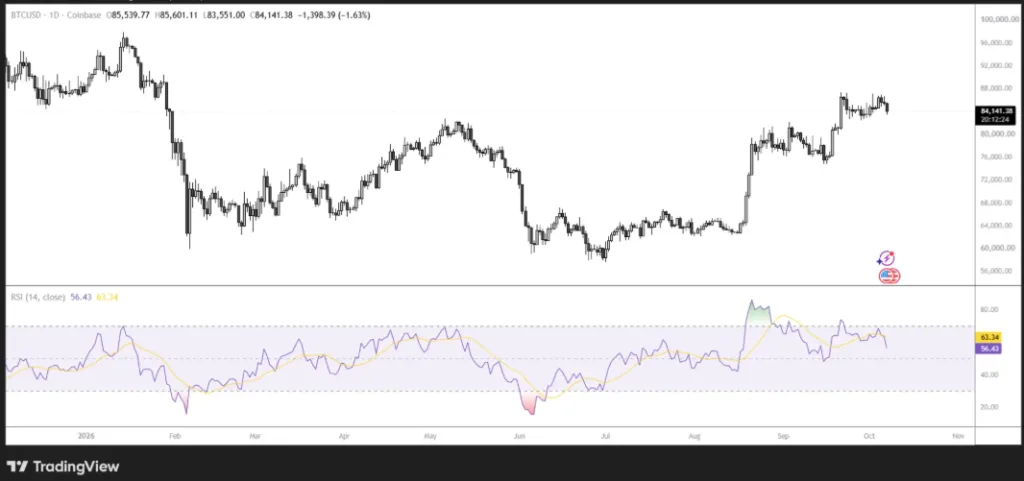
The most important level in the near term is now $82,538. Bitcoin needs to hold this support to prevent the pullback from developing into a deeper correction.
If buyers defend $82,538, BTC could stabilize and attempt to reclaim $85,000. A move back above that resistance would put the recent $87,000 high back within reach and could restore some bullish momentum.
However, a sustained break below $82,538 would increase the risk of a move toward the 50-day EMA at $79,430. If that level also fails, Bitcoin could eventually test the closely grouped 100-day and 200-day EMAs around $75,565 and $75,056.
For now, Bitcoin’s short-term outlook depends largely on whether buyers can defend $82,538 while profit-taking, ETF outflows and unfavorable macroeconomic conditions continue to weigh on the market.
ALSO READ: Best Stablecoin Corporate Cards for Businesses in 2026
DISCLAIMER:
This article reflects the author’s views and is provided for informational purposes only. While we strive for accuracy, the publisher does not guarantee that all information is complete or current. Readers should verify important information and consult appropriate sources before making decisions based on this content.