



- Bitcoin is facing growing pressure as its hashrate declines and mining conditions become more challenging.
- It’s now fighting to hold above $60,000 after losing the key $65,000-$66,000 support zone.
Bitcoin has come under renewed pressure after a sharp decline erased much of its recent recovery. It has fallen roughly 16% since the start of the week, leaving investors closely watching whether the $60,000 level can hold as support.
While the price drop has captured most of the attention, data from the Bitcoin mining sector is now flashing an important signal that has historically appeared during periods of market weakness.
Bitcoin Hashrate Decline Raises Concerns
According to CryptoQuant analyst Woominkyu, Bitcoin’s 30-day average hashrate has started to trend lower alongside the recent price decline. Hashrate measures the total computing power securing the Bitcoin network and is often viewed as a reflection of miner confidence and network strength.

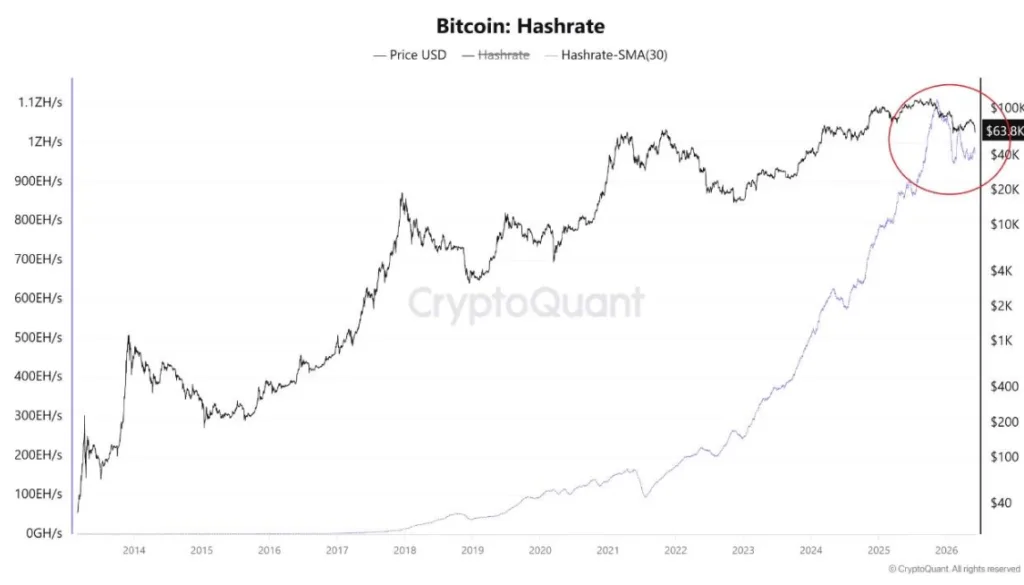
When both Bitcoin’s price and hashrate fall at the same time, it can indicate growing pressure on miners. Mining operations rely on profitability, and lower prices can force weaker participants out of the market.
However, history shows that hashrate declines are not unusual during difficult market conditions. Similar contractions were recorded during the 2018 bear market, the 2021 China mining ban, the 2022 downturn, the 2024 halving period, and another pullback in late 2025.
In many cases, these periods coincided with major market lows before Bitcoin eventually recovered.
Current Mining Data Shows Limited Damage
The latest figures suggest that mining stress remains relatively moderate compared to previous cycle lows.
Bitcoin’s seven-day hashrate change stands at approximately -6.6%, while the 30-day reading has declined by around -3.0%. Although these numbers confirm that miners are facing challenges, they remain significantly smaller than the declines recorded during major capitulation events.
For comparison, the 2021 China mining ban triggered a hashrate collapse of roughly 43%, making the current downturn far less severe.
Another factor weighing on miners is network difficulty. Difficulty has increased by nearly 4.9% over the past month, meaning miners are competing in a more challenging environment even as profitability comes under pressure.
Despite these headwinds, miner reserves remain largely unchanged. This suggests that miners are still holding their Bitcoin rather than rushing to sell their holdings on exchanges. The absence of large-scale miners selling indicates that the market has not yet entered the type of capitulation phase typically associated with major cycle bottoms.
Why the Next Few Weeks Matter
Woominkyu believes the current hashrate decline remains within the range of a normal correction. A stabilization near current levels would support the view that Bitcoin is experiencing a temporary margin squeeze rather than a deeper structural problem.
However, a deeper decline toward the -10% to -40% range seen during previous market bottoms could signal more significant weakness ahead.
For now, the data points to caution rather than panic. Investors are watching closely to see whether mining conditions improve or deteriorate further in the coming weeks.
Bitcoin Loses Major Support Zone
Beyond the mining data, Bitcoin’s price structure has suffered significant technical damage.
BTC recently broke below the important $65,000-$66,000 support area that had supported the market since February. The breakdown accelerated selling pressure and pushed the asset toward the $63,000 region.

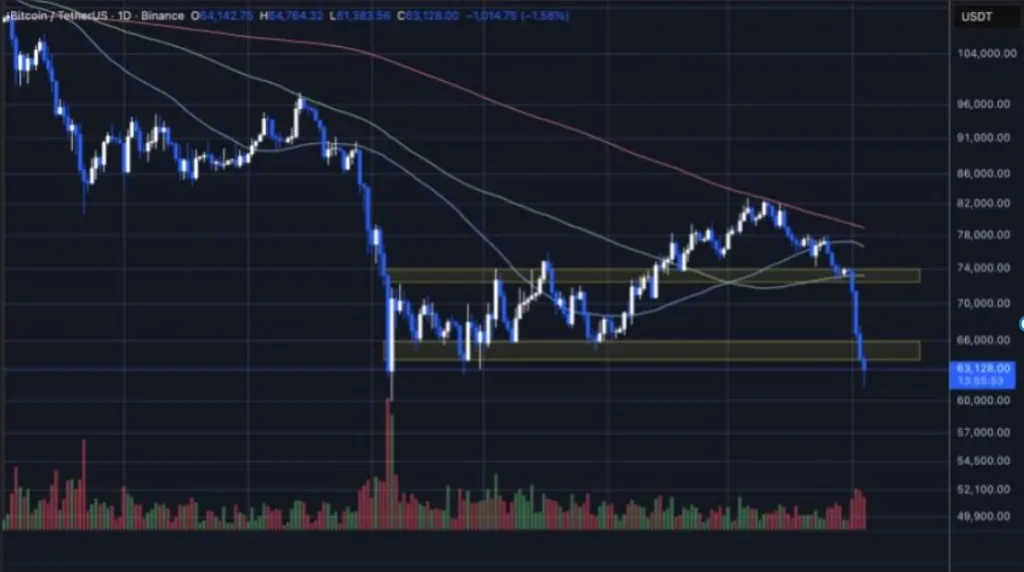
The move also invalidated the higher-low pattern that had supported Bitcoin’s recovery through April and May.
Adding to bearish sentiment, Bitcoin has fallen below its 50-day, 100-day, and 200-day moving averages. This signals weakness across several major trend indicators and suggests sellers currently control the market.
Trading volume has also increased during the decline, showing that the selloff is being driven by active selling rather than low market participation.
$60,000 Emerges as the Critical Level
The most important support zone now sits between $62,000 and $64,500. This area previously acted as a demand zone during the February market correction and could determine Bitcoin’s next major move. If buyers manage to defend this range, Bitcoin could attempt to rebuild strength and target higher levels.
However, a decisive break below the zone could expose the February lows near $61,000 and increase the likelihood of a test of the psychologically important $60,000 level. For bullish traders, reclaiming $65,000 remains the immediate objective. Yet the former support zone between $65,000 and $66,000 has now turned into resistance.
Until Bitcoin moves back above that area, short-term risks remain tilted to the downside, with sellers maintaining the upper hand.
ALSO READ: Bitcoin Drops to Lowest Since February as IPO Boom Drains Crypto Liquidity
DISCLAIMER:
The views and opinions expressed herein are solely those of the author and do not necessarily reflect the views of the publisher. The publisher does not endorse or guarantee the accuracy of any information presented in this article. Readers are encouraged to conduct further research and consult additional sources before making any decisions based on the content provided.