



Bitcoin is sending mixed signals to investors this week as institutional demand begins to recover through spot exchange-traded funds (ETFs), while a major corporate sale continues to weigh on market sentiment.
After eight consecutive weeks of net outflows, U.S. spot Bitcoin ETFs posted their first week of positive inflows, suggesting that institutional investors may be regaining confidence in the world’s largest cryptocurrency. At the same time, markets are still digesting Strategy’s decision to sell 3,588 BTC, worth approximately $216 million, creating fresh concerns about short-term selling pressure.
The opposing developments have left Bitcoin trading in a narrow range as investors weigh improving institutional demand against one of the largest recent corporate Bitcoin sales.
Institutional Investors Return Through ETFs
The return of positive ETF flows marks an important shift for Bitcoin after months of subdued institutional participation.
Spot Bitcoin ETFs have become one of the primary indicators of institutional demand since their launch, with inflows generally viewed as a sign that pension funds, asset managers, and wealth advisors are increasing exposure to digital assets.
The latest weekly data ended an eight-week streak of net outflows, indicating that long-term investors may once again be accumulating Bitcoin despite recent market volatility.

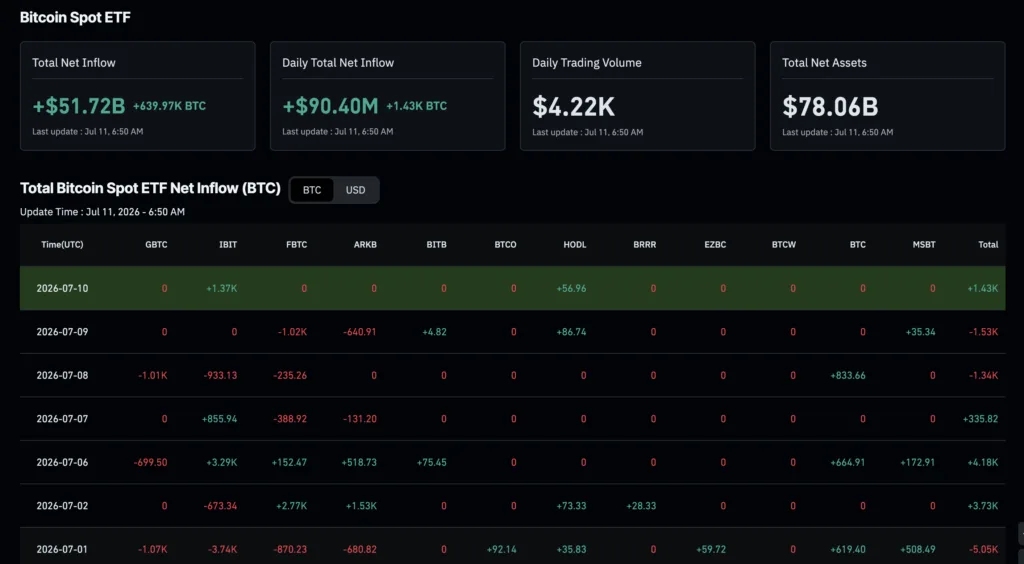
Market analysts say renewed ETF demand reflects improving confidence as investors anticipate greater regulatory clarity and potentially more favorable macroeconomic conditions in the second half of 2026.
Strategy’s $216 Million Bitcoin Sale Raises Questions
While ETF investors returned to the market, Strategy surprised investors by disclosing the sale of 3,588 Bitcoin, valued at approximately $216 million.
Although the company remains one of the world’s largest corporate Bitcoin holders, the sale has sparked debate over whether major institutions could begin reducing exposure after Bitcoin’s strong performance over the past year.
Analysts note that a single corporate sale does not necessarily signal a broader trend. However, large transactions from high-profile holders often influence short-term market sentiment, particularly during periods of uncertain price action.
The announcement temporarily increased selling pressure as traders reassessed the balance between institutional buying and corporate profit-taking.
Mixed Signals for the Bitcoin Market
The contrasting developments highlight two competing narratives currently shaping Bitcoin’s outlook.
On one hand, renewed ETF inflows suggest institutional investors continue to view Bitcoin as an attractive long-term investment.
On the other, significant corporate sales remind the market that large holders may take profits during periods of elevated prices, creating temporary headwinds.
This tug of war has contributed to Bitcoin’s relatively muted price action despite improving investor sentiment in other parts of the crypto market.
Macro Factors Still Driving Price Action
Beyond ETF flows and corporate activity, Bitcoin remains highly sensitive to broader macroeconomic developments.
Investors are closely watching this week’s U.S. inflation data and any signals from Federal Reserve officials regarding the path of interest rates.
Lower inflation or expectations of future rate cuts could strengthen demand for risk assets, including cryptocurrencies. Conversely, stronger-than-expected inflation could pressure Bitcoin by reinforcing expectations of tighter monetary policy.
Geopolitical developments are also contributing to market uncertainty, with investors balancing improving institutional adoption against broader global risks.
Long-Term Outlook Remains Positive
Despite the recent volatility, analysts argue that Bitcoin’s long-term fundamentals remain intact.
Institutional participation continues to expand through regulated investment products, while governments and financial institutions are steadily increasing their involvement in blockchain technology and digital assets.
Many market participants believe ETF demand will remain one of the most important drivers of Bitcoin’s price over the coming years, particularly if additional institutional capital enters the market.
Meanwhile, Strategy’s latest sale is viewed by many analysts as a short-term event rather than evidence of weakening confidence in Bitcoin’s long-term prospects.
Bitcoin is entering a pivotal period where institutional demand, corporate investment decisions, and macroeconomic developments are all competing to shape market direction.
The return of ETF inflows offers a positive signal that long-term investors remain engaged, but Strategy’s $216 million Bitcoin sale highlights that selling pressure from major holders can still influence prices in the short term.
As traders await fresh economic data and further institutional activity, Bitcoin’s next significant move may depend on whether renewed buying demand can outweigh continued profit-taking from large market participants.