


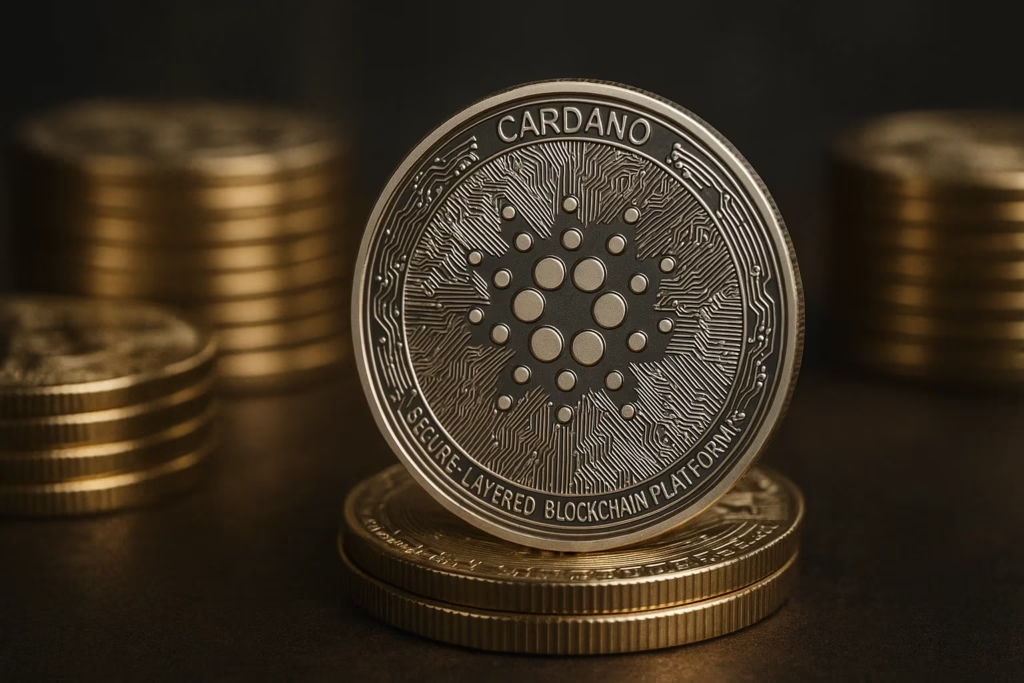
- Cardano trades around $0.25, down over 90% from its peak, making it look like a deep bargain.
- However, weak adoption, low institutional interest, and strong competition suggest it may be a value trap rather than a recovery opportunity.
Cardano looks like a deep bargain on paper. The price sits around $0.25, more than 90% below its all-time high. The market cap is still close to $9 billion, keeping it in the top tier of cryptocurrencies. But beneath the low price, concerns about long-term strength are growing.

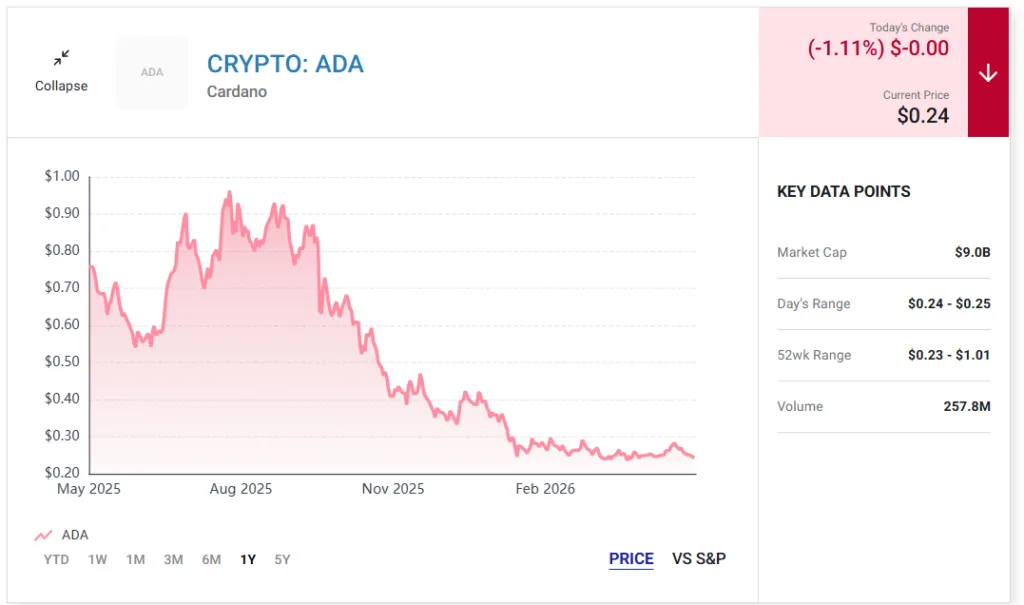
Cardano trades far below its peak
The collapse from its previous highs has made Cardano appear heavily discounted. Many investors often see such drops as a recovery opportunity. However, price alone does not tell the full story.
Cardano (ADA) blockchain has struggled to regain its earlier market excitement. Even after years of development, growth has slowed. The network has not recovered its lost dominance in key blockchain sectors.
Weak position in smart contract competition
Cardano was once promoted as a major Ethereum rival. That vision has not fully played out. Ethereum gained early traction in smart contracts, while Cardano entered the space later.
By the time Cardano launched smart contracts, competitors had already taken strong positions. Today, newer chains like Solana and other Layer-1 networks have pulled ahead in activity and developer interest.
Cardano also ranks low in total value locked, a key measure of decentralized finance strength. Even newer blockchain projects have surpassed it in this area. This signals weak demand for applications built on its network.
No spot ETF support limits demand
Institutional adoption is another major challenge. Bitcoin, Ethereum, and several other cryptocurrencies now have spot ETF products. These products help attract large pools of traditional capital.
Cardano has not yet secured a spot on an ETF listing. That gap limits exposure to institutional investors. Without this demand channel, price growth becomes harder to sustain.
Market observers also note that institutional interest in Cardano remains low. Investment firms are not aggressively pushing Cardano-based products. This lack of demand adds pressure on its long-term outlook.
Why investors are cautious
A major concern is whether Cardano is undervalued or fundamentally weak. Low prices often attract buyers looking for rebounds. But in this case, weak ecosystem growth raises caution flags.
The blockchain still faces:
- Slow developer activity compared to rivals
- Weak decentralized finance participation
- Limited institutional product support
- Strong competition from faster-growing chains
These issues make recovery harder, even at discounted prices.
Is there a recovery path
There are still some positive signals. A long-term roadmap aims to improve ecosystem activity by 2030. Some ETF applications are also under review and could change sentiment if approved.
However, uncertainty remains high. The gap between Cardano and leading blockchains is still wide. Catching up would require strong adoption growth and renewed investor confidence.
Cardano’s price may look attractive, but risk factors remain significant. Weak institutional demand and fading competitiveness weigh on its outlook. While a rebound is not impossible, caution dominates the current narrative.
For now, the low price alone may not be enough to justify a strong conviction.
ALSO READ: Solana Lags Ethereum Despite Speed Advantage as ETFs Fail to Attract Investors
DISCLAIMER:
The views and opinions expressed herein are solely those of the author and do not necessarily reflect the views of the publisher. The publisher does not endorse or guarantee the accuracy of any information presented in this article. Readers are encouraged to conduct further research and consult additional sources before making any decisions based on the content provided.