



- Cardano remains under pressure as bearish derivatives data and weak technical indicators continue to limit its recovery.
- A break above $0.173 could improve the outlook, while losing $0.150 may trigger further downside.
Cardano (ADA) continues to struggle as bearish market sentiment limits its chances of a stronger recovery. While the ADA has attempted to stabilize after recent losses, traders in the derivatives market remain cautious, suggesting that any short-term rebound could face heavy resistance.
Bearish Derivatives Data Weighs on Cardano
Cardano was trading around $0.165 on Monday after ending the previous week with mild losses. Recent derivatives data shows that many traders still expect the price to move lower.
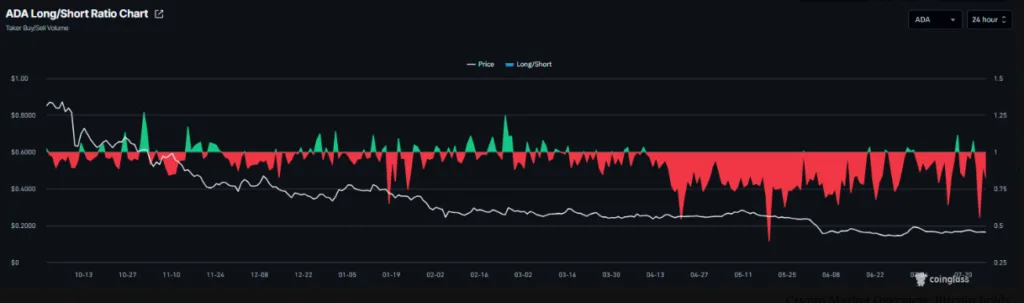
According to CoinGlass, Cardano’s long-to-short ratio has dropped to 0.82, close to its lowest level in more than a month. A ratio below 1 means more traders are opening short positions than long positions, reflecting growing expectations of further downside.

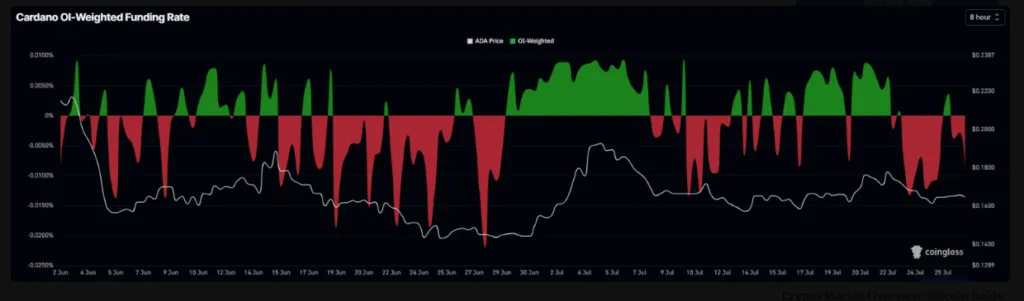
Funding rates have also turned negative. Cardano’s funding rate fell to -0.008, showing that traders holding short positions are paying those with long positions. Negative funding rates often indicate that bearish sentiment is strengthening in the futures market.

ADA Remains Below Major Moving Averages
Cardano continues to trade below its major technical resistance levels, keeping the short-term outlook tilted to the downside.
ADA is currently trading beneath its 50-day, 100-day, and 200-day Exponential Moving Averages (EMAs), which are clustered between $0.180 and $0.270. These moving averages often act as dynamic resistance during downtrends, making it more difficult for buyers to build sustained upward momentum.
As long as Cardano remains below these key EMAs, sellers are likely to retain control of the market. A decisive move above the 50-day EMA near $0.175 would be the first sign that buying pressure is returning. If buyers manage to clear that level, ADA could target the next resistance zones around $0.195 and $0.200, where the 38.2% Fibonacci retracement and the 100-day EMA converge.
Technical Indicators Show Limited Recovery
Momentum indicators suggest Cardano is trying to recover, but the improvement remains modest.
The Relative Strength Index (RSI) is around 47, slightly below the neutral 50 mark. This indicates that buying momentum has improved slightly but is still not strong enough to confirm a bullish reversal.

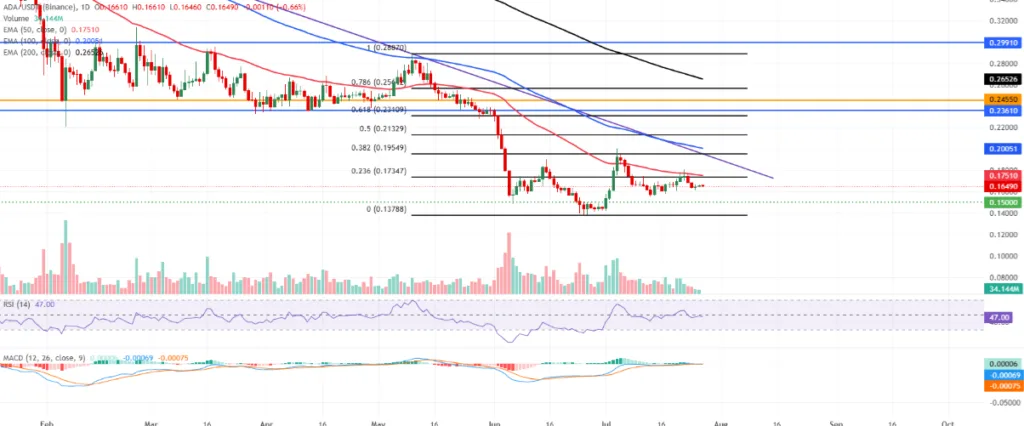
Meanwhile, the Moving Average Convergence Divergence (MACD) has started moving closer to a bullish crossover. However, the positive signal remains weak, suggesting that any recovery could be temporary unless buying activity increases.
Key Price Levels to Watch
Cardano’s first major resistance sits near $0.173, which aligns with the 23.6% Fibonacci retracement level. The 50-day EMA around $0.175 adds another barrier for buyers.
If ADA breaks above this zone, the next upside targets are:
- $0.195 at the 38.2% Fibonacci retracement
- $0.200 near the 100-day EMA
- $0.213 at the 50% Fibonacci retracement
- $0.231 at the 61.8% Fibonacci level
A stronger rally would then face another resistance zone between $0.236 and $0.245.
On the downside, $0.150 remains the nearest support level. If selling pressure increases, Cardano could revisit $0.137, where buyers may attempt to slow the decline.
Outlook
Cardano remains under pressure as bearish derivatives data and weak technical signals continue to limit upside potential. While momentum indicators hint at a possible short-term recovery, ADA must break above key resistance levels before a stronger trend reversal can take shape. Until then, traders are likely to keep a close watch on the $0.150 support level and whether buyers can regain control above $0.173.
ALSO READ: Ripple Launches UDAX Program to Boost XRP Ledger Development in Brazil
DISCLAIMER:
The views and opinions expressed herein are solely those of the author and do not necessarily reflect the views of the publisher. The publisher does not endorse or guarantee the accuracy of any information presented in this article. Readers are encouraged to conduct further research and consult additional sources before making any decisions based on the content provided.