


- Chainlink reported over $15 billion in CCIP migrations in 2026, alongside new institutional partnerships and expanding government adoption.
- Meanwhile, LINK trades near $12 as bearish indicators point to continued selling pressure.
Chainlink reported more than $15 billion in cross-chain token migrations in 2026 as it expanded its institutional partnerships and blockchain infrastructure during the third quarter. However, LINK traded near $12.24 on October 22, with technical indicators pointing to continued selling pressure.
Chainlink CCIP Migrations Surpass $15 Billion
Chainlink’s third-quarter review highlighted growing adoption of its Cross-Chain Interoperability Protocol (CCIP), which enables digital assets and data to move between different blockchain networks.
The network reported more than $15 billion in token migrations during 2026 as projects moved assets from other interoperability providers to CCIP. BitGo, the Wyoming Stable Token Commission, Aave, Coinbase and tokenized equities provider xStocks were among the projects connected to its expanding cross-chain infrastructure.
CCIP 2.0 also went live during the third quarter, introducing additional security, compliance and settlement controls designed to support institutional transfers between blockchains.
Chainlink separately reported that CCIP secured more than $85 billion in cross-chain token value. This figure measures the token value secured by the protocol, while the $15 billion migration figure represents assets that moved from other interoperability providers during 2026.
⬡ CHAINLINK Q3 MOMENTUM ⬡
• Launched CCIP 2.0
• $15B+ migrates to CCIP
• $140B secured across onchain finance
• TradFi adoption: DTCC, Swift, & more
• Enterprise adoption: Infosys, Robinhood, & more
• Work with policymakers across the U.S., UK, & Hong Kong https://t.co/kWuZop7iLw— Chainlink (@chainlink) October 21, 2026
The network’s cumulative transaction value enabled also exceeded $36 trillion. This metric covers activity supported by Chainlink’s services and does not represent its revenue or the total value transferred through CCIP.
Swift and DTCC Expand Chainlink’s Institutional Reach
Chainlink continued to expand its role in traditional finance through new integrations and financing solutions involving major financial institutions.
At the Sibos banking conference, the network introduced Fulcrum, a service designed to support securities financing and collateral management across public and private blockchains. The platform aims to help financial institutions coordinate financing terms and collateral settlement without relying on a single blockchain.
Chainlink also introduced a solution connecting banks to Swift’s blockchain ledger through its Chainlink Runtime Environment (CRE). The system is designed to coordinate smart contract operations while allowing financial institutions to retain control of their transaction-signing keys.
The Depository Trust & Clearing Corporation (DTCC) also advanced its use of Chainlink infrastructure through its Collateral AppChain initiative, which is designed to support collateral management across financial markets.
A separate production transaction demonstrated how JPMorgan could use tokenized stock as collateral to meet margin requirements with CME Group.
These developments show how Chainlink is expanding beyond blockchain data feeds into financial applications involving securities, collateral and settlement.
Government and Stablecoin Adoption Grows
Chainlink also reported progress with government-backed digital assets and stablecoin infrastructure during the third quarter.
Wyoming’s Stable Token Commission moved its FRNT stablecoin to CCIP in August after a security review. In September, the commission adopted Chainlink Proof of Reserve to make independently examined reserve information available across supported blockchains.
The arrangement is intended to help blockchain applications verify the reserves backing FRNT, with additional work underway on reserve-linked minting controls.
Hong Kong’s Tokenized Securities Framework also selected CCIP and Chainlink’s Automated Compliance Engine. Meanwhile, the Bank of England’s Synchronisation Lab showcased CRE for coordinating settlement between central bank money and tokenized assets.
Chainlink’s data services expanded to additional blockchain projects during the quarter. Data Feeds launched on Tempo to provide market information for stablecoin payments, collateral valuation and automated financial applications.
The network also reported adoption among prediction markets, including Polymarket, World and LBank, which use Chainlink technology for market resolution and payouts.
LINK Price Nears $12 as Bearish Signals Persist
Despite the latest adoption milestones, Chainlink’s price struggled to maintain its recent gains. LINK traded around $12.24 on October 22, down approximately 0.67% over 24 hours after retreating from an October high near $15.70.

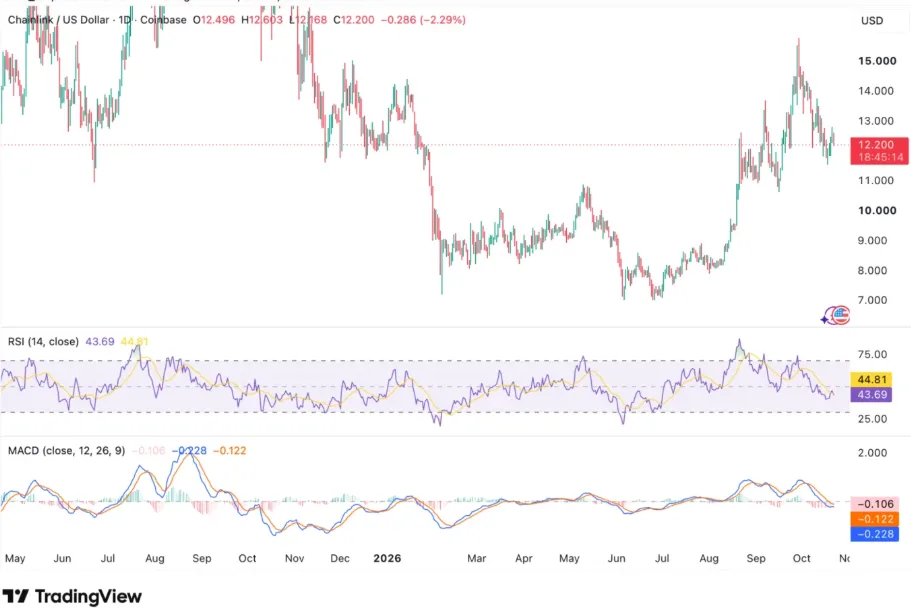
LINK remained up roughly 1.68% over seven days, but technical indicators suggested that buying pressure was weakening.
The RSI stood at 44.11, below the neutral 50 mark. This reading indicates that selling pressure has gained ground, although LINK was not yet in oversold territory. The MACD line stood at -0.224, below its signal line at -0.121, while the histogram reading of -0.103 indicated continued selling pressure.
Can LINK Hold the $12 Support Level?
The $12 level is the immediate support zone to watch. A sustained break below it could expose LINK to further declines toward $11.
On the upside, a recovery above $13 could help the token regain ground and bring resistance around $14 into focus. However, the bearish MACD reading suggests that a stronger recovery may require renewed buying pressure.
Chainlink’s quarterly review also reported that its Reserve accumulated 1,543,330.47 LINK during the third quarter, bringing total holdings to 6,047,498.3150 LINK. Its Smart Value Recapture service surpassed $24.4 million in cumulative recaptured value.
For now, Chainlink’s expanding institutional adoption contrasts with LINK’s weakening technical picture. Whether the token can hold $12 or recover toward $13 will be an important near-term signal for its price direction.
ALSO READ: Pi Network Announces First Ecosystem Summit for November 17–19, 2026
DISCLAIMER:
This article reflects the author’s views and is provided for informational purposes only. While we strive for accuracy, the publisher does not guarantee that all information is complete or current. Readers should verify important information and consult appropriate sources before making decisions based on this content.