


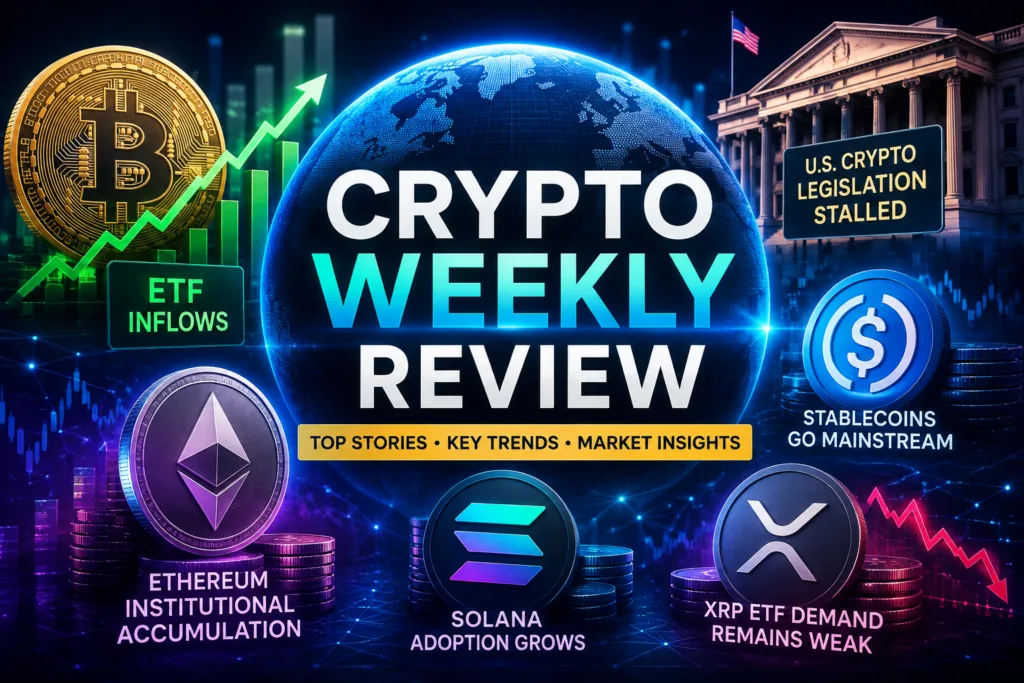
The crypto market had another eventful 1st week of August.
Bitcoin struggled to establish a decisive breakout while institutional demand returned through U.S. spot Bitcoin ETFs.
At the same time, Washington’s crypto legislation hit another roadblock, Ethereum faced a new debate over staking economics, and traditional financial companies continued moving deeper into stablecoins and blockchain infrastructure.
The week also produced some less obvious developments worth watching, including the closure of a U.S. spot Bitcoin ETF, growing institutional accumulation of Ethereum, and Western Union’s expansion into stablecoin-based payments on Solana.
Here are the biggest crypto stories from the past week and weekend.
Bitcoin ETF Inflows Return
One of the clearest bullish developments last week came from the U.S. spot Bitcoin ETF market.
Bitcoin ETFs recorded five consecutive days of net inflows, bringing approximately $853.5 million into the funds.
That reversed the previous week’s $61.5 million in net outflows and suggested that institutional demand was beginning to recover.
The recovery began early in the week.
Between August 3 and August 5, U.S. spot Bitcoin ETFs attracted roughly $626 million, with BlackRock’s IBIT accounting for approximately $478.5 million of that total.
The inflows continued toward the end of the week. On August 7, Bitcoin ETFs recorded another roughly $102 million in net inflows, while Ethereum ETFs added approximately $50 million.
The important point is that ETF demand improved even though Bitcoin remained relatively close to the $60,000-$65,000 range.
That could make ETF flows one of the most important indicators to watch this week.
Source: Crypto.news — Bitcoin ETFs draw $853.5M in five-day inflow streak
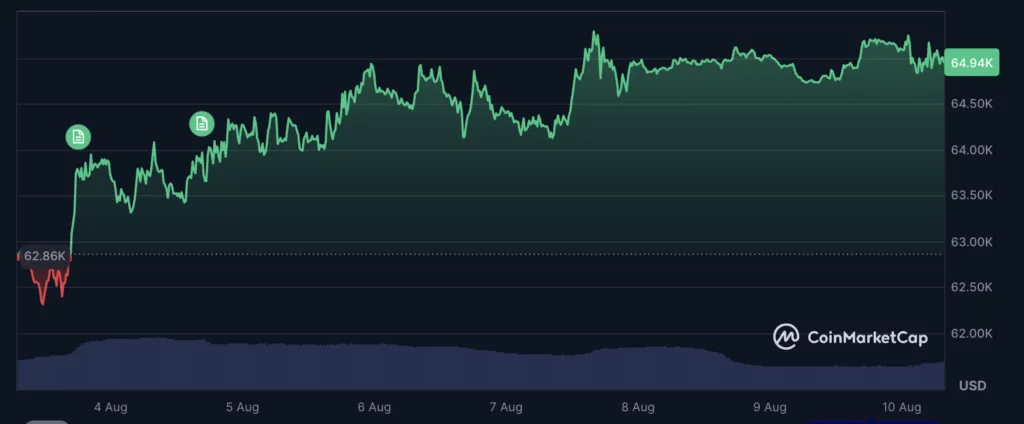
Bitcoin Remained Stuck Around $64,000-$65,000
Despite the improvement in ETF demand, Bitcoin failed to produce a major breakout.
By the end of the week, BTC was trading around the mid-$60,000 range, with traders watching resistance around $67,000 and higher levels above that.
The market therefore produced an interesting divergence.
Institutional money was returning to Bitcoin ETFs, but the price reaction remained relatively limited.
That suggests sellers are still active at higher levels.
The coming week could therefore be important if Bitcoin can convert the renewed ETF demand into a sustained move above resistance.

U.S. CLARITY Act Runs Into Another Roadblock
Regulation was another major theme last week.
The U.S. Senate’s CLARITY Act faced growing uncertainty as lawmakers struggled to move the legislation forward before the summer recess.
Prediction markets were already pricing in substantially lower odds of passage than earlier in the year. One analysis put the implied probability at about 37% on August 3, down from more than 70% earlier in the spring.
The uncertainty matters because the CLARITY Act is designed to establish clearer rules around digital assets and the responsibilities of U.S. financial regulators.
For crypto companies, exchanges and institutional investors, regulatory clarity could make it easier to determine which assets fall under different regulatory regimes.
The delay does not necessarily mean the legislation is dead.
But it does mean the crypto industry may have to wait longer for one of the most closely watched pieces of U.S. digital-asset legislation.
Source: Crypto.news — CLARITY Act stall: what happens if crypto’s big bill fails
The First U.S. Spot Bitcoin ETF Is Set to Close
One of the week’s more unusual stories came from the ETF market itself.
Hashdex announced plans to liquidate its DEFI ETF after August 17, making it the first U.S. spot Bitcoin ETF expected to close since the products launched.
The fund was considerably smaller than the major Bitcoin ETFs. It held about $14.7 million in net assets, compared with tens of billions of dollars for the largest products such as BlackRock’s IBIT.
The closure should not be interpreted as a collapse of the Bitcoin ETF market.
Instead, it highlights the growing gap between the largest institutional products and smaller funds competing for investor attention.
BlackRock’s IBIT, for example, has become one of the dominant vehicles for institutional Bitcoin exposure.
The development could ultimately accelerate consolidation among smaller crypto ETFs.
Source: CoinDesk — First U.S. spot bitcoin ETF to close as inflows dwindle
Ethereum Institutional Accumulation
Ethereum also attracted significant institutional attention last week.
BitMine continued accumulating ETH, purchasing more than 10,000 ETH in one reported transaction and taking its holdings close to 5.8 million ETH.
The company’s Ethereum holdings were valued at roughly $11.3 billion and represented around 4.8% of Ethereum’s total supply, according to a weekly market review.
That makes corporate Ethereum accumulation an increasingly important trend.
Bitcoin has traditionally dominated the institutional crypto narrative through ETFs and corporate treasury strategies.
Ethereum is now developing its own institutional story, with companies accumulating ETH as a treasury asset and as an asset capable of generating staking-related returns.
The question is whether this trend can continue if ETH prices remain below previous cycle highs.
Ethereum’s Staking Economics on Monetary Staking
Ethereum also faced a fresh debate over its monetary policy and staking model.
Galaxy Research highlighted similarities between Ethereum and Solana as both networks confront questions about token issuance and inflation.
The discussion became particularly relevant after renewed attention around Ethereum proposal EIP-8363, which could affect staking economics and validator rewards.
Critics have warned that changes to consensus rewards could reduce the attractiveness of staking, while supporters argue that Ethereum needs to balance network security, issuance and long-term monetary policy.
This is a story worth watching because Ethereum’s investment case increasingly includes staking.
If staking yields change materially, the economics of holding ETH could change alongside them.
Source: Crypto.news — Galaxy says Ethereum, Solana may rethink token inflation models
Western Union Takes Stablecoins to Consumers Through Solana
Stablecoins continued their expansion into mainstream payments last week.
Western Union launched Stablecard across 37 markets, bringing its USDPT stablecoin into a consumer-facing payment product built on Solana.
The development is significant because Western Union has spent decades operating traditional cross-border money-transfer infrastructure.
Its move into stablecoins illustrates how established financial companies are increasingly treating blockchain networks as payment infrastructure rather than simply as speculative markets.
The bigger story may therefore be the gradual convergence between traditional payments and crypto infrastructure.
Consumers may not necessarily care whether a transaction uses blockchain technology.
But companies increasingly care about faster settlement, lower costs and global interoperability.
Stablecoins could become one of the main ways those advantages reach consumers.
Source: Crypto.news — Western Union’s stablecoin play
Mastercard Pushes Stablecoin Infrastructure Further
Stablecoins were also at the center of another important development involving Mastercard.
The company’s Stablecoin Credential initiative is focused on verifying participants in stablecoin transactions rather than acting as a stablecoin payment network itself.
The system is designed to address compliance and identification issues surrounding cross-border digital-asset transfers.
That distinction is important.
Traditional financial companies are not necessarily trying to replace existing payment networks with crypto.
Instead, many are building the compliance, identity and infrastructure layers that allow blockchain-based payments to operate within existing financial systems.
This could become an important theme as stablecoins move beyond crypto exchanges.
XRP Struggles to Match Bitcoin and Ethereum ETF Demand
XRP also remained under pressure last week as institutional ETF activity failed to match the strength seen in Bitcoin and Ethereum.
Reports over the weekend highlighted a sharp decline in weekly XRP ETF inflows, with demand falling significantly while the token continued to test the important $1 psychological level.
XRP’s market structure was also closely watched around the $1 level.
Some analysts identified resistance around $1.06-$1.08, while losing $1 could expose the token to lower support levels.
The contrast with Bitcoin is notable.
Bitcoin attracted hundreds of millions of dollars through ETFs during the week, while XRP’s institutional demand remained comparatively weak.
That divergence could become increasingly important if investors continue rotating toward assets with stronger ETF demand.
Source: Coinspot — XRP ETF inflow analysis and price outlook
Solana Remains One of the Stronger Altcoin Stories
Solana was another cryptocurrency that attracted attention during the week.
While Bitcoin remained relatively range-bound, SOL showed stronger short-term performance than several other major altcoins.
Market reports on August 8 highlighted Solana outperforming Bitcoin and Ethereum during the weekend session.
More importantly, Solana’s relevance is increasingly tied to developments outside speculative trading.
Western Union’s stablecoin rollout provides another example of businesses using Solana as infrastructure.
That could strengthen the broader investment narrative around SOL if more payment companies and financial institutions choose the network.
Cardano Opens Its First IBC Connection on Testnet
Cardano made a significant move toward broader blockchain interoperability last week after its first Inter-Blockchain Communication (IBC) connection went live on testnet with Injective.
The connection links Cardano’s pre-production network with Injective’s testnet and allows test ADA to move in both directions. Importantly, the integration is still in testing, meaning mainnet ADA and other real-value assets are not yet able to cross between the networks.
The development is nevertheless important because IBC is designed to allow blockchains to communicate and transfer assets without relying on a traditional centralized intermediary. Once expanded beyond the testnet stage, Cardano could potentially gain access to a much wider network of applications and liquidity connected through the IBC ecosystem.
The integration also builds on months of development around Cardano’s IBC infrastructure. Cardano’s 2026 development report shows work on Caribic, IBC-Go upgrades, Injective testnet connectivity and ICS-20 token-transfer functionality.
For ADA holders, the bigger story is therefore not simply that Cardano connected to Injective. It is that Cardano is gradually positioning itself to become more interoperable with other blockchain ecosystems, potentially giving developers and users more ways to move assets and applications across networks.
The Bigger Story: Crypto Is Moving Further Into Financial Infrastructure
Taken together, last week’s developments point to a broader trend.
Bitcoin remains the dominant institutional crypto asset.
Ethereum is developing a stronger corporate treasury and staking narrative.
Solana is increasingly being used for stablecoin and payment infrastructure.
XRP is trying to establish stronger institutional demand through ETFs.
Cardano Launches First IBC Connection on Testnet.
And stablecoins are becoming increasingly integrated with traditional financial companies.
At the same time, regulators are still struggling to establish the rules governing the industry.
That creates an unusual market environment.
Crypto prices remain volatile, but the underlying infrastructure is becoming increasingly connected to traditional finance.
What to Watch This Week
Several themes could dominate the crypto market in the coming days.
Bitcoin ETF flows: After five consecutive days of inflows, investors will be watching whether institutional demand continues.
Bitcoin’s $67,000 resistance: A sustained break above that area could change the short-term market structure.
The CLARITY Act: Any new developments from U.S. lawmakers could quickly affect crypto sentiment.
Ethereum staking: The debate around issuance and validator rewards could become increasingly important for ETH investors.
Stablecoins: Western Union, Mastercard and other financial companies suggest that stablecoin adoption is becoming one of the industry’s biggest real-world use cases.
XRP ETF demand: Investors will be watching whether institutional interest in XRP can recover.
Final Takeaway
The past week was not defined by one massive crypto price move.
Instead, it was defined by a series of developments showing how the industry is changing.
Bitcoin ETF demand returned.
Ethereum attracted more institutional accumulation.
Stablecoins moved further into mainstream payment infrastructure.
Solana gained another major real-world use case.
XRP struggled to attract the same level of institutional demand.
And U.S. lawmakers continued to debate the regulatory framework for digital assets.
For traders, the immediate focus remains Bitcoin’s price and ETF flows.