



- Dogecoin shows a sell signal near $0.109, hinting at short-term weakness after a strong rally.
- However, it remains bullish above $0.1078 as buyers continue defending key support.
Dogecoin is showing mixed signals after a technical warning appeared near the $0.109 region, even as price continues to hold above crucial support levels. While short-term indicators suggest cooling strength, broader market structure still leans in favor of buyers defending the ongoing breakout range.
TD Sequential Sell Signal Raises Caution
A TD Sequential sell signal appeared on the 3-day chart after DOGE’s extended upward move from around $0.089 toward recent highs above $0.112. This pattern often signals exhaustion rather than an immediate reversal.

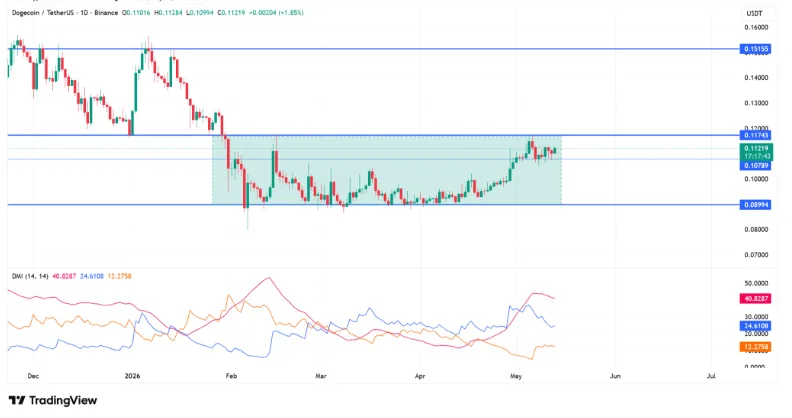
The setup suggests that bullish pressure is slowing after an extended rally, especially as traders begin taking profits near resistance zones. However, the signal alone does not confirm a breakdown, and price action remains relatively stable.
Bulls Still Defending Key Support Zones
Despite the warning, DOGE continues to trade above critical support at approximately $0.1078. This level has become a key line for maintaining the broader breakout structure.
Recent price behavior shows that buyers are still active, absorbing selling pressure instead of allowing a sharp rejection back into lower ranges. The accumulation zone between $0.089 and $0.117 remains structurally important, with bulls repeatedly defending it over recent weeks.
If this support holds, another attempt toward the $0.1174 resistance remains likely.
Traders Remain Leaning Bullish Despite Cooling Confidence
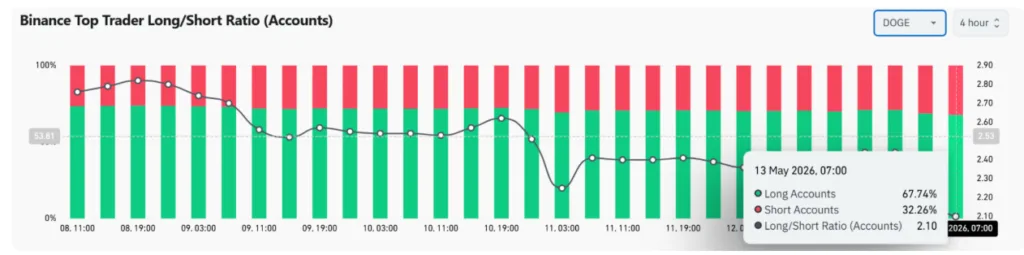
Derivatives positioning still reflects strong bullish sentiment among larger market participants. Long accounts account for roughly 67.74% of positions, compared to 32.26% shorts, keeping the long/short ratio elevated.
However, this ratio has declined from earlier peaks above 2.80, signaling that some traders are beginning to reduce exposure as volatility increases. Even so, the overall bias still favors buyers. The key takeaway is that confidence remains intact, but slightly less aggressive than before.

Resistance Levels Still Cap Upside Movement
DOGE recently reclaimed the $0.1174 level during its breakout attempt but has since entered a consolidation phase. The next major resistance sits around $0.1515, which remains the larger upside barrier on higher timeframes.
The current structure suggests that the market is still absorbing selling pressure rather than rejecting the breakout entirely. This is often a sign of continuation potential if support levels remain intact.
As long as DOGE stays above $0.1078, bulls retain a chance to retest resistance levels.
Trend Strength Remains Intact Despite Cooling Pressure
Technical trend indicators continue to show strength even as short-term acceleration slows. The ADX reading remains elevated at 40.82, indicating a strong directional trend rather than sideways consolidation.
Additionally, the +DI remains above the -DI, confirming that buyers still dominate overall market direction. This supports the view that the broader structure has not yet broken down.
Liquidation Data Shows Bearish Traders Taking Losses
Recent derivatives data shows that short traders have been hit harder during volatility, with short liquidations exceeding $474K compared to less than $57K in long liquidations. Major exchanges, including Binance and OKX, contributed significantly to short-side losses as DOGE held above key support levels.

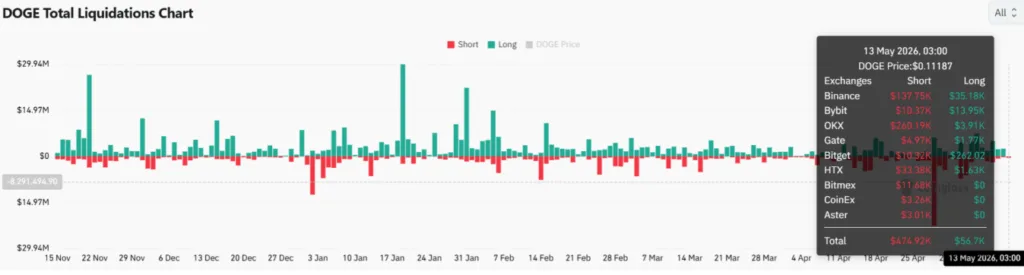
However, liquidation intensity has begun to ease, suggesting that aggressive leveraged positioning is cooling down.
Dogecoin remains at a critical technical point. While the TD Sequential signal warns of potential exhaustion near recent highs, price structure still favors bulls as long as the $0.1078 support holds.
A breakdown below this level could weaken the broader bullish setup, while continued defense may open another attempt toward $0.1174 and higher resistance zones.
ALSO READ: Chainlink Network Activity Hits 8-Month High as CCIP Adoption Surges
DISCLAIMER:
The views and opinions expressed herein are solely those of the author and do not necessarily reflect the views of the publisher. The publisher does not endorse or guarantee the accuracy of any information presented in this article. Readers are encouraged to conduct further research and consult additional sources before making any decisions based on the content provided.