


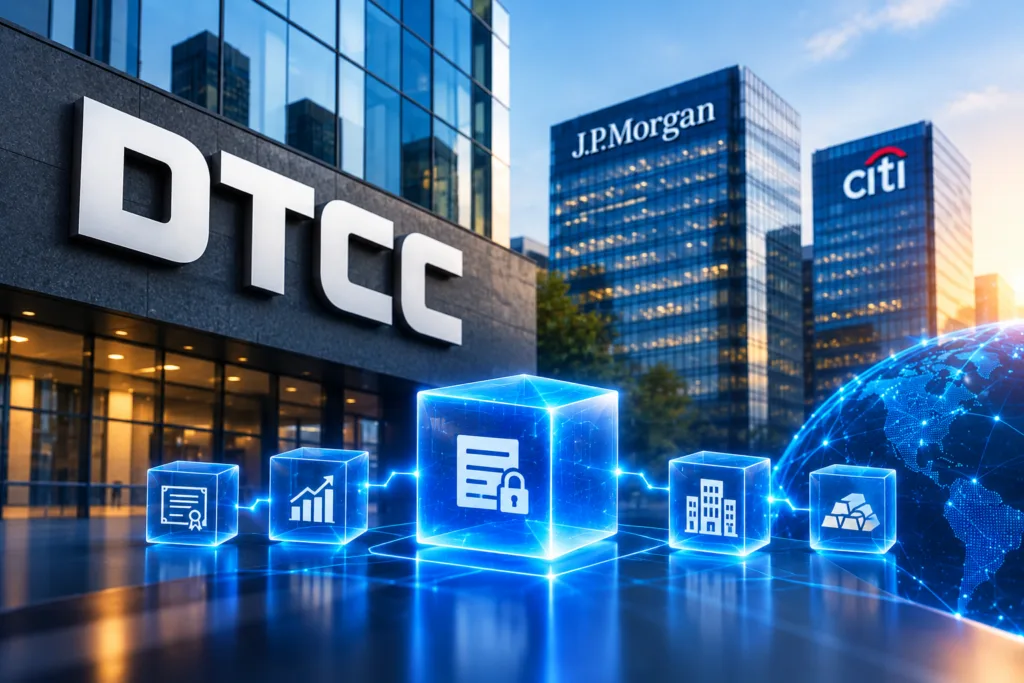
- DTCC launches a $30 trillion tokenization service with major banks.
- The move strengthens blockchain adoption in traditional finance.
The Depository Trust & Clearing Corporation (DTCC) launched its Tokenization Service on October 28, bringing 34 eligible securities worth approximately $30 trillion into its new blockchain initiative.
JPMorgan and Citi are among 20 financial institutions that have signed agreements to access the service, marking a significant step in the adoption of blockchain technology across traditional financial markets.
The launch puts DTCC, one of the most important institutions in U.S. securities infrastructure, at the center of Wall Street’s shift toward tokenized assets. It also creates a new pathway for major financial institutions to bring stocks, ETFs and U.S. Treasury securities into blockchain-based financial systems.
DTCC Opens $30 Trillion in Securities to Tokenization
The new service allows eligible financial institutions to create blockchain-based representations of securities held by DTCC’s subsidiary, the Depository Trust Company (DTC).
The initial selection includes certain large-cap stocks from the Russell 1000 index, ETFs tracking major indices and U.S. Treasury securities. Together, the 34 eligible securities represent approximately $30 trillion in market value. This figure reflects the value of securities eligible for tokenization, not the amount already converted into blockchain tokens.
The distinction is important because DTCC holds more than $114 trillion in assets under custody. Its new service creates a controlled route for eligible securities to enter digital markets without replacing the established custody infrastructure behind them.
Rather than issuing unrelated digital versions of traditional assets, DTCC’s approach links tokenized representations to securities already held within its system.
JPMorgan and Citi Among 20 Institutions Signed Up
The launch has attracted participation from some of the largest names in traditional finance. JPMorgan and Citi are among 20 DTC participants that have signed agreements to access the service.
Other institutions include Bank of America, Barclays, BNP Paribas, Fidelity Investments, Morgan Stanley, State Street and UBS.
Their involvement highlights how established financial institutions are moving beyond blockchain experimentation toward practical applications in securities markets.
However, signing an access agreement does not necessarily mean every institution is already using the service for transactions at scale. DTCC plans to onboard additional participants over time.
How DTCC’s Blockchain Service Works
DTCC’s Tokenization Service allows eligible participants to convert securities held at DTC into digital tokens and move them to registered blockchain wallets.
These tokens retain the ownership rights, investor protections and economic entitlements of their traditional counterparts. DTC also maintains the official ownership records, ensuring that tokenization does not create a separate claim to the underlying securities.
The service currently operates through two blockchain networks: the Canton Network and DTCC’s private Besu network. Additional integrations are planned for 2027.
This multi-network approach is important because financial institutions operate across different blockchain environments. Supporting interoperability could make it easier to transfer tokenized assets between approved platforms while maintaining the controls required by traditional financial markets.
Why DTCC’s Launch Matters for the Crypto Industry
DTCC’s involvement carries weight because it occupies a central position in U.S. financial market infrastructure. Its subsidiary, DTC, provides custody and asset servicing for securities valued at more than $114 trillion.
Bringing tokenization into this established system could expand blockchain’s role beyond cryptocurrencies and stablecoins.
One potential application is collateral management. Financial institutions could use tokenized securities to move collateral more efficiently, reducing delays associated with traditional processes. The technology could also support faster asset transfers and create new opportunities to connect traditional financial markets with blockchain-based applications.
The launch also strengthens the institutional case for tokenization. When an organization responsible for critical securities infrastructure introduces a live blockchain service, it gives the technology a more direct role in established financial markets.
However, the immediate impact should not be overstated. The service begins with a limited selection of eligible securities, and its long-term significance will depend on actual usage, transaction activity and the expansion of supported assets and networks.
What Comes Next for DTCC Tokenization?
DTCC’s next challenge is turning institutional interest into sustained adoption. The 20 access agreements provide an initial foundation, but the service’s broader impact will depend on how financial institutions integrate tokenized securities into their operations.
The planned expansion to additional blockchain networks in 2027 could also widen access and improve connectivity across digital financial markets.
For the crypto industry, the development represents a meaningful shift in how traditional finance approaches blockchain technology. DTCC is no longer simply exploring tokenization through limited trials; it has introduced a service that allows eligible securities to be represented and transferred on blockchain networks.
The $30 trillion headline reflects the scale of the opportunity rather than money already moving on-chain. Whether that opportunity translates into widespread adoption will become clearer as more institutions begin using the service and tokenized securities find practical applications across financial markets.
ALSO READ: Bitfinex’s 80% Bitcoin Recovery Pledge: How Could It Affect UNUS SED LEO Price?
DISCLAIMER:
This article reflects the author’s views and is provided for informational purposes only. While we strive for accuracy, the publisher does not guarantee that all information is complete or current. Readers should verify important information and consult appropriate sources before making decisions based on this content.