


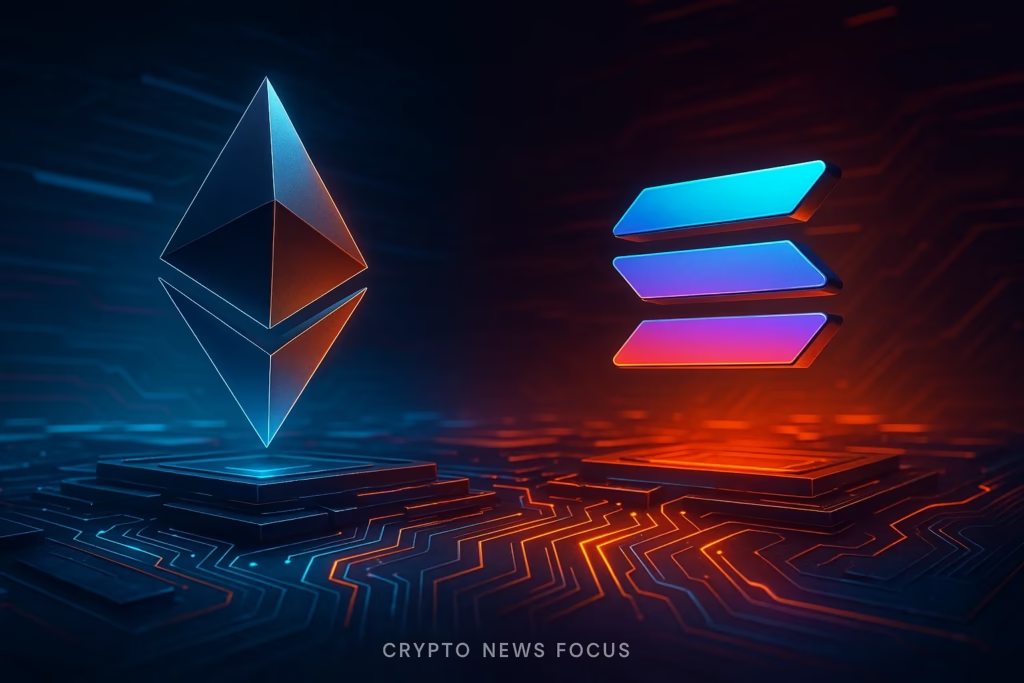
- Ethereum founders Vitalik Buterin and Anatoly Yakovenko clash over Layer-2 security.
- The debate raises concerns about blockchain risks, scalability, and ecosystem fragmentation.
Ethereum co-founder Vitalik Buterin and Solana’s Anatoly Yakovenko are in a public debate over the security of Ethereum’s Layer-2 solutions. The discussion focuses on whether Ethereum’s multi-layer system truly maintains the strong protections of its base layer. With over $35 billion locked across networks like Arbitrum, Base, Optimism, and Worldchain, the stakes are high for developers, investors, and the future of blockchain scalability.
Buterin Defends Ethereum Layer-2s
Vitalik Buterin argues that Ethereum Layer-2s inherit strong security from the base layer, making them resistant to 51% attacks. Even if most validators acted maliciously or encountered software bugs, they could not validate invalid blocks or steal users’ assets. However, Buterin notes a limitation: when users rely on validators for functions not directly controlled by the blockchain, this protection weakens. This highlights the delicate balance between decentralization and the trust mechanisms Layer-2 networks rely on to scale effectively.
Regular reminder:
— vitalik.eth (@VitalikButerin) October 26, 2025
A key property of a blockchain is that even a 51% attack *cannot make an invalid block valid*. This means even 51% of validators colluding (or hit by a software bug) cannot steal your assets.
However, this property does not carry over if you start trusting…
Yakovenko Highlights Structural Flaws
Anatoly Yakovenko disagrees, claiming Ethereum Layer-2s do not fully inherit base layer security. Comparing Wormhole ETH on Solana with ETH on Base, he argues both carry similar risks in worst-case scenarios while generating comparable Layer-1 revenue. Yakovenko identifies three major concerns:
well yes of course, and the point of L2s is to have different trust tradeoffs than an L1 not identical ones!
— _gabrielShapir0 (@lex_node) October 26, 2025
otherwise it would not need to borrow trust mitigation services from the L1
- Complex L2 code increases attack surfaces, making audits difficult.
- Multisig arrangements could allow fund movement without user consent.
- Off-chain processing centralizes control, undermining decentralization.
He questions whether Layer-2s can ever fully resolve these issues despite years of development, pointing to the 129 verified and 29 unverified L2 networks as evidence of inefficiency.
Fragmentation and Its Impact
The rapid growth of Layer-2 networks creates liquidity fragmentation and complicates user experience, which may weaken Ethereum compared to monolithic blockchains like Solana. Early 2025 data showed Solana outperforming Ethereum, reflecting investor concerns about scalability and security trade-offs.
For developers and DeFi protocols, choosing a Layer-2 network is a strategic decision. Differences in transaction costs, speed, and security directly affect adoption and the total value locked. As Ethereum and Solana continue to compete, debates over Layer-2 security and efficiency will shape the future of smart contract ecosystems.
DISCLAIMER:
The views and opinions expressed herein are solely those of the author and do not necessarily reflect the views of the publisher. The publisher does not endorse or guarantee the accuracy of any information presented in this article. Readers are encouraged to conduct further research and consult additional sources before making any decisions based on the content provided.