


- Ethereum recorded over 200 million transactions in Q1 2026, marking its highest network activity ever.
- Despite this growth, ETH price remains far below its 2025 peak due to reduced fee impact and Layer 2 dominance.
Ethereum has reached a major milestone in network activity, marking a significant turnaround after years of slower growth. However, its price has yet to reflect this surge, creating a gap between usage and market value.
Ethereum Records Its Busiest Quarter Ever
Ethereum processed over 200 million transactions on its base layer in the first quarter of 2026. This marks the highest quarterly activity in the network’s history.

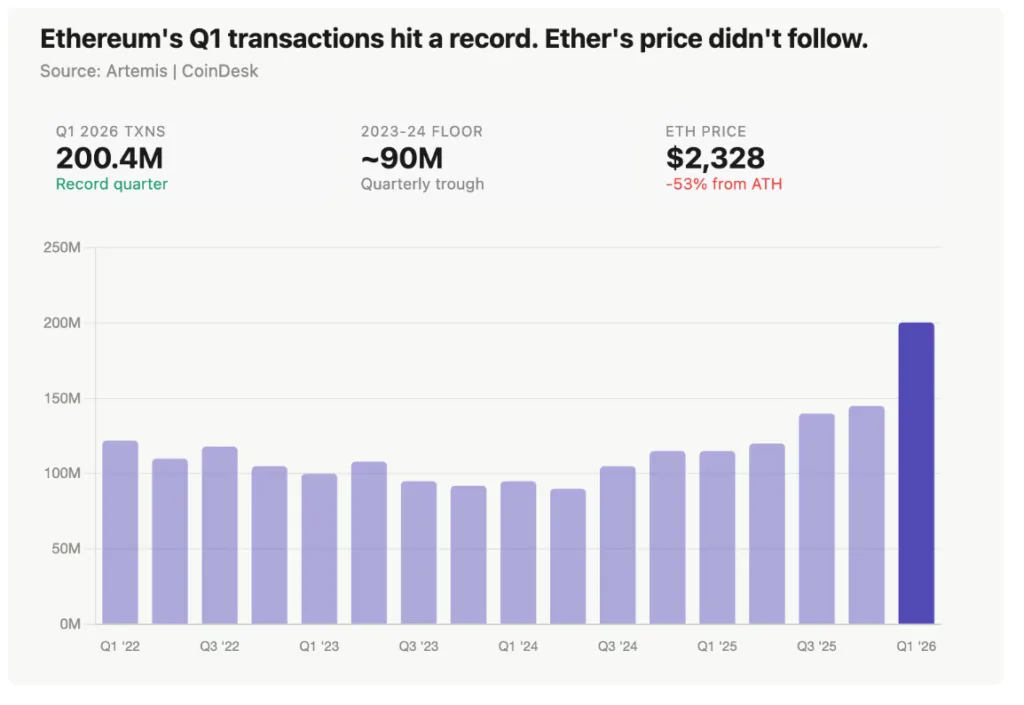
The growth follows a steady recovery that began in 2025. Transaction counts had dropped to around 90 million in 2023 before stabilizing in 2024. Since then, activity has climbed each quarter, forming a clear recovery trend.
This increase highlights renewed demand for the Ethereum network. More users and applications are interacting with the blockchain, pushing activity to new highs.
Layer 2 Solutions and Stablecoins Drive Growth
Much of Ethereum’s recent growth comes from Layer 2 networks and stablecoin usage. These systems help reduce costs and improve transaction speed.
Layer 2 platforms such as Base and Arbitrum allow users to process transactions off the main chain. These transactions are later settled on Ethereum’s base layer.
This setup increases the total transaction count without overloading the network. It also makes Ethereum more accessible to users seeking lower fees.
At the same time, stablecoins are playing a major role. The total stablecoin supply on Ethereum has reached around $180 billion. This represents a large share of the global stablecoin market.
Stablecoins are widely used for payments, trading, and transfers. Their growth continues to boost activity across the network.
Why Ethereum Price Has Not Followed
Despite the surge in activity, Ethereum’s price remains significantly below its 2025 peak. The token is still more than 50 percent down from its high near $5,000.
One reason is the impact of the Dencun upgrade. This upgrade reduced transaction costs for Layer 2 networks. While this supports growth, it also lowers the fees generated on Ethereum’s base layer.
Lower fees mean reduced token burn. This weakens the direct link between network usage and price growth.
In simple terms, more activity no longer guarantees higher value for holders. The network is growing, but the economic benefits are being distributed differently.
What This Means for Ethereum’s Future
Ethereum’s recent performance shows strong fundamentals. The network has recovered from its previous slowdown and is now seeing record usage.
This type of growth has often come before price increases in past cycles. However, the current structure of the network has changed.
Future price movement will depend on whether activity remains high and whether it reflects real user adoption. Some analysts also warn that automated transactions could be inflating activity levels.
If growth continues into the next quarter, Ethereum could be entering a new phase of expansion. If not, this surge may represent a short-term peak.
Ethereum’s record-breaking quarter signals a strong recovery in network activity. However, the gap between usage and price highlights a shift in how value is created within the ecosystem.
ALSO READ: Dogecoin Price Forecast Points to Possible $0.15 Move on Musk’s X Money Developments
DISCLAIMER:
The views and opinions expressed herein are solely those of the author and do not necessarily reflect the views of the publisher. The publisher does not endorse or guarantee the accuracy of any information presented in this article. Readers are encouraged to conduct further research and consult additional sources before making any decisions based on the content provided.