



- Ethereum developers proposed burning more staking rewards to potentially bring ETH issuance to zero as staking grows.
- The plan could boost scarcity but faces community debate.
Ethereum developers have introduced a new proposal that could reshape ETH’s monetary policy by gradually reducing staking rewards and eventually cutting new issuance to zero.
The proposal suggests burning a larger share of validator rewards as more ETH enters staking. If staked ETH reaches around 60.25 million ETH, worth about $112 billion at current estimates, the network would burn 100% of newly created ETH rewards and stop increasing supply.
Ethereum Could Move Toward a Zero-Issuance Model
Ethereum relies on staking to secure its network. Validators lock ETH and help process transactions, earning newly issued ETH as rewards.
Under the proposed change, validators would continue receiving transaction fees and tips from block production. However, newly created ETH used for staking rewards would gradually be burned instead of being added to circulation.

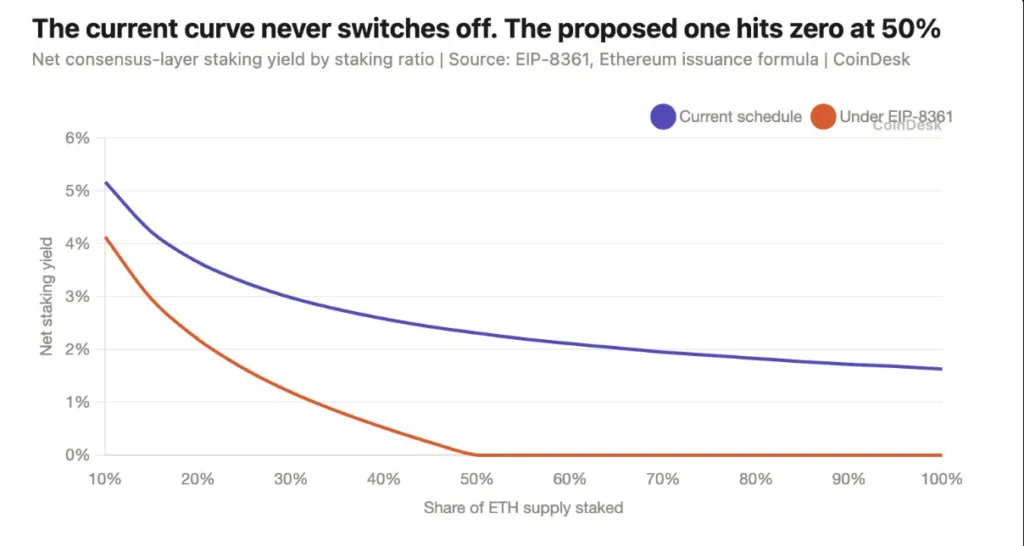
The burn mechanism would activate every 6.4 minutes at the end of each Ethereum epoch. The percentage of rewards burned would increase as the staking ratio rises, eventually reaching full ETH issuance removal when staking reaches about half of the total supply.
The adjustment would not happen immediately. Developers proposed an 18-month transition period after the upgrade goes live, giving the ecosystem time to adapt.
Ethereum Staking Growth Raises Supply Concerns
Ethereum currently has around 41 million ETH staked, representing nearly 34% of total supply. Millions more ETH are waiting in the activation queue as demand for staking continues to grow.

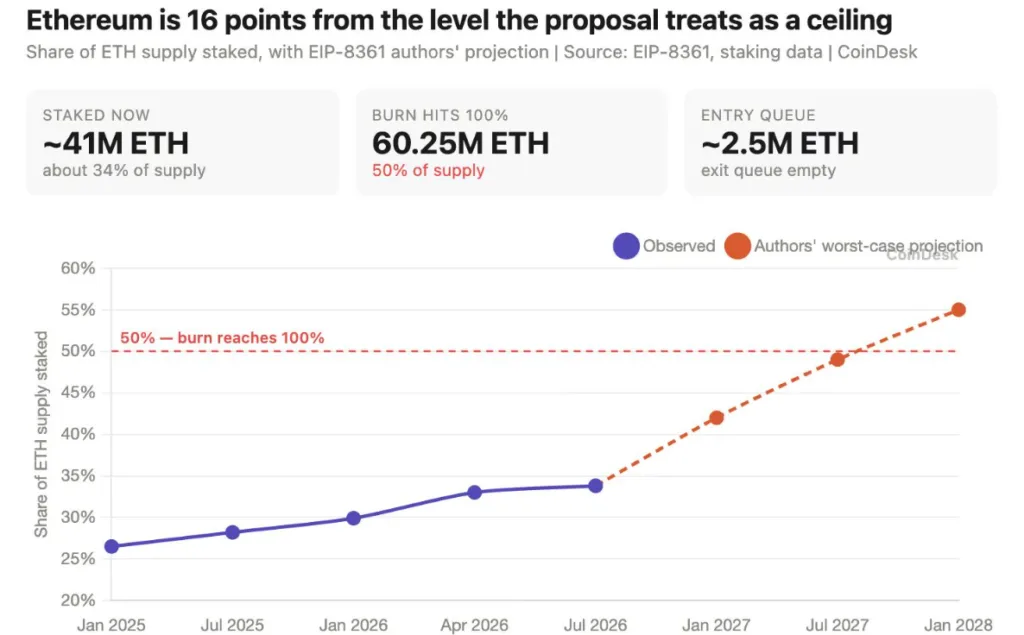
Researchers behind the proposal argue that unlimited staking growth could create long-term issues. Even if almost all ETH becomes staked, Ethereum would still need to provide rewards, creating continued supply expansion.
The proposal estimates that more than 70 million ETH could be staked by January 2028 if current trends continue. Developers warn that excessive staking could reduce network diversity by shifting more ETH toward large exchanges and staking providers.
Proposal Faces Pushback From DeFi Community
The suggested change has created debate among Ethereum developers and DeFi participants.
Some industry leaders argue that reducing staking rewards could affect borrowing strategies that depend on ETH staking yields. Staking-based strategies on lending platforms may become less attractive if rewards decline significantly.
Critics also believe the proposal could hurt smaller independent validators while benefiting large staking providers with lower operating costs.
However, supporters argue that reducing issuance could strengthen ETH’s long-term scarcity and reduce dilution for existing holders.
Will Ethereum Include the Change in Hegotá Upgrade?
The proposal arrived shortly before the deadline for changes to Ethereum’s upcoming Hegotá upgrade, expected in the second half of 2026.
However, the proposal still lacks broad agreement among validators and developers. Its limited implementation timeline makes it less likely to be included in Hegotá and could push the change to a future network upgrade.
If approved later, the proposal would represent one of Ethereum’s biggest monetary policy shifts since the move to proof-of-stake. By limiting new ETH creation, developers aim to create a more predictable supply model while balancing network security and staking incentives.
ALSO READ: Zcash Price Surges 5% as DCG-Backed Miner Buys New Mining Facility
DISCLAIMER:
The views and opinions expressed herein are solely those of the author and do not necessarily reflect the views of the publisher. The publisher does not endorse or guarantee the accuracy of any information presented in this article. Readers are encouraged to conduct further research and consult additional sources before making any decisions based on the content provided.