


IOTA’s Rebased upgrade has fundamentally changed the network. What was once an unusual distributed ledger is now a programmable, proof-of-stake Layer 1 competing in the same broad arena as modern smart-contract platforms.
For years, IOTA occupied a strange position in the cryptocurrency industry.
It was one of the best-known distributed ledger projects outside the mainstream blockchain world, but it was also difficult to compare directly with networks such as Ethereum, Solana or other smart-contract platforms.
The reason was simple: IOTA was built differently.
Its original architecture revolved around the Tangle rather than a conventional blockchain, with a strong emphasis on feeless transactions, scalability and eventually machine-to-machine communication and real-world applications.
That made IOTA technologically distinctive.
It also left the network facing an increasingly important problem.
As the blockchain industry moved toward programmable Layer 1 networks, decentralized finance, tokenization and on-chain applications, IOTA needed a much more powerful native smart-contract environment.
That is where IOTA Rebased changed the story.
Also Read: IOTA Activates Starfish Upgrade to Strengthen Global Trade Network
The Rebased transformation
IOTA Rebased represents the most significant architectural change in the network’s history.
The upgrade moved IOTA’s Layer 1 toward an object-based architecture powered by the Move Virtual Machine (MoveVM), while also introducing delegated proof-of-stake, staking rewards, transaction fees and fee burning.

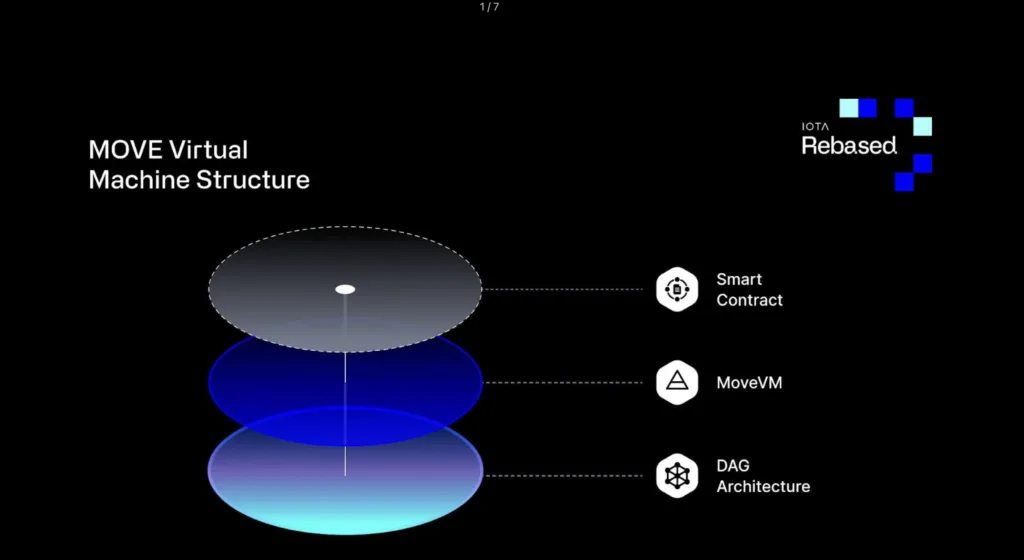
Most importantly, smart contracts are now supported directly on IOTA’s Layer 1.
That distinction matters.
IOTA had previously offered smart-contract functionality through the IOTA Smart Contracts framework and its EVM-based Layer 2. Rebased takes programmability directly into the base layer. The official IOTA documentation now describes MoveVM smart contracts as a native capability of the IOTA Mainnet.
This is part of the network’s architecture.
The Rebased mainnet launched in 2025, completing the transition from the previous protocol to the new Layer 1 architecture. By the end of 2025, IOTA described the network as a decentralized Layer 1 with Move smart contracts integrated at the base layer.
Why MoveVM matters
MoveVM is not simply another programming environment.
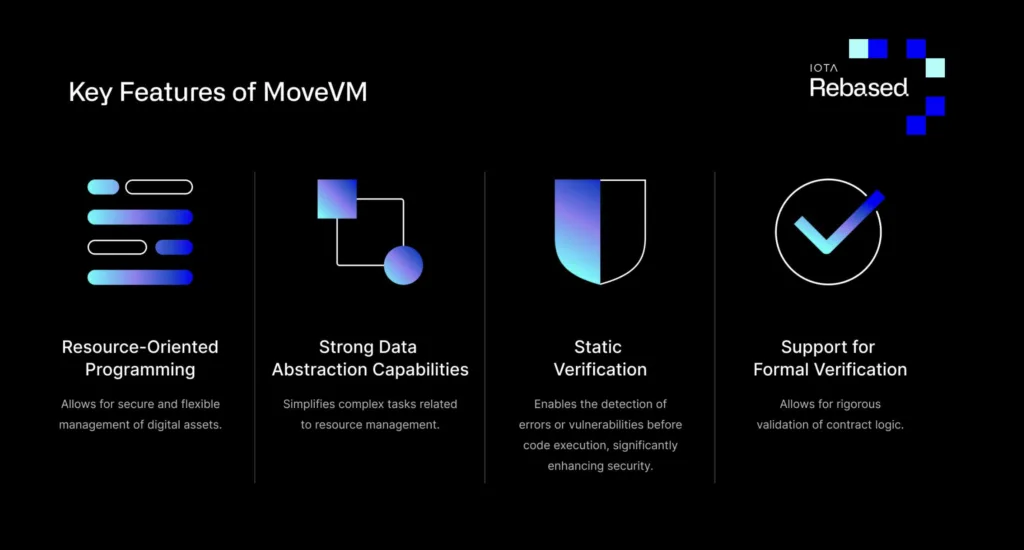
The Move language was designed around the concept of digital assets as resources. That gives developers tools for managing assets in ways intended to reduce certain classes of programming errors and vulnerabilities.
IOTA’s implementation uses Move’s resource-oriented programming model and supports features including static and formal verification.
For developers, the practical implication is much more important than the terminology.
A programmable IOTA Layer 1 can support applications whose logic executes directly on the network.
That includes potential applications involving:
- decentralized exchanges
- decentralized finance
- tokenized assets
- NFTs
- digital identity
- supply-chain infrastructure
- automated payments
- digital credentials
- real-world asset applications
IOTA’s technical documentation specifically describes MoveVM as the foundation for decentralized applications, tokenized ecosystems and programmable digital assets.
The network is therefore no longer asking developers to think of IOTA merely as a transaction or data ledger.
It can now be treated as a general-purpose programmable Layer 1.

From a different kind of ledger to a familiar blockchain proposition
This may actually be the most important part of the change.
IOTA spent much of its early history trying to convince the market that distributed ledger technology did not necessarily have to look like a conventional blockchain.
The Tangle was central to that vision.
But the blockchain market evolved rapidly.
Ethereum demonstrated the power of programmable contracts. Other Layer 1 networks followed with different approaches to execution, consensus, scalability and asset management.
Eventually, simply having an alternative ledger architecture was no longer enough.
Developers wanted programmability.
Users wanted applications.
Capital wanted liquidity and financial infrastructure.
Businesses wanted tokenization, identity and automated processes.
IOTA Rebased is, in many ways, an acknowledgment of that reality.
Instead of continuing to pursue a long and uncertain path toward its previous IOTA 2.0 architecture, IOTA chose to rebase the Layer 1 around an architecture that could deliver native smart contracts and decentralization much sooner. The Foundation’s original Rebased proposal explicitly described the move as a way to accelerate Layer 1 programmability and make the network more attractive to builders.
IOTA is also moving toward staking
Rebased did not stop with smart contracts.
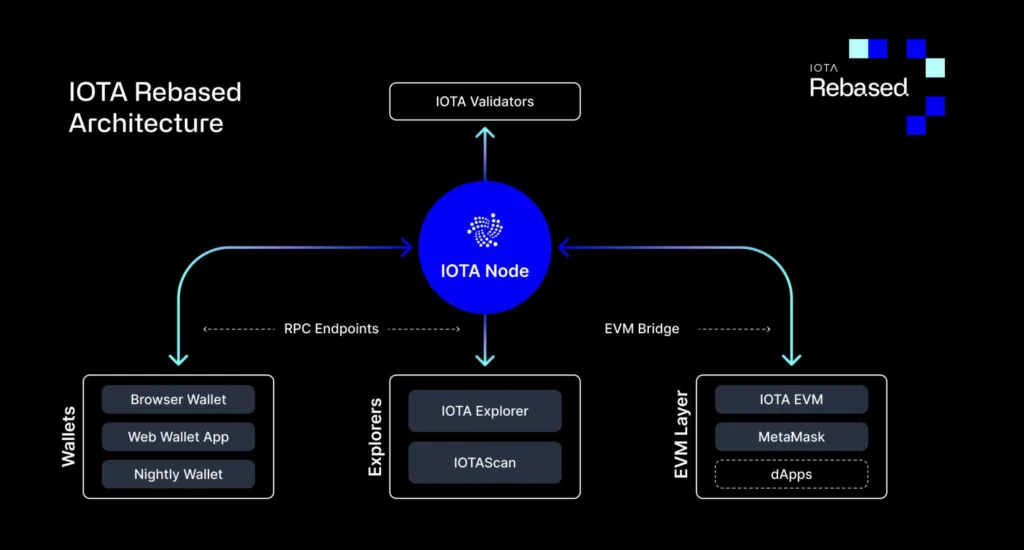
The network also adopted a delegated proof-of-stake model.
Under the new system, validators secure the network while token holders can delegate their IOTA to validators and participate in staking rewards.
That gives IOTA a much more familiar economic model for a modern Layer 1.
The IOTA token now has several important functions within the network.
It can be used for transactions, staking and network security, while transaction fees are burned according to the new tokenomics model.
This also changes the relationship between network activity and the token.
Under the new model, greater network usage can generate more transaction fees that are subsequently burned, creating a counterweight to the new IOTA issued as staking rewards.
That does not automatically make IOTA deflationary.
But it does create a more conventional economic connection between network activity and the native asset.
What about EVM?
IOTA’s transition to MoveVM does not mean the EVM story has simply disappeared.
The existing IOTA EVM operates as a Layer 2, while IOTA’s longer-term roadmap includes bringing EVM capabilities directly into the Layer 1 as part of a multi-VM architecture.
That could ultimately give developers more flexibility.
Move developers can build using IOTA’s native smart-contract environment, while EVM compatibility can potentially make it easier for developers already familiar with Ethereum’s tooling and programming model to enter the ecosystem.
That is important because blockchain adoption is not only about technology.
It is also about developer friction.
A technically impressive blockchain with no developers, applications or liquidity is still an empty network.
IOTA appears increasingly focused on solving that problem.
The developer ecosystem is starting to take shape
The transition to MoveVM has also resulted in a greater emphasis on developer tooling and education.
In 2025, IOTA ran Move-focused developer initiatives including its Moveathon, while its ecosystem team reported onboarding more than 40 validators and integrating infrastructure providers, wallets, data tools and DeFi projects around the new mainnet.
That is still early.
But it is significant because it demonstrates that the Rebased strategy is not limited to changing the protocol itself.
IOTA is attempting to build the surrounding ecosystem required to make a programmable Layer 1 useful.
By the end of 2025, the Foundation reported a growing DeFi ecosystem that included liquid staking, decentralized exchanges, collateralized borrowing and perpetual trading applications.
Whether these applications eventually achieve meaningful scale is another question.
But the infrastructure is beginning to look much more like that of a conventional smart-contract network.
And this is where the story gets interesting
The technical transformation is impressive.
But technology alone does not create a successful cryptocurrency.
The real test for IOTA now is adoption.
Can developers build applications that users actually want?
Can IOTA attract meaningful liquidity?
Can its real-world trade, identity and tokenization initiatives translate into sustained on-chain activity?
And perhaps most importantly for investors:
Will that activity create meaningful demand for IOTA itself?
Those questions remain unanswered.
IOTA’s own 2025 review claimed that the Rebased network could achieve more than 50,000 transactions per second with sub-second finality, while also highlighting developments in trade, tokenization, digital identity and DeFi.
Those are interesting capabilities.
But raw throughput is not enough.
The cryptocurrency industry has repeatedly demonstrated that the most valuable networks are not necessarily those with the largest theoretical transaction capacity.
They are the networks where developers build, users transact, capital moves and applications become difficult to replace.
IOTA has finally entered the competition
This is perhaps the simplest way to understand what has happened.
For years, IOTA was trying to prove that its alternative distributed-ledger architecture could become important infrastructure for the real world.
Now it has something much more familiar to offer.
A programmable Layer 1.
It has native MoveVM smart contracts.
It has delegated proof-of-stake.
It has staking.
It has programmable native assets.
It has a developing DeFi ecosystem.
It has EVM infrastructure alongside the new Layer 1 architecture, with a longer-term multi-VM direction.
And it is continuing to pursue applications involving trade, identity, tokenization and real-world infrastructure.
That does not guarantee that IOTA will become a major Layer 1.
But it does mean the old criticism that “IOTA isn’t really a smart-contract platform” is becoming increasingly difficult to sustain.
The question has changed.
It is no longer:
“Will IOTA eventually become programmable?”
It already is.
The question now is:
“What will developers and institutions actually build with it?”
And that may be a much more interesting question for IOTA holders than anything the project has faced in years.
Official IOTA resources
For readers who want to go deeper, IOTA’s official documentation provides technical information about the Rebased architecture, MoveVM, staking and the new Layer 1. The Foundation’s technical and tokenomics whitepaper also provides a detailed description of the new protocol.
Disclaimer: This article is for informational purposes only and should not be considered financial advice. Cryptocurrency investments are highly volatile and carry significant risk. Readers should conduct their own research before making investment decisions.