


- IOTA leverages blockchain to enhance the circular economy by improving traceability and enabling reuse, recycling, and refurbishment of products.
- Its growing real-world utility and enterprise adoption suggest strong market potential for MIOTA in the coming months.
IOTA Blockchain Supports Circular Economy at Product End-of-Life
IOTA is leading the way in applying blockchain to the circular economy. Research by the IOTA’s Foundation and University College Dublin shows that IOTA’s Tangle can track product parts. It identifies which components can be reused, refurbished, remanufactured, or recycled. Unlike linear economies, which often treat products as disposable, IOTA promotes sustainability and reduces waste.
Turning Waste into Value with IOTA
A recent IFAC PapersOnLine study highlights how IOTA’s distributed ledger technology (DLT) transforms waste into value. Blockchain improves transparency, accountability, and traceability in remanufacturing and refurbishing. Researchers Masood Ahmad, Pezhman Ghadimi, Vincent Hargaden, and Nikolaos Papakostas note that digital solutions like IOTA provide proof of origin and monitor product performance throughout its lifecycle.
IOTA’s Market Potential Grows with Sustainability Trends
Beyond technology, IOTA shows strong market potential. The TWIN Initiative, which focuses on customs, taxes, and trade digitization, increases its real-world utility. Market analysts suggest that MIOTA could rise 15–25% in the coming months, especially if Europe advances digital product passport regulations. Past sustainability-focused events have also helped IOTA’s value increase steadily.
IOTA’s Current Trading Status
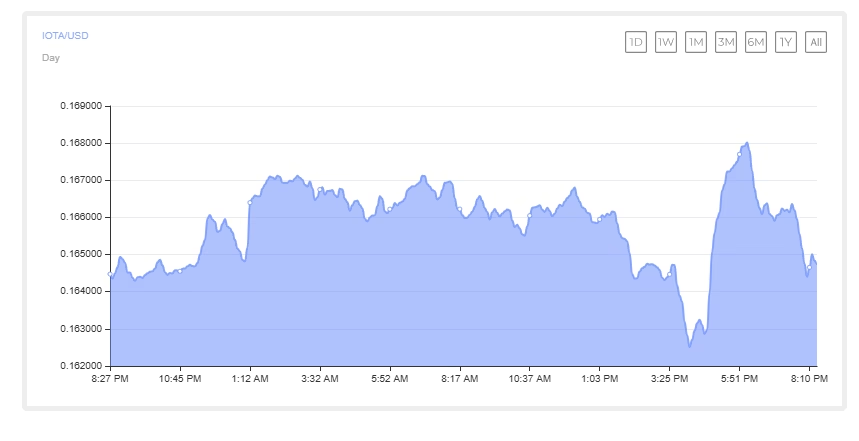
Currently, It trades around $0.1657 USD, up 2.29% over the past week. Its market capitalization is approximately $675 million. As a mid-sized cryptocurrency, IOTA still has room to grow. Enterprise adoption and increased on-chain activity are expected to support its long-term potential. Many investors consider it undervalued, given its link to the trillion-dollar circular economy market.

Why IOTA Matters for the Circular Economy
By integrating blockchain into product lifecycle management, IOTA helps close material loops and reduce environmental impact. As companies adopt circular economy practices, IOTA stands out. It is a cryptocurrency with real-world applications, long-term growth potential, and a clear role in sustainable business development.
DISCLAIMER:
The views and opinions expressed herein are solely those of the author and do not necessarily reflect the views of the publisher. The publisher does not endorse or guarantee the accuracy of any information presented in this article. Readers are encouraged to conduct further research and consult additional sources before making any decisions based on the content provided.