


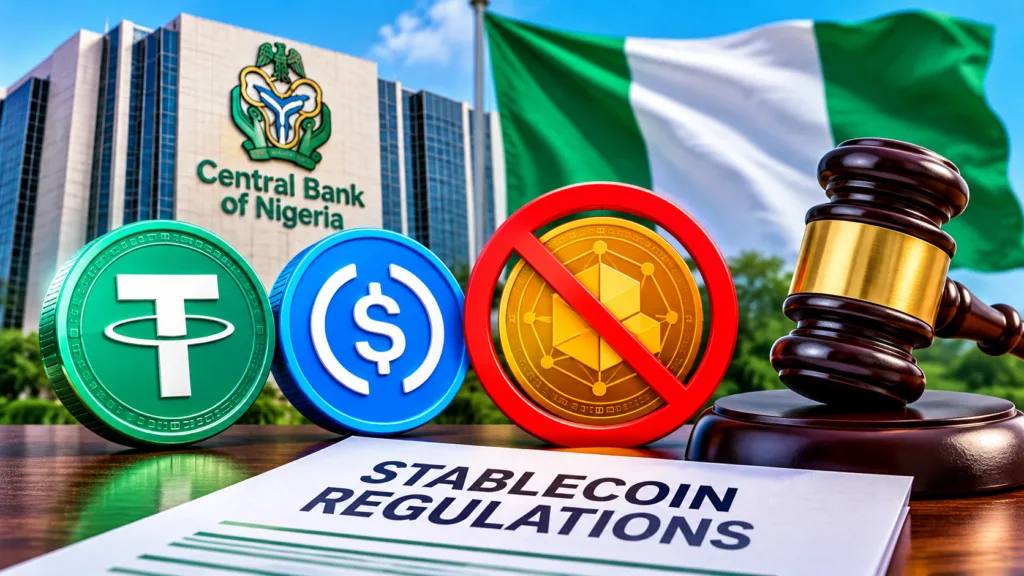
Nigeria has introduced a new regulatory framework for stablecoins and other non-security virtual assets, requiring foreign-currency stablecoin issuers to establish locally incorporated entities and obtain approval from the Central Bank of Nigeria (CBN).
The regulations took effect on November 5, 2026, and introduce separate licensing categories for naira-backed and foreign-currency-backed stablecoins. They also prohibit algorithmic stablecoins and establish minimum capital requirements of ₦10 billion for naira stablecoin issuers and ₦15 billion for foreign-currency stablecoin issuers.
The new framework extends beyond token issuance. It covers cryptocurrency exchanges, wallet providers, custodians, payment services, remittances and certain peer-to-peer (P2P) transactions.
The CBN says the rules are intended to strengthen financial stability, consumer protection, payment-system oversight and foreign exchange monitoring.
Also Read: The Real Crypto Revolution May Not Be Bitcoin — It’s Stablecoins
Foreign Stablecoin Issuers Must Establish Nigerian Entities
One of the most significant changes concerns foreign-currency stablecoins, including tokens designed to maintain their value against the US dollar.
Under the new framework, these tokens fall under the Class 2 stablecoin category. Issuers must operate through Nigerian-incorporated entities and obtain a Foreign Currency Issuer Licence from the CBN.
Foreign companies cannot rely solely on licences obtained in other jurisdictions to make their stablecoins available to Nigerian customers.
The regulations also require separate written approval for each stablecoin before issuance. Applications must provide details including the token’s reference currency, reserve arrangements, name, ticker and supported blockchain networks.
The requirements could affect how international stablecoin issuers structure their operations in Nigeria.
However, the regulations do not amount to a blanket ban on dollar-backed stablecoins. Instead, they establish local incorporation, licensing, capital and reserve conditions for issuers seeking access to the Nigerian market.
CBN Sets ₦15 Billion Capital Requirement for Dollar Stablecoins
The CBN has introduced different minimum capital requirements depending on the currency referenced by a stablecoin.
Under Section 15 of the regulations:
- Class 1 issuers of naira-referenced stablecoins must maintain at least ₦10 billion in paid-up capital.
- Class 2 issuers of foreign-currency-referenced stablecoins must maintain at least ₦15 billion.
- Providers of other regulated non-security virtual asset services must maintain at least ₦1 billion.
The capital requirements must be maintained throughout the issuer’s operations and are separate from the reserves backing stablecoins in circulation.
This distinction is important. The capital requirement is intended to provide financial resources for the issuer, while reserve assets support the value and redemption obligations of the stablecoins themselves.
For foreign-currency stablecoin issuers, the ₦15 billion threshold creates a substantial entry requirement, particularly for smaller companies considering the Nigerian market.
Algorithmic Stablecoins Are Prohibited
The new regulations explicitly prohibit algorithmic stablecoins that rely primarily on changes in token supply or demand to maintain their price instead of being fully backed by eligible reserve assets.
The prohibition also covers other arrangements, including:
- Fiat-referenced tokens backed wholly or primarily by other cryptocurrencies.
- Tokens marketed as stablecoins without an enforceable right of redemption at face value.
- Tokens issued by or on behalf of sanctioned individuals or entities.
The CBN’s approach places greater emphasis on identifiable reserve assets and enforceable redemption rights.
For approved stablecoins, issuers must maintain eligible reserves corresponding to outstanding tokens. The regulations also require an additional reserve buffer of at least 2% of the value of stablecoins in circulation.
Issuers must reconcile their outstanding tokens against reserve assets daily and cannot create new tokens before receiving the corresponding backing assets.
These requirements are designed to reduce the risk of reserve shortfalls and improve transparency around the assets supporting stablecoins.
Nigeria Brings P2P Stablecoin Transactions Under FX Oversight
The regulations also address peer-to-peer cryptocurrency transactions, particularly those involving exchanges between the naira and foreign-currency stablecoins.
Under the framework, platforms facilitating P2P transactions involving Class 2 stablecoins and naira must obtain the relevant CBN approval.
The rules also require compliance with foreign exchange monitoring, documentation and reporting requirements.
Where applicable, the naira side of a transaction must be settled through, or reported to, an authorised foreign exchange dealer designated by the CBN.
The regulator has also prohibited operators from splitting or routing transactions through multiple channels to avoid foreign exchange controls, transaction limits or reporting obligations.
This is significant because P2P trading has become an important route for Nigerians accessing dollar-linked digital assets.
The new requirements could change how platforms facilitate naira-to-stablecoin conversions and how they manage transactions involving Nigerian users.
Existing Crypto Businesses Have 180 Days to Apply
The CBN has provided a transition period for businesses already operating under the activities covered by the regulations.
Existing operators have 180 days from the November 5 commencement date to submit applications for the appropriate licence or authorisation.
However, the transition period comes with additional obligations. Businesses must register with the CBN within 30 days and begin submitting supervisory reports within 60 days.
Operators are also required to comply with applicable anti-money laundering, customer identification and transaction-monitoring requirements.
The regulations allow existing businesses to continue operating during the transition period subject to the prescribed conditions and at their existing scale.
Companies that fail to submit the required applications within the 180-day period must stop the regulated activities until they obtain the necessary authorisation.
The transition arrangements therefore give established operators time to prepare, but do not provide an unrestricted exemption from the new framework.
What the New Rules Mean for USDT and USDC Users
The regulations are particularly relevant to users of dollar-backed stablecoins such as Tether’s USDT and Circle’s USDC.
Both tokens are foreign-currency-referenced stablecoins and could fall within the Class 2 framework when issued, distributed or made available to Nigerian users through regulated arrangements.
However, the regulations do not specifically announce that USDT or USDC has been banned in Nigeria.
Instead, their issuers and relevant service providers will need to assess the requirements for local incorporation, licensing, token approval and compliance with the new rules.
For users, the immediate implications may become clearer as exchanges, wallet providers and stablecoin businesses respond to the requirements.
The framework also does not mean that individuals need a CBN licence simply to hold cryptocurrency in a personal wallet. Its licensing obligations primarily concern businesses carrying out regulated activities.
Nigeria Expands Oversight of Its Digital Asset Market
Nigeria’s latest rules represent a broader attempt to bring stablecoin issuance and related crypto services within the country’s existing financial regulatory structure.
The CBN will oversee non-security virtual assets connected to payments, transfers, remittances, settlement and foreign exchange activities. The Securities and Exchange Commission will retain responsibility for securities and capital-market products.
Businesses whose activities fall under both regulators may need approvals from each authority.
The new framework could make it more difficult for smaller stablecoin issuers and service providers to enter the Nigerian market, particularly given the capital requirements and local incorporation obligations.
At the same time, it establishes clearer requirements around reserves, redemption, customer protection and regulatory supervision.