


- PayPal has expanded its stablecoin PYUSD to the TRON blockchain through LayerZero, boosting its speed, liquidity, and real-world payment utility.
- The move positions PYUSD at the center of global stablecoin settlements, enabling faster, cheaper cross-border transfers for millions of users.
PayPal has officially launched its US dollar-backed stablecoin, PayPal USD (PYUSD), on the TRON blockchain using LayerZero’s cross-chain technology. This move signals the payments giant’s intention to expand beyond Ethereum, where PYUSD debuted in 2023, and into a network already known for high-volume stablecoin transactions.
TRON processes around 9 million transactions daily and hosts over $76 billion in Tether (USDT), making it one of the largest stablecoin ecosystems globally. By deploying PYUSD here, PayPal positions its stablecoin where digital dollars are actively used for cross-border payments, remittances, and e-commerce.
ALSO READ:PayPal Unveils PYUSD Rewards and Brings Support to Arbitrum Chain
Why TRON Makes Strategic Sense for PayPal
When PYUSD first launched on Ethereum, adoption was steady but modest, with integrations into exchanges, wallets, and Venmo. However, Ethereum’s high fees and slower transaction speeds limited PYUSD’s broader utility.
TRON, by contrast, offers speed, low costs, and massive liquidity. Its ecosystem of 332 million accounts and $28 billion in assets ensures that PYUSD is not just another blockchain experiment but a tool for real-world payments. For users, this means easier, cheaper, and faster digital transfers across borders.
Seamless Transfers with PayPal and LayerZero
The integration leverages LayerZero’s interoperability framework, which allows PYUSD to move across chains without manual conversions or bridging. Whether held on Ethereum or TRON, the token remains the same dollar-backed asset, ensuring consistency and usability across platforms.

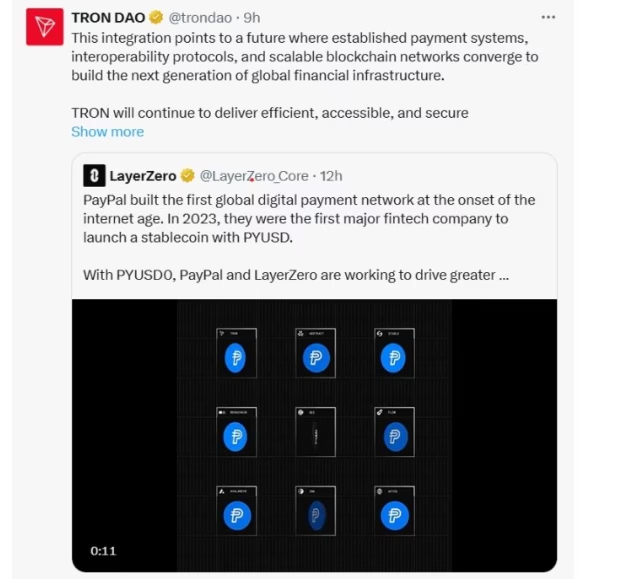
This level of interoperability aligns with a broader vision of breaking down blockchain silos and enabling frictionless payments. As Tron DAO noted, the collaboration represents a step toward “the next generation of global financial infrastructure.”
TRON’s Role in the Stablecoin Economy
Since its mainnet launch in 2018, TRON has facilitated over $21 trillion in transactions and continues to dominate stablecoin settlements. Its strength lies in serving practical use cases—remittances, payroll, and e-commerce—rather than speculation.
For PayPal, this is a strategic bet on legitimacy and adoption. By placing PYUSD in TRON’s thriving payment network, the company ensures its stablecoin is positioned where digital dollars are most needed.
A Step Toward Mainstream Crypto Payments
PayPal’s TRON integration transforms PYUSD from a cautious Ethereum-based pilot into a globally relevant payment tool. For millions of users, it unlocks a faster, cheaper way to send and receive digital dollars, while for PayPal, it represents a decisive move into the heart of crypto-powered financial infrastructure.
ALSO READ:XRP Price Holds Above $3 as Buyers Eye Next Resistance
DISCLAIMER:
The views and opinions expressed herein are solely those of the author and do not necessarily reflect the views of the publisher. The publisher does not endorse or guarantee the accuracy of any information presented in this article. Readers are encouraged to conduct further research and consult additional sources before making any decisions based on the content provided.