


- Ripple’s CTO warned that DeFi protocols often skip key security features for convenience, as seen in the KelpDAO exploit.
- Meanwhile, XRP stays flat near $1.40 amid broader market weakness.
Ripple’s CTO has raised serious concerns about DeFi bridging systems after the KelpDAO exploit triggered a wider market reaction. The comments highlight a growing tension in decentralized finance between convenience and security. At the same time, XRP price remains steady around $1.40 despite broader market weakness.
The discussion is less about short-term price action and more about structural risks inside DeFi systems. While XRP continues to trade in a tight range, attention has shifted to how protocols handle security features they already have but often do not fully use.
Ripple CTO Highlights a Hidden Risk in DeFi Bridging
The Ripple CTO reviewed several DeFi bridging systems while evaluating infrastructure for RLUSD, Ripple’s stablecoin. His focus was mainly on security and risk management.
I evaluated a lot of DeFi bridging systems for use by RLUSD. I was almost exclusively focused on the security and risk aspect. One thing I noticed is that most schemes were very well designed and had really strong mechanisms available to protect against exactly the type of attack…
— David 'JoelKatz' Schwartz (@JoelKatz) April 20, 2026
He found that most bridging systems are technically well designed. Many already include strong protections meant to prevent attacks similar to the one seen in the KelpDAO and rsETH incident.
However, a deeper issue stood out. Many projects quietly discourage the use of their strongest security features. These tools exist, but they are often avoided because they add operational complexity and reduce convenience.
Instead, projects promote ease of use and fast scaling across multiple chains. The trade-off is rarely explained clearly. In practice, users are encouraged to prioritize simplicity over maximum protection.
The CTO noted a recurring pattern in these systems. Teams often assume users will not activate full security settings, even though those settings are the reason the system is considered safe in the first place.
This creates a contradiction. Projects market strong security, but rely on users not enabling it fully.
DeFi’s Convenience Problem Exposed by KelpDAO Exploit
The KelpDAO exploit has become a case study in how DeFi systems can fail outside of pure technical design.
According to the concerns raised, some protocols may intentionally avoid enabling advanced security layers to reduce friction. This includes optional protections that could have reduced or prevented the exploit.
The result is a system that appears secure on paper but becomes vulnerable in real-world usage.
The CTO suggested that similar decisions may have played a role in recent incidents. While not confirming specific causes, he pointed to a broader industry behavior where convenience is prioritized over risk reduction.
This creates a structural weakness. When exploits happen, the entire ecosystem suffers, even if the underlying technology was originally designed with stronger safeguards.
The KelpDAO situation has now become a warning sign for other DeFi platforms. It highlights how governance decisions and cost-cutting priorities can override technical safety features.
XRP Price Stays Flat at $1.40 Amid Market Pressure
While DeFi security concerns dominate the discussion, XRP price action remains relatively stable. XRP is trading near $1.40 and has shown little movement this week.
The coin is down slightly, around 1.5%, but no XRP-specific developments are driving the change. No major announcements, protocol changes, or derivative shocks have been reported.
Instead, the broader crypto market is under pressure. Total market capitalization has declined by about 1.25%, reflecting general risk-off sentiment.
A key factor behind the weakness is renewed geopolitical tension. Reports of instability around the Strait of Hormuz on April 19 have increased uncertainty in global markets. This has impacted risk assets across the board, including cryptocurrencies.
XRP has largely mirrored the wider market rather than reacting to any internal catalysts.
Technical Outlook Shows XRP in Consolidation
Recent technical data shows XRP remains in a consolidation phase. Price movement has been narrow, with limited volatility.
The MACD indicator has shown minimal directional strength, reflecting a lack of momentum in either direction. The market appears balanced between buyers and sellers.
Short-term trading levels remain clearly defined. XRP is currently ranging between $1.35 and $1.45.
A move above $1.45 would likely require a strong external catalyst to break resistance. On the downside, a drop below $1.35 could expose the $1.30 support level.

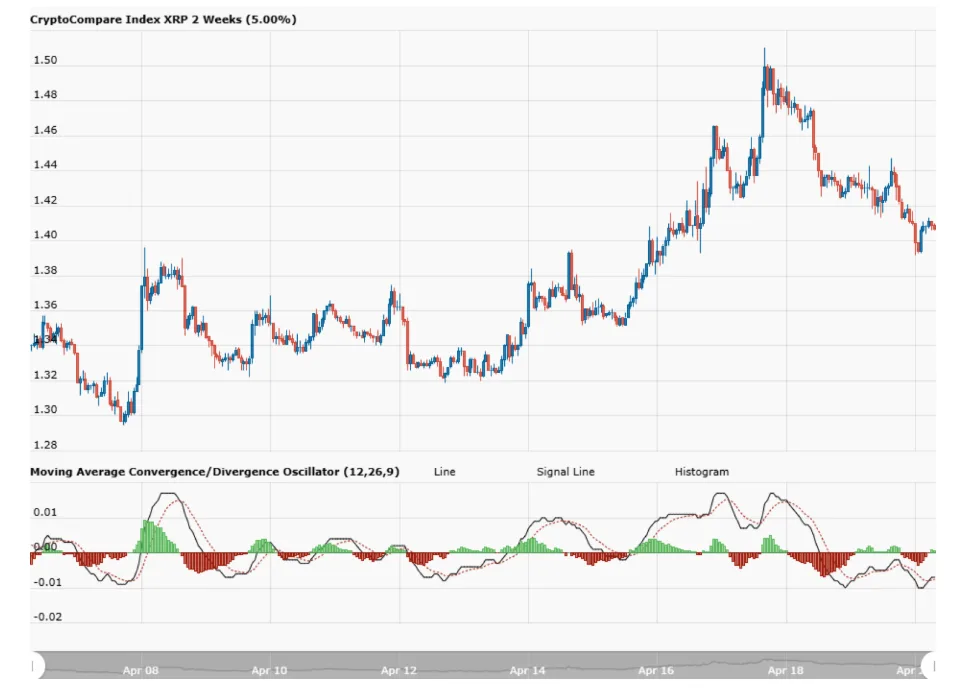
For now, the structure suggests indecision rather than trend formation. XRP is effectively waiting for a stronger market driver.
Final Outlook
The Ripple CTO’s comments have shifted attention toward a deeper issue in DeFi. Security features exist, but they are not always fully used due to convenience trade-offs.
The KelpDAO exploit has reinforced that gap between design and real-world implementation. It highlights how governance choices can weaken otherwise strong systems.
Meanwhile, XRP continues to trade quietly near $1.40, unaffected directly by DeFi incidents. Its movement remains tied more to broader market sentiment than internal catalysts.
Until either market conditions improve or stronger drivers emerge, XRP is likely to remain in a sideways range while the DeFi sector continues to reassess its security priorities.
ALSO READ: Ripple Joins Forces With Kyobo to Launch South Korea’s First Tokenized Bond Settlement System
DISCLAIMER:
The views and opinions expressed herein are solely those of the author and do not necessarily reflect the views of the publisher. The publisher does not endorse or guarantee the accuracy of any information presented in this article. Readers are encouraged to conduct further research and consult additional sources before making any decisions based on the content provided.