


- Ripple predicts that on-chain stablecoin volume will reach $33 trillion in 2026, surpassing the combined GDP of the US and China.
- Japan remains a key market, with Ripple expanding fintech partnerships and driving institutional crypto adoption.
Ripple has made a bold prediction: on-chain stablecoin volume is expected to hit $33 trillion in 2026. This announcement came during XRP Tokyo 2026, one of the largest XRPL-focused conferences, held on April 7 in Japan.
Stablecoins Are Becoming Essential for Fintechs
Ripple’s flyer at the event sends a clear message: stablecoins are no longer optional for fintech companies.

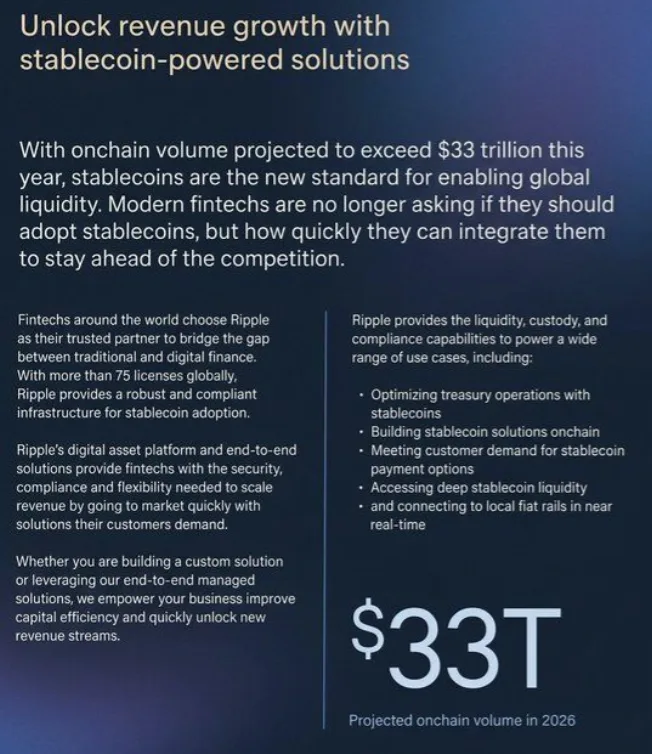
Ripple emphasizes its position as a trusted bridge between traditional and digital finance. With over 75 licenses worldwide, the company claims to provide a robust and compliant setup for stablecoin adoption.
For perspective, the projected $33 trillion volume would surpass the combined GDP of the United States and China.
Why Japan Is Key for Ripple and XRP
Japan has consistently been crypto-friendly, with clear regulations and a strong adoption rate. Ripple has leveraged this environment through a partnership with SBI Holdings, one of Japan’s largest financial groups. Together, they created SBI Ripple Asia in 2016 to promote blockchain integration across Japanese financial institutions.
This partnership gives Ripple direct access to Japanese banks and positions XRP as a key player in institutional crypto adoption. Japanese regulators’ progressive approach to digital assets further supports Ripple’s broader product suite, including RLUSD.
XRP Tokyo 2026 Highlights Ripple’s Strategy
The XRP Tokyo 2026 conference, sponsored by Ripple, highlighted several strategic areas:
- Institutional adoption of XRP
- Tokenization of real-world assets (RWA)
- Growth in decentralized finance (DeFi)
Ripple’s global presence, backed by 75+ licenses, strengthens its fintech partnerships across Asia. The company’s focus on compliant stablecoin solutions makes it a central figure in the region’s digital finance expansion.
ALSO READ: Ripple Partners With Convera to Launch Faster Global Payments Using Stablecoins
DISCLAIMER:
The views and opinions expressed herein are solely those of the author and do not necessarily reflect the views of the publisher. The publisher does not endorse or guarantee the accuracy of any information presented in this article. Readers are encouraged to conduct further research and consult additional sources before making any decisions based on the content provided.