



- Solana generated more fees than Ethereum across 24-hour, seven-day and 30-day periods.
- Ethereum, however, maintained a slight lead in reported burns, highlighting differences in their fee and supply mechanics.
Solana generated more user fees than Ethereum in DefiLlama’s Sept. 22 data snapshot, but Ethereum still recorded a higher amount of reported burns. The difference shows how fee activity can benefit validators, applications and network supply in different ways.
Solana Leads Ethereum in Daily and Monthly Fees
DefiLlama’s data showed Solana generating about $1.1 million in chain fees over 24 hours, compared with $649,423 for Ethereum. Solana also recorded higher fees across the longer seven-day and 30-day periods.
Over seven days, Solana generated $5.93 million in chain fees, while Ethereum recorded $3.09 million. The 30-day figures were further apart, with Solana at $23.58 million and Ethereum at $12.04 million.
Ethereum, however, maintained a lead in reported burns. Its 24-hour burn stood at $226,298, compared with $117,138 for Solana.
| Metric | Solana | Ethereum |
|---|---|---|
| 24-hour chain fees | $1.10M | $649,423 |
| 24-hour reported burns | $117,138 | $226,298 |
| 7-day chain fees | $5.93M | $3.09M |
| 7-day reported burns | $698,884 | $761,849 |
| 30-day chain fees | $23.58M | $12.04M |
| 30-day reported burns | $2.66M | $2.80M |
The longer-term figures make the difference in burns much smaller. Over 30 days, Ethereum burned about $2.8 million, only slightly above Solana’s $2.66 million.
The data comes with some limitations. Exact measurement windows were not disclosed, and DefiLlama’s revenue table showed a slightly different Ethereum daily figure. The numbers therefore describe the displayed aggregates rather than a perfectly synchronized comparison.
Why Solana Fees Do Not Translate Directly Into Burns
The way each blockchain handles fees helps explain the gap between total fees and reported burns.
Under Solana’s fee structure, the base fee is split between burning and the validator producing the block. Priority fees paid for faster transaction processing go entirely to validators.

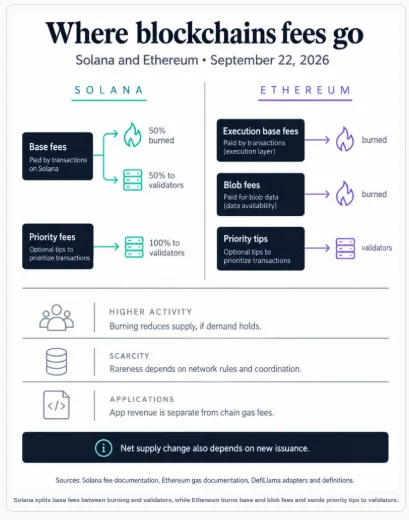
That means Solana can generate substantial fee revenue without burning an equivalent amount. A higher share of priority fees, for example, can increase validator income while having a smaller effect on the amount of SOL removed from circulation.
Ethereum follows a different structure. Base fees are burned, while priority tips go to validators. DefiLlama’s Ethereum calculations also include blob fees in its reported fee and burn figures.
As a result, the amount users spend on a network and the amount removed from its supply are separate measurements.
Burning also does not mean that existing holders receive the value directly. It reduces the supply relative to what it would otherwise have been, while validator rewards and staking income follow different mechanisms.
Solana Also Leads in App Fees
The difference extends beyond chain-level fees. DefiLlama’s Sept. 22 data showed Solana applications generating $18.2 million in fees and $7.7 million in revenue over 24 hours. Ethereum applications recorded $8.5 million in fees and $1.9 million in revenue.
These figures cover application activity rather than simply the fees paid to the underlying blockchain.
For SOL and ETH holders, this distinction matters because higher network or application activity does not automatically translate into direct income for someone holding the asset. Staking arrangements, validator commissions, issuance and the way fees are distributed all affect the eventual economics.
SOL and ETH Supply Dynamics Remain Different
Ethereum’s higher reported burn becomes more notable when compared with the networks’ different valuations. The Sept. 22 snapshots placed Ethereum’s market capitalization at roughly $335 billion, compared with about $69 billion for Solana.
However, comparing burn values against market capitalization alone does not establish which asset has stronger returns. Investors also need to account for newly issued coins during the same period.
Ethereum’s net supply depends on both issuance and burning. Solana also has its own inflation schedule, with the accepted SGP-0002 proposal calling for changes to its disinflation rate subject to implementation.
The key takeaway from the September data is therefore narrower: Solana generated more fees, while Ethereum recorded slightly more reported burns over 30 days.
A broader comparison between SOL and ETH would require matched-period data covering fees, burns, new issuance and the portion of rewards that ultimately reaches stakers.
ALSO READ: Circle’s Arc Is a Blockchain Where USDC Pays the Gas
DISCLAIMER:
This article reflects the author’s views and is provided for informational purposes only. While we strive for accuracy, the publisher does not guarantee that all information is complete or current. Readers should verify important information and consult appropriate sources before making decisions based on this content.