- Solana price is targeting $80 after breaking out of a falling wedge, with $74 to $75 acting as key support.
- However, weakening spot demand and lower trading activity could limit the rally unless buyers push SOL above $80.
Solana price is holding near $75 to $76 after breaking out of a falling wedge pattern. The setup gives bulls a chance to push SOL toward the $80 resistance level.
However, weakening spot demand raises concerns about whether the breakout has enough buying pressure to continue. Traders are now watching the $74 to $80 range for the next major move.
Solana Price Holds Above Key Support
As of August 13-14, 2026, Solana is trading around $75.50 to $76.80 across major exchanges. SOL has slipped slightly over the past 24 hours but remains about 3% higher over the past week.
Solana’s market cap stands near $44 billion, while its circulating supply is about 582.6 million SOL. Open interest is also close to $4.95 billion.
The current price sits just above the $74 to $75 support zone. Holding this area could give buyers room to challenge higher resistance.
Falling Wedge Breakout Puts $80 in Focus
Solana recently broke above a falling wedge that had formed after an earlier rejection at higher levels.
The pattern narrowed for several weeks as SOL traded within a declining range. The breakout above $74 to $75 now gives bulls a potential path toward $80.
The $78 to $80 area remains the first major resistance zone. A daily close above $80 could strengthen the bullish setup and expose SOL to $85 and then $90.
However, a move below $74 would weaken the breakout and could send Solana toward the $65 to $70 support area.
Forward Industries Continues to Buy SOL
Forward Industries has resumed its Solana purchases after a brief pause. The company added 254,000 SOL between July 1 and August 3 at an average price near $75.
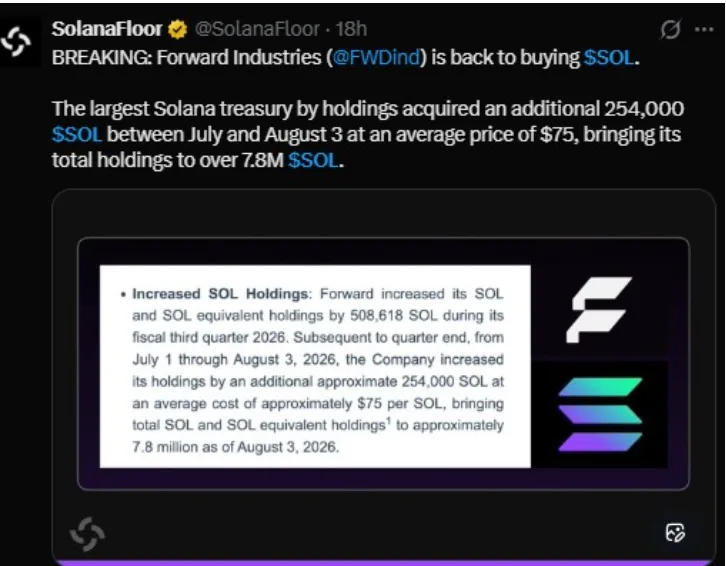
Its total SOL and SOL-equivalent holdings have now reached roughly 7.8 million tokens.
The company also increased its SOL holdings by 508,618 tokens during its fiscal third quarter. The continued accumulation provides a supportive factor for SOL, although it does not guarantee a price increase.
Weak Spot Demand Raises a Warning
Solana’s technical breakout faces one major challenge. Spot demand has been declining while SOL remains near $75 to $76.
Trader Ted Pillows highlighted this divergence as a factor traders should watch. Weak spot demand can indicate that derivatives are contributing more to price stability than direct buying.
Derivatives activity has also cooled. Open interest fell 0.36% to about $4.95 billion, while options volume dropped almost 20%.
Overall 24-hour volume declined more than 11% to around $4.63 billion. These figures suggest that traders need stronger spot buying to confirm the breakout.
Solana Finality Upgrade Could Support Long-Term Demand
Solana co-founder Anatoly Yakovenko has discussed a finality upgrade expected in September.
The upgrade could reduce transaction finality from about 12.8 seconds to roughly 150 milliseconds. Faster confirmation could improve Solana’s appeal for payments and other real-world applications.
The upgrade may strengthen Solana’s long-term network narrative. However, its impact on SOL price will likely depend on broader market conditions and actual adoption.
Solana Price Prediction
Solana’s immediate price structure remains focused on the $74 to $80 range. The $74 to $75 area is the key support zone, while $78 to $80 remains the main resistance.
A daily close above $80 would strengthen the falling wedge breakout and could open the way toward $85 and then $90. However, a drop below $74 would weaken the setup and expose SOL to the $65 to $70 support zone.
For now, the outlook remains mixed. The wedge breakout and continued treasury buying support the bullish case, while weaker spot demand and declining trading activity remain risks.
The next major move above $80 or below $74 could set Solana’s short-term direction.
ALSO READ: IOTA Is Finally Becoming a Conventional Smart-Contract Chain
DISCLAIMER:
The views and opinions expressed herein are solely those of the author and do not necessarily reflect the views of the publisher. The publisher does not endorse or guarantee the accuracy of any information presented in this article. Readers are encouraged to conduct further research and consult additional sources before making any decisions based on the content provided.
About the Author