


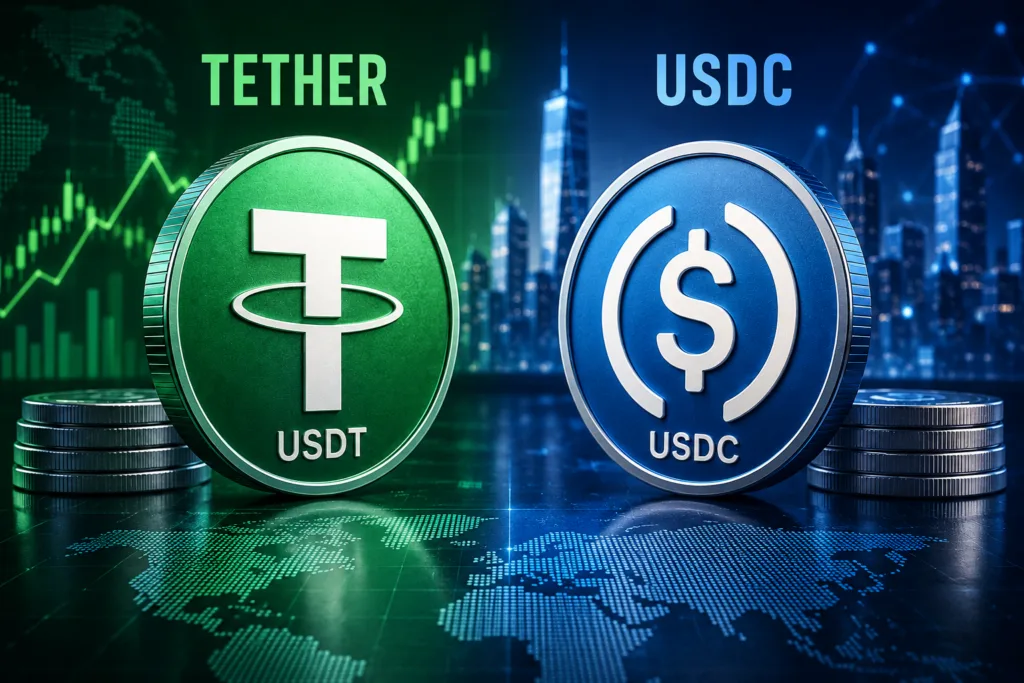
- Tether (USDT) leads by market size, while USDC dominates adjusted transaction activity.
- Both are expanding their roles across crypto and finance.
Tether (USDT) and USDC remain the two dominant names in the stablecoin market, but the race between them is no longer as simple as comparing market caps.
Tether has a commanding lead in circulating supply, with USDT worth about $183 billion in August 2026. USDC sits far behind at roughly $72 billion. Yet USDC has taken the lead in adjusted transaction activity, giving the competition a new dimension.
The numbers show that USDT still dominates the market by size, while USDC is gaining ground in how stablecoins are actually being used.
Tether Still Leads by Market Size
USDT remains the largest stablecoin by a wide margin. Tether’s market capitalization stands near $183 billion, compared with roughly $72 billion for USDC. Together, the two account for more than 80% of the total stablecoin market.
That size gives USDT a major advantage in crypto trading.
USDT is available across major exchanges and blockchain networks. Traders use it to move funds between platforms, enter crypto positions and maintain dollar exposure without converting back to traditional currency.
Tether’s scale also creates deep liquidity across thousands of trading pairs. For now, USDC has no close answer to USDT’s lead in circulating supply.
USDC Is Winning the Transaction Race
This is where the comparison becomes more interesting.
Visa-adjusted data showed that USDC accounted for about 70% of adjusted stablecoin transaction volume during the first half of 2026. USDT accounted for roughly 25%. Total adjusted stablecoin volume reached $8.82 trillion during the period.
The figures exclude activity that Visa considers inorganic, such as certain bot-driven transactions, giving a different picture from raw blockchain volume.
USDC has also recorded strong growth in its own on-chain activity.
Circle reported that USDC circulation reached $77 billion at the end of the first quarter, up 28% year over year. USDC on-chain transaction volume reached $21.5 trillion during the quarter, a 263% increase from a year earlier.
Circle’s second-quarter results showed USDC circulation at $73.3 billion, up 19% year over year. On-chain transaction volume increased 151%. That suggests USDC is being used more frequently even though its supply remains much smaller than USDT.
Tether vs USDC Market Share
The market-share battle currently looks like this:
| Metric | Tether USDT | USDC |
|---|---|---|
| Market capitalization | About $183B | About $72B |
| Market position | #1 | #2 |
| Market-share advantage | Clear leader | Growing |
| Adjusted H1 2026 transaction share | About 25% | About 70% |
| Main strength | Crypto liquidity and trading | Payments and transaction activity |
Market capitalization figures can change as users mint and redeem stablecoins. Transaction-volume figures also depend on the methodology used.
That distinction matters. USDT leads the supply race. USDC leads the adjusted transaction-volume race.
Tether’s Reserves Remain a Major Strength
Tether has built one of the largest reserve portfolios in the crypto industry.
The company reported $1.5 billion in net operating profit for the second quarter of 2026. Its total assets reached about $187.75 billion at the end of June, while liabilities stood at about $183.64 billion. That left Tether with roughly $4.11 billion in excess reserves.
Tether has also continued expanding its exposure to gold and Bitcoin.
The company added 14 metric tons of gold during the second quarter, taking its reported gold holdings above 146 tons.
The reserve strategy gives Tether more than one source of backing beyond its U.S. Treasury exposure.
Tether Takes a Step Toward Greater Transparency
Reserve transparency has been one of the biggest issues surrounding Tether for years, particularly as USDT has grown into the world’s largest stablecoin.
Tether recently announced that KPMG U.S. had completed a full independent audit of its 2025 financial statements. The company described the audit as its first full financial statement audit, although the results had not yet been released publicly.
The move comes as stablecoin issuers face growing pressure to provide clearer information about their reserves. A full audit could strengthen Tether’s transparency and help address long-running concerns about the reserves backing USDT.
USDC Has an Institutional Advantage
Circle has taken a different approach to growing USDC.
The company has focused heavily on regulated financial infrastructure, payments and institutional adoption.
Circle’s second-quarter results showed continued USDC growth despite a difficult crypto market. The company also highlighted expanding use cases beyond traditional crypto trading, including payments and tokenized assets.
That strategy could become increasingly important as banks, payment companies and financial institutions explore blockchain-based settlement.
USDC therefore has an advantage in markets where regulatory compliance and institutional access matter more than exchange liquidity.
Regulation Could Reshape the Tether vs USDC Race
Regulation may become one of the most important factors in the competition as stablecoin issuers face growing pressure to provide clear reserve disclosures, maintain adequate backing and comply with regulatory requirements in the markets where they operate.
USDC has focused heavily on compliance, regulated financial services and institutional adoption, giving it a stronger position among businesses and financial institutions entering the stablecoin market.
Tether, meanwhile, has the advantage of scale and global crypto adoption while taking steps to improve its transparency, keeping USDT firmly positioned across crypto trading and liquidity.
This could give the two stablecoins an advantage in different areas. USDT remains strongest in crypto trading and liquidity, while USDC is gaining ground in payments, institutional use and regulated financial services.
So, Which Stablecoin Is Winning in 2026?
The answer depends on how the two stablecoins are measured.
Tether Leads the Market by Size
USDT has more than twice the market capitalization of USDC and remains the dominant source of stablecoin liquidity across crypto markets. Its lead in circulating supply and trading activity keeps Tether firmly ahead in the overall stablecoin market.
USDC Leads in Adjusted Transaction Activity
USDC has gained an advantage when transaction activity is measured differently. Visa data for the first half of 2026 showed USDC accounting for about 70% of adjusted stablecoin transaction volume, compared with roughly 25% for USDT.
The figures make the competition more balanced than market capitalization alone suggests. USDT remains stronger in crypto liquidity and trading, while USDC is gaining ground in payments, institutional activity and other financial applications.
Tether Still Holds the Overall Lead
For now, Tether remains ahead because of its much larger market size and deep integration across crypto markets. USDC, however, is building a stronger position in transaction activity and financial applications, making the competition worth watching as stablecoin adoption expands.
The Bottom Line
Tether remains the market leader, but USDC is becoming a serious competitor in stablecoin usage. For now, USDT wins on size, liquidity and crypto-market dominance. USDC wins on adjusted transaction activity and is gaining ground in institutional and payment use cases.
The real question is no longer whether USDC can overtake Tether’s market capitalization. It is whether USDC’s faster growth in transaction activity can eventually translate into a much larger share of the stablecoin market.
For 2026, Tether still holds the crown. But USDC is winning battles that could matter more as stablecoins move beyond crypto trading and into mainstream payments and financial infrastructure.
ALSO READ: Bitcoin Halving Explained: What the 2028 Supply Cut Means for BTC
DISCLAIMER:
The views and opinions expressed herein are solely those of the author and do not necessarily reflect the views of the publisher. The publisher does not endorse or guarantee the accuracy of any information presented in this article. Readers are encouraged to conduct further research and consult additional sources before making any decisions based on the content provided.