



While crypto investors continue to focus on Bitcoin price targets, ETFs, and meme coin rallies, a much larger transformation is quietly unfolding behind the scenes.
The story is not about a new blockchain. It is not about a new cryptocurrency.
It is about the infrastructure that powers global finance.
In May 2026, the Depository Trust & Clearing Corporation (DTCC) announced major progress toward launching a tokenization service designed to bring traditional financial assets onto blockchain rails. For most retail investors, the announcement barely registered. Yet DTCC is not just another financial institution—it sits at the center of the U.S. securities market.
The growth of tokenized assets comes as institutional adoption of digital assets continues to accelerate, building on momentum created by products such as spot Bitcoin ETFs.
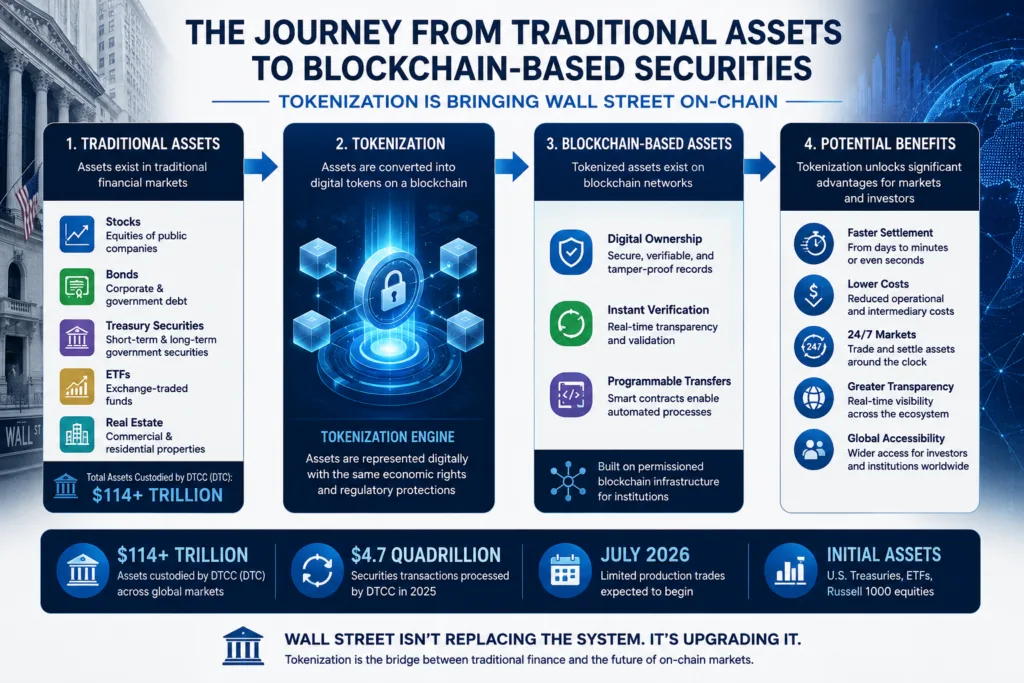
Its depository subsidiary, DTC, currently provides custody and asset servicing for more than $114 trillion worth of securities.
| Metric | Value |
|---|---|
| Assets Custodied by DTCC (DTC) | $114+ Trillion |
| Securities Transactions Processed (2025) | $4.7 Quadrillion |
| Initial Assets Expected for Tokenization | U.S. Treasuries, ETFs, Russell 1000 Stocks |
| Expected Initial Production Launch | 2026 |
| Main Benefit | Faster settlement and operational efficiency |
That number is larger than the annual GDP of every country on Earth combined.
And now, portions of that infrastructure are beginning to move on-chain.
Why DTCC Matters More Than Most Crypto Companies
Most people have never heard of DTCC.
Yet nearly every stock trade in the United States eventually passes through systems operated by the organization.
According to DTCC, its subsidiaries processed approximately $4.7 quadrillion in securities transactions during 2025, making it one of the most important pieces of financial infrastructure in the world.
When Bitcoin launched in 2009, its goal was to create an alternative financial system.
Seventeen years later, Wall Street appears to be taking a different approach: rather than replacing financial infrastructure, it is gradually rebuilding that infrastructure using blockchain technology.
The distinction is important.
Instead of asking investors to leave traditional finance behind, institutions are exploring ways to bring traditional assets directly onto blockchain networks.
The Shift From Crypto Assets to Real-World Assets
For years, the crypto industry focused primarily on digital-native assets.
Bitcoin represented digital money.
Ethereum enabled decentralized applications.
Thousands of tokens emerged around various use cases.
Now, attention is increasingly shifting toward tokenized real-world assets (RWAs).
Tokenization involves creating a blockchain-based representation of an existing asset such as stocks, bonds, Treasury securities, commodities, or real estate.
Supporters argue that tokenization can unlock several advantages:
- Faster settlement times
- Reduced operational costs
- Increased transparency
- Extended trading hours
- Greater asset mobility
- Improved global accessibility
Major financial institutions including BlackRock, JPMorgan, Franklin Templeton, Goldman Sachs, and Citi have all expanded their tokenization initiatives over the past several years.
What makes the DTCC announcement different is scale.
Rather than tokenizing a single fund or testing a limited pilot, DTCC is building infrastructure capable of supporting assets already embedded within the global financial system.

Wall Street Is Building the Rails
DTCC’s tokenization service is scheduled for limited production trades in July 2026, with a broader launch expected later in the year.
The service will initially support selected highly liquid assets, including:
- Russell 1000 equities
- Major ETF products
- U.S. Treasury securities
Importantly, tokenized versions of these assets are expected to maintain the same ownership rights, investor protections, and regulatory safeguards as their traditional counterparts.
In other words, Wall Street is not trying to create a parallel financial universe.
It is attempting to modernize the existing one.
This is a significant distinction from many earlier crypto experiments that sought to operate outside traditional financial structures.
Why Investors Should Care
The rise of tokenization does not necessarily mean cryptocurrencies will replace traditional markets. Instead, it suggests blockchain technology is becoming a foundational layer for financial infrastructure.
For investors, the trend could create opportunities across several sectors, including:
- Blockchain infrastructure providers
- Digital asset custodians
- Stablecoin issuers
- Tokenization platforms
- Traditional financial institutions adopting blockchain technology
As more real-world assets move on-chain, the distinction between traditional finance and crypto may continue to fade.
Bigger Than Bitcoin?
At first glance, comparing tokenization to Bitcoin may seem excessive.
Bitcoin remains the world’s largest cryptocurrency and one of the most successful financial innovations of the modern era.
However, Bitcoin’s current market capitalization remains only a fraction of the value represented by global securities markets.
The question is not whether all $114 trillion in DTCC-custodied assets will move on-chain.
They will not.
At least not anytime soon.
The more important question is this:
What happens if even a small percentage does?
If just 1% of DTCC’s custodial assets eventually become tokenized, that would represent approximately $1.14 trillion worth of blockchain-based securities.
Even a 0.1% migration would amount to more than $100 billion.
Those figures dwarf many segments of today’s crypto economy.
The Road Ahead
Despite growing momentum, tokenization is far from guaranteed success.
Regulators continue to examine the risks associated with blockchain-based securities.
Industry groups have also raised concerns regarding liquidity, interoperability, investor protections, and operational complexity.
Recent academic research has further suggested that tokenization alone does not automatically improve liquidity. Simply placing an asset on-chain does not guarantee active trading or efficient markets.
These challenges remain significant.
However, the direction of travel is becoming increasingly difficult to ignore.
What began as isolated blockchain experiments has evolved into coordinated efforts involving some of the world’s largest banks, asset managers, exchanges, and market infrastructure providers.
The conversation is no longer about whether traditional finance will engage with blockchain technology.
It already is.
The Bigger Picture
Crypto investors often focus on visible milestones such as ETF approvals, exchange listings, and token launches.
Yet history suggests that the largest technological shifts are often driven by infrastructure rather than headlines.
The internet was not transformed by websites alone. It was transformed by fiber networks, data centers, and payment systems.
Electricity was not just about light bulbs. It was about the grid.
Likewise, blockchain’s most important contribution may not be cryptocurrencies themselves.
It may be the financial infrastructure quietly emerging beneath them.
While investors debate Bitcoin’s next move, Wall Street is building something potentially much larger: a blockchain-based settlement layer for traditional finance.
And unlike most crypto stories, this one is measured not in billions, but in trillions.