For years, XRP’s investment story has revolved around a single idea: cross-border payments.
Supporters have long argued that XRP could help financial institutions move money faster and more efficiently across borders, reducing the friction and costs associated with traditional payment systems.
That narrative remains central to XRP’s identity.
However, a quieter transformation is taking place across global finance—one that could ultimately prove just as important for XRP’s future.
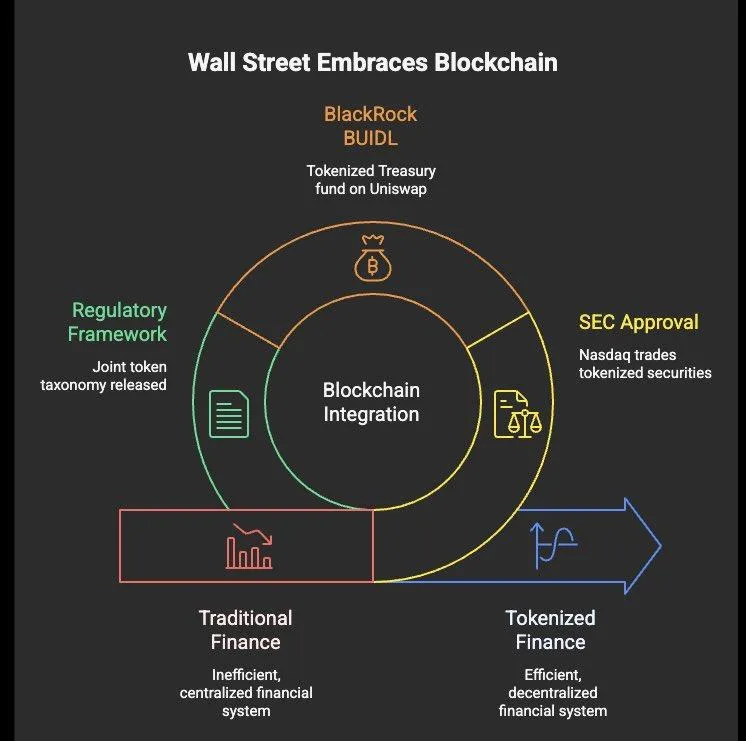
While much of the crypto market remains focused on Bitcoin ETFs, stablecoins, and short-term price movements, Wall Street is investing heavily in a different trend: tokenization.
From major asset managers to market infrastructure providers, institutions are increasingly exploring how stocks, bonds, Treasury securities, money market funds, and other real-world assets can be represented on blockchain networks.
If tokenization becomes one of the defining financial shifts of the next decade, XRP Ledger may have an opportunity that extends far beyond payments.
| Category | Why It Matters |
|---|---|
| XRP Ledger | Built for fast, low-cost settlement |
| Tokenization | Converting real-world assets into blockchain-based assets |
| Ripple Strategy | Expanding beyond payments into custody and infrastructure |
| Key Competitors | Ethereum, Solana, private bank blockchains |
| Long-Term Opportunity | Tokenized stocks, bonds, treasuries, and funds |
Wall Street’s New Blockchain Obsession
The tokenization movement has gained significant momentum over the past several years.
Some of the world’s largest financial institutions have launched blockchain-based initiatives designed to bring traditional assets on-chain.
Asset managers such as BlackRock and Franklin Templeton have introduced tokenized investment products. Major banks, including JPMorgan, have conducted tokenization pilots. Market infrastructure organizations are also exploring how blockchain technology can improve settlement and asset servicing.
The appeal is straightforward.
Tokenized assets can potentially offer:
- Faster settlement times
- Increased transparency
- Reduced operational costs
- Greater efficiency
- Improved accessibility
- Around-the-clock transaction capabilities
Rather than replacing traditional finance, many institutions are looking to modernize it.
The result is a growing belief that blockchain technology could become part of the infrastructure supporting future financial markets.
Why XRP Ledger Could Benefit
When investors think about XRP Ledger, they often focus on its role in payments.
Yet the network contains several features that make it relevant to tokenized asset markets as well.
XRP Ledger was designed with fast transaction finality, low fees, and built-in asset issuance capabilities. The network also includes a native decentralized exchange that allows issued assets to be traded directly on-chain.
These characteristics have led some institutions and developers to explore XRP Ledger for tokenization use cases.
In practical terms, tokenization allows real-world assets to be represented digitally on a blockchain.
Examples may include:
- Government bonds
- Corporate debt
- Investment funds
- Commodities
- Real estate interests
- Other financial instruments
As demand for tokenized assets grows, the value of blockchain networks may increasingly be measured by their ability to support these markets efficiently.
Ripple Is Building More Than a Payments Company
Another reason investors are paying closer attention to tokenization is Ripple’s broader strategic direction.
Over the years, Ripple has expanded beyond payment-focused solutions.
The company has invested in custody services, institutional infrastructure, enterprise blockchain solutions, and more recently, stablecoin initiatives.
This evolution suggests Ripple sees opportunities beyond payment settlement alone.
Instead of operating solely as a cross-border payments company, Ripple increasingly appears to be positioning itself as a provider of digital financial infrastructure.
If tokenized assets become a larger part of global markets, custody, settlement, compliance, and asset servicing could become major growth areas.
These developments may create new opportunities for networks associated with institutional adoption.
The Market Opportunity Is Massive
The scale of the tokenization opportunity helps explain why institutions are paying attention.
Global financial markets are measured in the hundreds of trillions of dollars.
Equity markets, bond markets, money market funds, real estate assets, and government securities collectively represent enormous pools of capital.
No credible analyst expects all of these assets to move on-chain.
However, even a small percentage could create a market worth trillions of dollars.
For blockchain networks, the opportunity extends beyond transaction fees.
Networks that become trusted infrastructure for tokenized assets could benefit from increased activity, deeper liquidity, broader institutional participation, and stronger ecosystem development.
This is one reason tokenization is increasingly viewed as one of the most important long-term themes in digital assets.
XRP Faces Serious Competition
Despite the opportunity, XRP Ledger is far from alone.
Ethereum currently leads the tokenized asset market and has attracted significant institutional interest.
Other networks, including Solana and various permissioned blockchain platforms, are also competing for market share.
Traditional financial institutions are developing proprietary blockchain systems as well.
In addition, regulatory requirements, interoperability challenges, and adoption barriers remain important considerations.
The tokenization market is still in its early stages, and no single blockchain has emerged as the definitive winner.
For XRP Ledger, success will depend on continued adoption, ecosystem growth, technological development, and the ability to attract institutional participants.
Why Investors Should Pay Attention
For years, XRP’s value proposition focused primarily on payments.
Tokenization introduces a second narrative.
If financial institutions increasingly move securities, funds, and other assets onto blockchain networks, the winning blockchains may benefit from:
- Greater transaction volume
- Institutional adoption
- Increased liquidity
- Broader ecosystem growth
- New enterprise use cases
This does not guarantee XRP will become a dominant tokenization platform, but it does expand the discussion beyond cross-border payments.
The Bigger Question for XRP Investors
For much of its history, XRP has been viewed primarily through the lens of payments.
But the financial landscape is evolving.
As Wall Street increases its focus on tokenized assets, investors may eventually begin evaluating blockchain networks on a broader set of criteria.
The question may no longer be which network moves money the fastest.
Instead, it may become which networks can help support the next generation of digital financial markets.
If tokenization becomes a multi-trillion-dollar industry, XRP Ledger’s future could be influenced as much by digital asset infrastructure as by payment settlement.
That possibility represents a different way of thinking about XRP—one that extends beyond cross-border transfers and into the foundations of tomorrow’s financial system.
Whether XRP ultimately captures a meaningful share of that opportunity remains uncertain.
What is becoming increasingly clear, however, is that the conversation around XRP may be getting much bigger than payments alone.
About the Author