



- USDC is a dollar-denominated stablecoin issued by Circle and designed to maintain a 1:1 value with the U.S. dollar.
- It is widely used for crypto trading, DeFi, payments and cross-border transfers, but users should understand its reserves, risks and regulatory considerations.
USDC, or USD Coin, is a dollar-denominated stablecoin designed to maintain a value of $1. Unlike cryptocurrencies such as Bitcoin and Ethereum, USDC is not designed for price appreciation. Instead, it provides a digital representation of the U.S. dollar that can be transferred and used across blockchain networks.
USDC has become an important part of the crypto and digital payments ecosystem, with uses ranging from trading and decentralized finance (DeFi) to business payments and cross-border transfers. Circle, the company that issues USDC, says the stablecoin is backed by highly liquid cash and cash-equivalent assets and is redeemable 1:1 for U.S. dollars.
But what exactly is USDC, how does it maintain its $1 value, what backs it, and is it safe to use? This guide explains how USDC works, where it can be used, its benefits and risks, and how it compares with other major stablecoins.
What Is USDC?
What Is USDC?
| Question | Answer |
|---|---|
| What does USDC stand for? | USD Coin |
| What is USDC? | A U.S. dollar-denominated stablecoin |
| Who issues USDC? | Circle |
| What is USDC designed to be worth? | $1 |
| Is USDC a cryptocurrency? | Yes, it is a stablecoin |
| What backs USDC? | Cash and cash-equivalent assets, including short-term U.S. Treasuries |
| Can USDC be used for payments? | Yes |
| Does USDC operate on multiple blockchains? | Yes |
USDC is a dollar-backed stablecoin created to maintain a value of $1. It allows users to access the benefits of blockchain technology while avoiding the extreme price fluctuations seen in many cryptocurrencies.
USD Coin was launched in 2018 by Circle and Coinbase through the Centre Consortium. Today, Circle manages the issuance of USDC and provides regular updates about its reserves.
Unlike traditional cryptocurrencies, USDC is not designed for price growth. Instead, it functions as a digital version of the U.S. dollar that can be transferred globally through blockchain networks.
How Does USDC Work?
Lets break down the stablecoin works in 3 ways:
Issuance
When USDC is issued, dollars or eligible reserve assets enter the reserve structure and corresponding USDC is created.
Redemption
When USDC is redeemed, the corresponding tokens are removed from circulation and the holder receives U.S. dollars subject to Circle’s applicable redemption terms.
Maintaining the $1 value
The key idea is that USDC is designed to be redeemable 1:1 for USD and backed by reserves.
Circle currently states that USDC is redeemable 1:1 and that the majority of its reserve is invested in the Circle Reserve Fund, an SEC-registered government money-market fund.
Why Is USDC Used?
USDC is widely used across the crypto ecosystem because it provides a stable way to transfer and manage digital dollars.
- Crypto Trading: Traders use USDC to reduce exposure to market volatility. Instead of converting crypto holdings into traditional currency, they can move funds into USDC while remaining within the crypto market.
- Decentralized Finance (DeFi): USDC is commonly used in DeFi platforms for lending, borrowing, liquidity provision, and decentralized trading.
- Cross-Border Payments: Businesses and individuals use USDC for international transfers because blockchain transactions can settle faster than traditional banking methods.
- Business Payments and Settlements: Companies can use USDC for digital payments, settlements, and financial operations without relying solely on traditional payment networks.
- Tokenized Finance: Financial institutions can use USDC to support blockchain-based financial products, including tokenized assets and digital securities.
What Backs USDC?
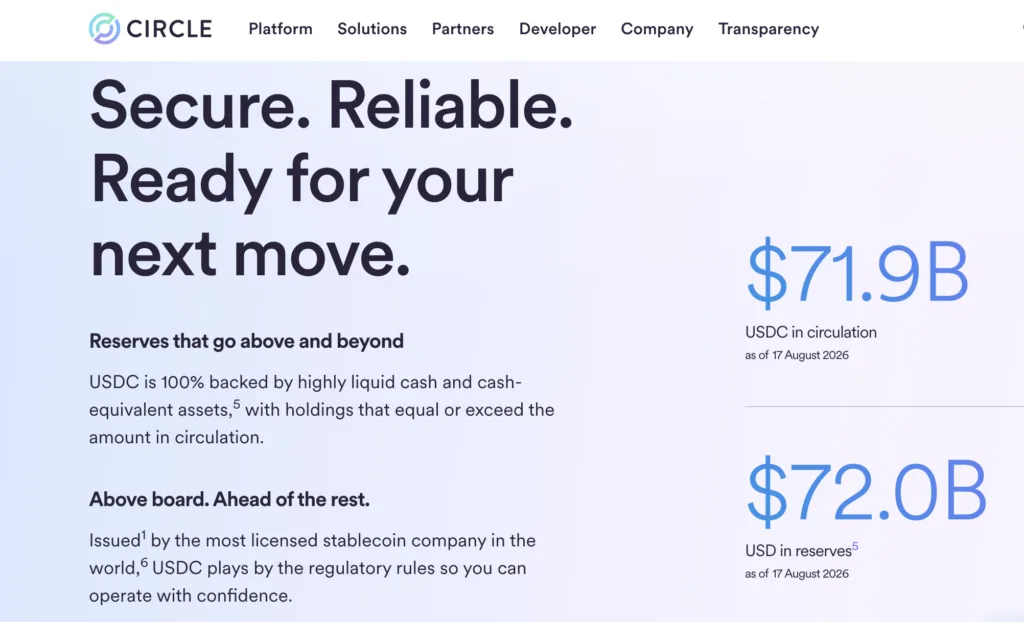
USDC is designed to be fully backed by highly liquid reserve assets rather than by a cryptocurrency such as Bitcoin or Ethereum. Circle says the reserves include cash and cash-equivalent assets, with a large portion held through the Circle Reserve Fund, a government money-market fund managed by BlackRock. Circle also publishes reserve information and monthly third-party attestations

Benefits of USDC
USDC has gained popularity because it combines the stability of the U.S. dollar with the speed and flexibility of blockchain technology.
- Price Stability: USDC is designed to maintain a value of $1, helping users avoid the sharp price fluctuations common in many cryptocurrencies.
- Fast and Global Transfers: Users can send USDC worldwide at any time without relying on traditional banking hours or lengthy settlement processes.
- Multi-Chain Support: USDC is available across dozens of blockchain networks. Circle’s current documentation lists more than 30 networks supporting native USDC, including Ethereum, Solana, Base, Arbitrum, Avalanche, Polygon, XRP Ledger, Stellar and Sui.
- Transparency: Circle regularly shares information about USDC reserves, helping users and institutions better understand how the stablecoin is backed.
- Wide Adoption: USDC is supported by many crypto exchanges, wallets, payment platforms, and DeFi applications, making it easy to access and use.
Risks of Using USDC
Although USDC is one of the most established stablecoins, it is not completely risk-free. Users should understand the potential challenges before relying on it for payments, trading, or storing value.
1. Reserve and Regulatory Risks
USDC depends on Circle’s ability to maintain adequate reserves and comply with financial regulations. Changes in stablecoin laws or financial policies could affect how USDC is issued, accessed, or used in different regions.
2. Temporary Loss of Dollar Peg
USDC is designed to maintain a $1 value, but it can experience temporary price fluctuations during periods of market stress. In March 2023, USDC briefly traded below its dollar peg after concerns emerged about Circle’s exposure to Silicon Valley Bank. The stablecoin later recovered after Circle confirmed access to its reserve funds.
The event showed that even reserve-backed stablecoins can face short-term disruptions during times of financial uncertainty.
3. Blockchain and Security Risks
Because USDC operates on blockchain networks, users may face risks such as network congestion, transaction fees, smart contract vulnerabilities, or losing access to their wallets. Using trusted platforms and securing private wallet information can help reduce these risks.
Where Can You Use USDC?
- Crypto exchanges
- DeFi
- International payments
- Business payments
- Remittances
- Treasury management
- Stablecoin corporate cards
- Tokenized financial applications
- Cross-border settlement
Businesses are also increasingly exploring USDC for corporate spending, including stablecoin-backed corporate cards that connect digital-dollar balances with traditional payment networks.
Is USDC the Same as a U.S. Dollar?
No.
USDC is a cryptocurrency designed to represent a U.S. dollar on blockchain networks. It is not a U.S. government-issued dollar, bank deposit or Federal Reserve digital currency.
USDC vs Other Stablecoins
USDC is one of the leading stablecoins alongside other dollar-pegged assets. However, it is often recognized for its focus on regulatory compliance, transparency, and institutional adoption.
While stablecoins share similar goals, they may differ in how they manage reserves, operate, and comply with regulations.
USDC vs USDT
| Feature | USDC | USDT |
|---|---|---|
| Issuer | Circle | Tether |
| Peg | U.S. dollar | U.S. dollar |
| Primary use | Payments, trading, DeFi, institutions | Trading, payments, liquidity |
| Reserve model | Cash and cash-equivalent assets | Reserve assets disclosed by Tether |
| Multi-chain | Yes | Yes |
| Main distinction | Strong emphasis on transparency and regulated financial infrastructure | Largest stablecoin by market presence |
Is USDC Safe?
USDC is designed to maintain a stable $1 value and is backed by reserve assets, but it is not risk-free.
Depeg risk
USDC briefly fell below $1 in March 2023 following concerns surrounding Silicon Valley Bank.
Issuer/counterparty risk
Users depend on Circle and the financial institutions involved in the reserve and redemption infrastructure.
Regulatory risk
Stablecoin rules can affect how USDC is issued, distributed and used in different jurisdictions.
Blockchain risk
Sending USDC to the wrong network or address can result in permanent loss.
Wallet risk
Users can lose funds through compromised private keys or phishing.
How to Buy USDC
Buying USDC is basically the same across platforms.
- Choose a reputable exchange or financial platform.
- Complete required identity verification.
- Deposit fiat.
- Purchase USDC.
- Withdraw to a compatible wallet if necessary.
- Confirm the blockchain/network before sending.
Warning: Always check the network before transferring USDC. USDC on one blockchain is not necessarily interchangeable with another version without the appropriate infrastructure.
The Future of USDC
As blockchain adoption continues to expand, USDC is expected to remain an important part of digital payments, decentralized finance, and tokenized financial systems.
The growing demand for digital dollars suggests that stablecoins like USDC could play a larger role in global payments and financial services.
Final Thoughts
USDC has become a key part of the cryptocurrency ecosystem by combining the stability of the U.S. dollar with the speed and accessibility of blockchain technology.
From crypto trading and DeFi to international payments and business transactions, USD Coin provides a practical way to move digital value. However, users should still understand the risks, including regulatory changes, reserve concerns, and potential temporary price disruptions.
Understanding how USDC works can help individuals and businesses make better decisions when using one of the most widely adopted stablecoins in the market.
ALSO READ: Could AI Agents Become the Next Major Users of Cryptocurrency?
Frequently Asked Questions (FAQs) About USDC
USDC is a dollar-backed stablecoin designed to maintain a value close to $1. It is issued by Circle and is widely used for crypto trading, payments, and DeFi.
Yes. USDC is a cryptocurrency, but unlike Bitcoin or Ethereum, it is designed to maintain a stable value rather than fluctuate significantly in price.
USDC is designed to stay close to $1, but it can temporarily trade above or below $1 due to market conditions, liquidity, or other factors.
USDC is backed by reserves consisting primarily of cash and short-duration U.S. government obligations and is intended to be redeemable 1:1 for U.S. dollars.
USDC is issued by Circle, a financial technology company focused on digital currencies and blockchain-based payments.
USDC is generally considered one of the major regulated stablecoins, but it is not risk-free. Users should consider issuer, reserve, regulatory, smart-contract, and market risks.
Yes. USDC can temporarily move away from its $1 target. In extreme market conditions, liquidity problems or concerns about reserves could put additional pressure on its peg.
USDC is used for crypto trading, digital payments, transferring funds, DeFi applications, remittances, and moving dollar-denominated value across blockchain networks.
USDC is available through many major cryptocurrency exchanges and wallets. Availability depends on the platform and the user’s location.
USDC and USDT are both dollar-pegged stablecoins, but they are issued by different companies and have differences in reserves, regulation, transparency, supported networks, and market adoption.
Disclaimer:
This article is for educational purposes only and does not constitute financial advice. Always conduct your own research and assess the risks before using or investing in digital assets.