


- XRP supply on exchanges is tightening as ETF inflows continue to build strong institutional demand.
- However, price remains capped below the $1.50–$1.52 resistance zone despite improving spot buying.
The market structure around XRP is shifting as exchange supply continues to shrink while institutional demand builds through ETF inflows. Despite improving spot demand conditions, price action remains capped under key resistance near $1.50. The result is a tightening setup where supply pressure and selling resistance are both active at the same time.
Exchange reserves drop signals tightening supply
XRP reserves on Binance have declined to about 2.70 billion XRP, marking the lowest level in nearly three months. Earlier in 2025, reserves were closer to 3.0 billion XRP while prices traded above $3.0.

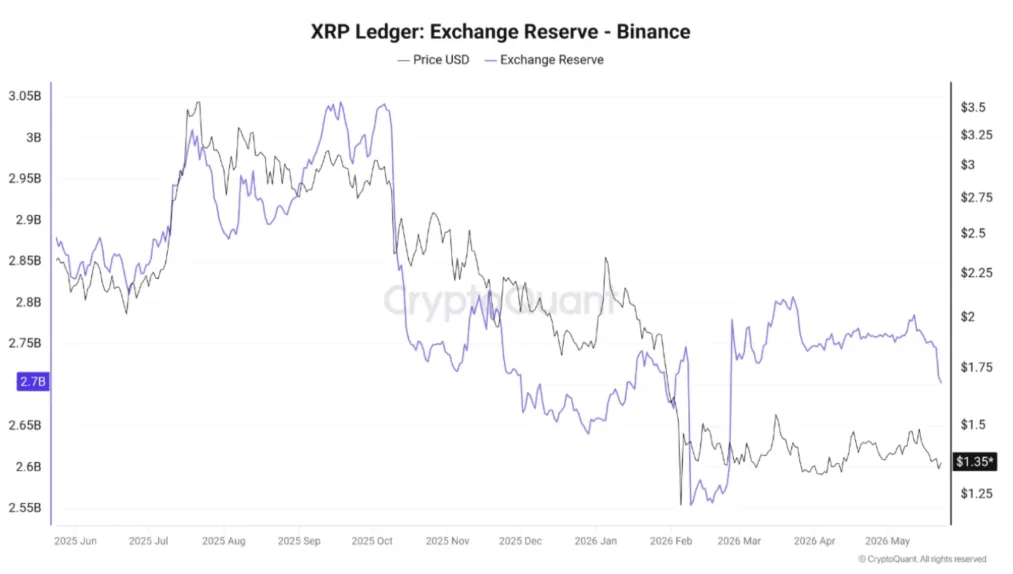
This steady decline shows that more holders are moving assets off exchanges. That typically reduces immediate sell-side liquidity. However, lower reserves alone do not guarantee a strong price breakout, especially when trading activity is still relatively soft.
The current structure reflects a market where available supply is tightening, but participation remains uneven.
ETF inflows strengthen institutional demand
Institutional interest has become a major driver of XRP spot demand. ETF inflows have added consistent pressure on available supply, with no recorded outflow sessions in recent periods.
Recent data shows strong accumulation patterns:
- Around $18.52 million inflows in earlier sessions
- About $10.87 million was added in subsequent sessions
- Roughly $9.47 million was recorded on May 22 alone
Cumulative inflows have reached approximately $1.41 billion, with ETF-held XRP exceeding $1.13 billion. Around 898 million XRP is now estimated to be locked within ETF products.

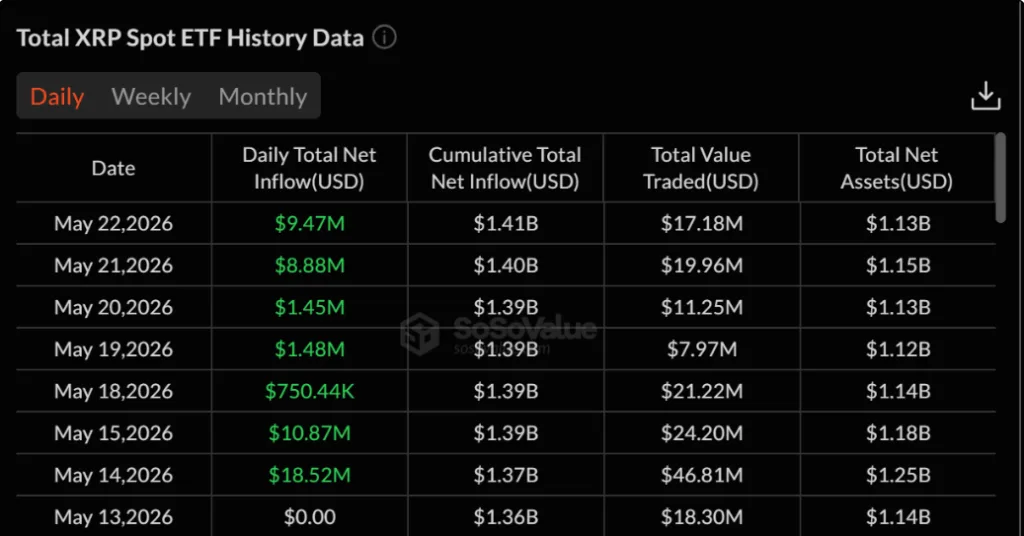
This steady accumulation reduces circulating liquidity and supports stronger long-term positioning in the market.
Resistance at $1.50 slows breakout attempts
Despite tightening supply conditions, XRP continues to struggle near the $1.50 to $1.52 resistance zone. Sellers remain active at these levels, limiting upward continuation.
Spot buying activity has improved, but it has not yet been strong enough to absorb overhead selling pressure. This has led to repeated consolidation phases rather than a clear breakout.
The market structure suggests that resistance is still controlling short-term price direction, even as supply conditions become more constrained.
What comes next for XRP
The next major move for XRP will depend on whether ETF-driven demand continues to absorb available supply at a faster pace. If inflows remain steady and resistance weakens, price discovery above $1.50 becomes more likely. If selling pressure persists, consolidation may continue even under tighter supply conditions.
The setup now reflects a balanced market where both demand strength and overhead resistance are shaping direction.
ALSO READ: Why Institutions Are Still Accumulating Bitcoin Despite Market Volatility
DISCLAIMER:
The views and opinions expressed herein are solely those of the author and do not necessarily reflect the views of the publisher. The publisher does not endorse or guarantee the accuracy of any information presented in this article. Readers are encouraged to conduct further research and consult additional sources before making any decisions based on the content provided.