


- XRP fell 2.45% as a stronger US dollar, higher Treasury yields, and weaker institutional demand reduced investor appetite.
- Long liquidations and ongoing regulatory uncertainty also added pressure to the price.
XRP extended its losses on August 6 as investors pulled back from risk assets amid a stronger US dollar and rising US Treasury yields. XRP fell 2.45% over the past 24 hours to $1.0433, bringing its seven-day decline to 3.86%.

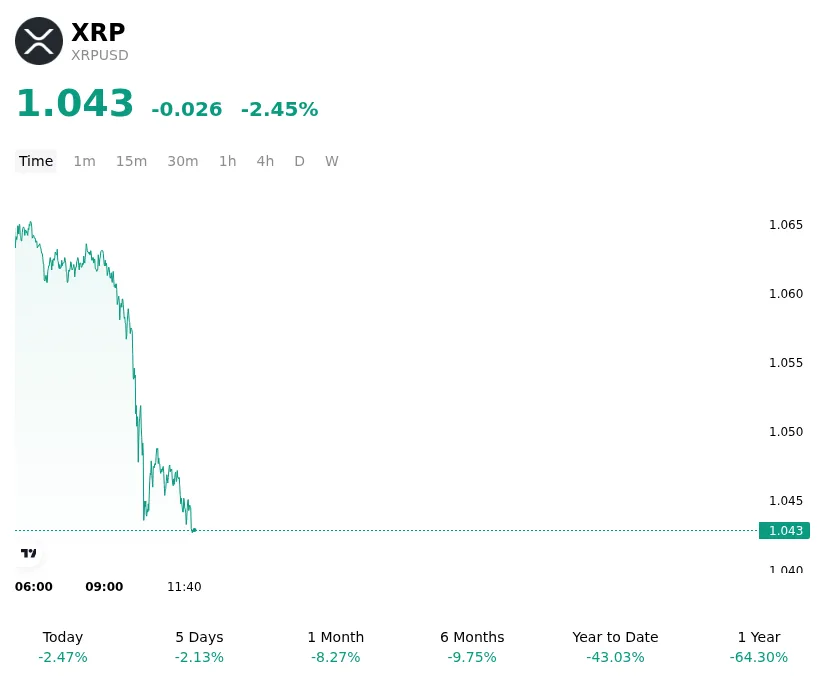
The latest pullback comes as several factors weigh on market sentiment, including macroeconomic pressure, slower institutional buying, and increased selling in the derivatives market. Here’s a closer look at what is driving XRP lower.
Stronger Dollar Reduces Demand for Risk Assets
One of the main reasons behind XRP’s decline is the changing macroeconomic environment. The US dollar has strengthened while Treasury yields have climbed following expectations that the Federal Reserve will keep interest rates higher for longer.
Higher yields make government bonds more attractive, encouraging investors to move money away from higher-risk assets such as cryptocurrencies. As liquidity tightens across financial markets, buying activity has slowed, putting additional pressure on XRP and other digital assets.
XRP is particularly sensitive to broader market sentiment because institutional investors often reduce exposure to cryptocurrencies during periods of economic uncertainty. As a result, even without negative news directly related to Ripple, the token has struggled to maintain recent gains.
Institutional Buying Has Lost Steam
Another factor weighing on XRP is the slowdown in institutional accumulation.
Large investors, commonly known as whales, have reduced their activity after weeks of steady buying. On-chain data suggests many are choosing to wait for fresh developments before increasing their positions again.
Investors are also watching for progress on global stablecoin regulations and new use cases for the XRP Ledger. The lack of major announcements in recent weeks has weakened the bullish narrative that previously supported XRP’s price.
At the same time, capital has continued flowing into assets such as Bitcoin and Ethereum, which have benefited from stronger institutional catalysts. That shift has left XRP facing relatively weaker demand.
Long Liquidations Increased Selling Pressure
The decline accelerated after XRP slipped below key technical support levels.
Many traders had opened leveraged long positions, expecting prices to continue climbing. When the market moved lower instead, exchanges automatically closed those positions to cover losses, creating a wave of forced selling.
This chain reaction, commonly known as a long squeeze, pushed XRP even lower despite no major change in its underlying fundamentals. Recent growth in leveraged positions had already made the market vulnerable to a sharp correction once selling began.
Regulatory Uncertainty Still Clouds the Market
Although Ripple has secured important legal victories in recent years, regulatory uncertainty continues to influence investor sentiment.
Market participants remain focused on the SEC’s ongoing remedies phase, which could affect Ripple depending on the final outcome. Until there is greater clarity, some institutional investors are choosing to remain on the sidelines.
Meanwhile, changing compliance requirements for digital payment providers in several countries are prompting firms to reassess their exposure to XRP. Reports of XRP transfers from Ripple-linked wallets and escrow releases to exchanges have also raised concerns that additional supply could temporarily weigh on prices.
XRP Technical Outlook
Technical indicators suggest bearish pressure remains in the short term, but they also hint that selling may be becoming overstretched.
The MACD continues to flash a sell signal, reflecting weak price momentum. Meanwhile, the Relative Strength Index (RSI) sits near 39, showing XRP is approaching oversold territory without reaching extreme levels.
The Williams %R indicator also points to oversold conditions, suggesting sellers may be losing strength. However, traders will likely want to see stronger buying volume and a move back above key support levels before confirming a sustained recovery.
Outlook
XRP remains under pressure as macroeconomic headwinds, weaker institutional demand, and leveraged liquidations continue to weigh on the market. Regulatory developments and broader investor sentiment are likely to determine the next major price move.
If market conditions improve and institutional buyers return, XRP could recover lost ground. Until then, traders should expect volatility to remain elevated as the market searches for a new direction.
ALSO READ: Uniswap v4 Secures 50% of Quarterly DEX Volume 18 Months After Launch
DISCLAIMER:
The views and opinions expressed herein are solely those of the author and do not necessarily reflect the views of the publisher. The publisher does not endorse or guarantee the accuracy of any information presented in this article. Readers are encouraged to conduct further research and consult additional sources before making any decisions based on the content provided.