



For years, XRP has been one of the most polarizing assets in crypto. Its price cycles were dramatic. Legal battles were dominating headlines for years. The community was vocal as always, but beneath all this, something more structural has been happening. Things have changed as XRP institutional adoption increases, regulatory clarity improves, and liquidity infrastructure expands.
The question is no longer whether XRP can outperform in the next retail rally. The more interesting question is whether XRP is ready for a functional liquidity asset in the global financial system.
Historically, XRP’s market narrative revolved around price movements and, of course, regulatory developments. Retail participation amplified its volatility, and much of the coverage focused on short-term momentum rather than long-term infrastructure.
Today, many of the micro factors that really define XRP are increasingly becoming the factors. Some of them include:
- Cross-border settlement efficiency
- Liquidity provisioning
- Payment corridor optimization
- Institutional integration potential
XRP is being evaluated more and more in terms of how it fits into global value transfer systems. How this is a positive for XRP is that assets tied to infrastructure adoption often experience slower but more durable growth trajectories. XRP is already dominant. The only thing it’s doing now is maintaining and growing around that dominance.
And in the line of ensuring growth, shortly after the SEC dropped its claims in October 2023 against Ripple Chief Executive Brad Garlinghouse and Executive Chairman Chris Larsen, following a judge’s partial ruling in the company’s favor, Ripple began focusing on product expansion. By December 17, 2024, the company launched RLUSD with approval from the New York Department of Financial Services (NYDFS).
Could Ripple be Reinventing Itself Through the Introduction of RLUSD as Part of a Broader Liquidity Strategy?
Another development that fits into XRP’s gradual repositioning is the introduction of RLUSD, a U.S. dollar–pegged stablecoin launched by Ripple.
Its timing was notable. RLUSD was introduced during a period when regulatory scrutiny around XRP remained elevated. While public attention centered on legal proceedings, Ripple expanded its product stack in a different direction — into regulated, dollar-denominated stable settlement infrastructure.
XRP has long been positioned as a bridge asset designed to move value efficiently across borders. RLUSD adds a stable, dollar-based instrument that can integrate more seamlessly into institutional balance sheet frameworks. Together, they form a more flexible liquidity architecture: one asset optimized for transfer efficiency, the other for price stability.
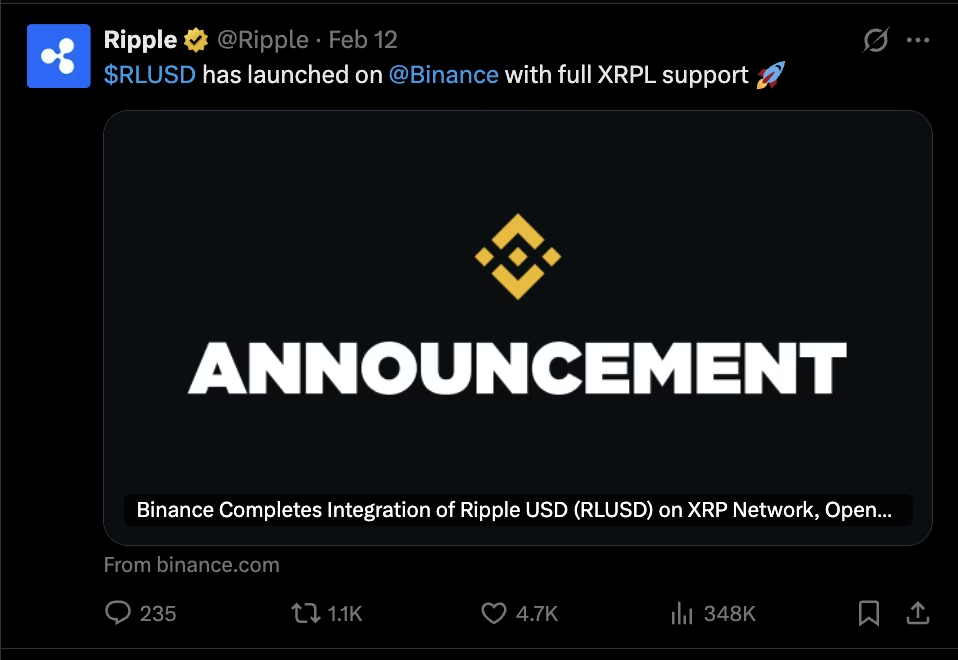
Rather than reacting defensively to legal pressure, the ecosystem expanded horizontally. RLUSD has been actively growing with major announcements basically happening now and then.

The Legal Overhang Is No Longer a Constraint
One of the most significant barriers to institutional consideration was legal uncertainty. For years, that overhang shaped perception as much as price.
But as regulatory positioning matured, institutions could begin reassessing exposure risk.
Usually, Institutions do not allocate capital to unresolved structural risk. Once ambiguity begins to lift, due diligence replaces hesitation.
The result is not instant price acceleration. Instead, it creates the foundation for strategic integration discussions — a much quieter but potentially more meaningful phase.
In the newest Crypto In One Minute, Ripple's Chief Legal Officer @s_alderoty explains why the SEC dropped its appeal against Ripple in March 2025, and where the US is going with smart crypto regulation on the horizon: https://t.co/HJ4wTBWDmx
🔒 Protecting consumers
🟢… pic.twitter.com/KD9bi66sGI— Ripple (@Ripple) May 2, 2025
Cross-border Solution
In traditional finance, cross-border transactions often rely on correspondent banking networks. These systems can be slow, capital-intensive, and operationally complex. Pre-funded accounts in multiple jurisdictions tie up liquidity and increase costs.
The XRP model introduces a different approach: on-demand liquidity.
Instead of pre-funding accounts globally, value can be bridged through a digital asset that settles quickly and can be converted into local currency at the destination.
In theory, this reduces idle capital and increases transaction speed.
Institutions evaluating cross-border solutions are less concerned with token narratives and more focused on:
- Liquidity depth
- Settlement finality
- Market stability
- Regulatory compatibility
That shift in evaluation criteria subtly changes XRP’s investor base profile.
Institutional Adoption Is Quiet by Nature
One misconception in crypto markets is that adoption must be loud to be meaningful.
Retail cycles are loud. Institutional integration is not.
Banks and financial entities do not announce exploratory pilots with social media enthusiasm. They move cautiously, test privately, and scale gradually.
This makes XRP’s institutional narrative less visible compared to trend-driven tokens. It also makes it easier for markets to overlook incremental structural progress.
Quiet adoption can be mistaken for stagnation.
In reality, it may signal maturation.
Reputation
Reputation in financial markets evolves slowly.
XRP’s identity was tied heavily to courtroom narratives and speculative rallies. That identity shaped perception even among those who never analyzed the underlying use case.
Reinvention rarely happens through a rebrand. It happens through the repetition of a different story.
Increasingly, that story is about liquidity corridors rather than legal drama. About infrastructure rather than hype.
The shift is subtle — but it’s measurable in tone.
More analysis now frames XRP within discussions of:
- Cross-border settlement modernization
- Institutional blockchain usage
- Digital asset liquidity provisioning
Less emphasis is placed purely on retail breakout cycles.
The Risk Factors
A sophisticated analysis must also address the risks.
XRP’s institutional thesis depends on:
- Sustained regulatory compatibility
- Sufficient liquidity depth
- Continued relevance of cross-border optimization
- Competition from alternative blockchain solutions
The cross-border space is not uncontested. Other blockchain networks are also positioning themselves as settlement layers. Additionally, traditional finance is modernizing independently through internal digital rails.
Institutional positioning is not guaranteed permanence. It must be defended through reliability and scalability.