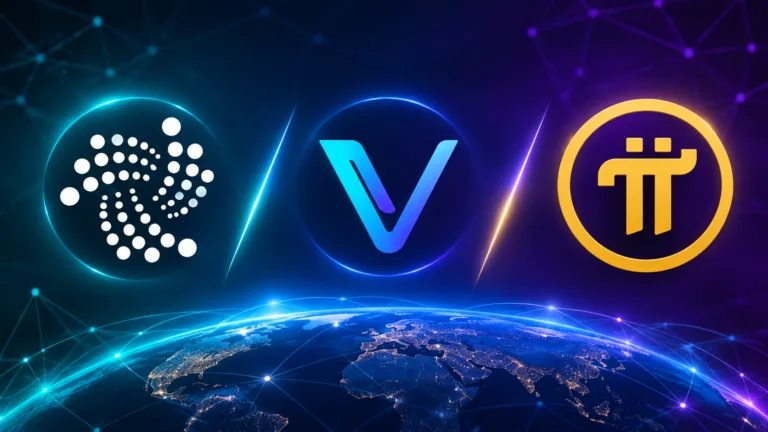
IOTA, VeChain and Pi Network have spent years building their portifolio in the cryptocurrency market. Each has a different vision. Each has attracted a dedicated community.
Yet all three face the same challenge.
Are these projects still worth holding for the long term, or are newer crypto projects offering better opportunities?
There are reasons to remain interested in all three. For instance; IOTA is developing its blockchain infrastructure and trade-focused applications. VeChain is expanding its enterprise and smart contract capabilities. Pi Network is working to turn its large user community into an active digital economy.
While, progress does not automatically translate into higher token prices, investors must also consider thing like token supply, actual network usage, competition and the demand for each cryptocurrency.
Here is where the three projects stand in November 2026.
Has IOTA’s technology finally caught up with the vision?
IOTA has gone through several changes since its early days. one of the projects is Tangle technology and ambitions to support the Internet of Things.
Its direction has since evolved. IOTA now operates as a Layer 1 blockchain with smart contract capabilities and a broader focus on digital trade infrastructure.
One of its more important developments in 2026 has been the Starfish-Speed upgrade.
According to IOTA’s Q3 2026 progress report, Starfish-Speed reached mainnet in September. As we covered, the network conditions allow, validators can commit blocks one round earlier. This is intended to improve transaction finality.
The network has also made progress on developer tools, node operations and its smart contract environment.
There are signs of real-world activity as well. Argentina’s national organ-transplant authority, INCUCAI, moved institutional identities and document signing onto IOTA Mainnet through its partnership with Extrimian. The implementation covers the authority and its 24 provincial agencies.
This is an important use case as it can demonstrates how blockchain infrastructure can support institutional records and verification.
IOTA is also continuing its Trade Worldwide Information Network (TWIN) initiative. The project aims to improve how businesses exchange and verify trade information.
But What could Really Drive IOTA’s Growth?
IOTA’s investment case rests on whether its technology can attract sustained usage.
Its trade infrastructure ambitions offer a potential source of demand. Smart contracts and developer improvements could also attract applications to the network.
However, these developments still need to translate into measurable economic activity.
Investors should watch transaction growth, active applications, developer participation and demand for the IOTA token.
Token supply is another consideration. According to IOTA’s Technical and Tokenomics Whitepaper, circulating supply is affected by issuance, burns and scheduled token unlocks. The published schedule extends through September 2027.
This means investors should not assess IOTA’s potential using market capitalization alone. Changes in circulating supply also matter.
Is IOTA still worth considering for long or short term investment?
IOTA has made meaningful technical progress. IOTA’s recent upgrades and institutional use cases provide reasons to keep watching the project.
But the investment case is not complete.
The network must attract more applications and generate demand that extends beyond speculation. Without that, technical improvements may have limited influence on the token’s long-term value.
IOTA could appeal to investors who believe in blockchain-based trade infrastructure and smart contract development. However, its ability to convert those ambitions into sustainable demand remains unproven.
VeChain: Can enterprise adoption translate into token value?
VeChain has taken a different approach from many cryptocurrency projects.
Rather than focusing primarily on retail speculation, it has spent years developing blockchain solutions for businesses. Its main areas of interest include supply-chain management, product verification, sustainability and enterprise data.
The project has continued to develop its network through the VeChain Renaissance.
One of the most important changes came with the Hayabusa upgrade in 2025. It moved VeChainThor towards a public Delegated Proof of Stake model and introduced changes to staking and network economics.
VeChain also introduced StarGate, allowing eligible VET holders to participate in network staking.
In 2026, the project moved further with Interstellar, an upgrade designed to improve compatibility with Ethereum’s development environment.
The Interstellar mainnet upgrade activated in September 2026. It brought support for additional Ethereum Virtual Machine features, making it easier for developers to use familiar tools and deploy compatible applications.
According to VeChain’s Interstellar announcement, the upgrade incorporates improvements from Ethereum’s Cancun, Prague and Osaka releases.
This matters because developer accessibility is an important factor in blockchain adoption.
What could drive VeChain’s growth?
VeChain’s strongest investment argument is its focus on practical applications.
Businesses need ways to verify products, track information and manage digital records. Blockchain technology can support these activities when implemented effectively.
Its VeBetter ecosystem is another area worth watching. The platform focuses on sustainability-related applications and rewards users for verified activities.
In its 2026 manifesto, VeChain reported more than 50 applications on VeBetter, over 5.2 million users and nearly 50 million transactions at the time of publication.
However, there is an important distinction between ecosystem activity and token demand.
More users do not automatically mean more demand for VET. Investors need to understand how network activity affects the economics of VET and VTHO.
VET plays a central role in the network’s staking and economic structure, while VTHO is used to pay transaction fees.
VeChain’s revised tokenomics have also changed how VTHO is generated and distributed. The network burns the base fee used in transactions, while its staking model determines how rewards are distributed.
These changes could improve the economic structure if network usage increases.
Is VeChain still an investment worth considering?
VeChain has a relatively clear use case compared with projects built mainly around speculation.
Its enterprise focus, network upgrades and staking changes provide a foundation for further development.
The challenge is proving that these developments can generate sustained demand for its tokens.
Partnership announcements and business integrations are encouraging, but investors should look for measurable transaction activity and evidence that businesses continue using the network.
VeChain remains an interesting project to watch. Its long-term investment potential will depend on whether enterprise adoption translates into meaningful economic value for VET and VTHO holders.
Can Pi Network large community become a real economy?
Pi Network has one advantage that many newer cryptocurrency projects would struggle to match, which is its large community.
Its mobile mining approach helped it attract millions of users. Many joined years before the project opened its network to external connectivity in February 2025.
That community gives Pi an opportunity to build a consumer-focused cryptocurrency ecosystem.
However, attracting users is only the first step.
The bigger challenge is getting those users to transact, build applications and use Pi for actual goods and services.
Pi Network has been working towards that goal through developer tools, ecosystem applications and payment infrastructure.
Its November 2026 Ecosystem Summit provided further insight into this direction.
The event featured demonstrations of AI-assisted application development, subscription smart contracts and payment integrations.
Pi Network also announced that its Launchpad, decentralised exchange (DEX) and automated market maker (AMM) capabilities are planned for mainnet in the first quarter of 2027.
These tools could help developers launch ecosystem tokens and create more applications that use Pi.
However, they are planned developments. Their eventual success will depend on implementation, liquidity and actual user demand.
The announcements can be explored in Pi Network’s November 2026 Ecosystem Summit update.
What could drive Pi Network’s growth?
Pi’s biggest opportunity is its existing user base.
If even a portion of its community becomes active in payments, applications and digital commerce, the network could develop a useful ecosystem.
Its KYC-based approach also aims to make the network more accessible to verified human users.
But the token’s supply model presents an important consideration.
Pi has a maximum supply of 100 billion tokens. According to its official whitepaper, 80% is allocated to the community and 20% to the Core Team.
The community allocation includes mining rewards, ecosystem development and liquidity reserves.
The release of tokens into circulation and the movement of previously mined balances can create selling pressure.
This does not guarantee that Pi’s price will decline. However, investors must consider how additional circulating supply could affect market demand.
The other challenge is utility.
A large community does not automatically create a strong economy. Pi needs applications that people genuinely want to use, not just platforms designed to encourage token accumulation.
Is Pi Network still worth considering?
Pi has an opportunity that comes with its large community and developing ecosystem.
The planned DEX, AMM and Launchpad could provide additional infrastructure for developers. If these tools attract useful projects and consistent activity, they could strengthen Pi’s investment case.
But there are still considerable uncertainties.
Investors need to see more than announcements and community engagement. They need evidence of meaningful transactions, useful applications, sustainable liquidity and demand for Pi beyond speculative trading.
Pi may have considerable potential, but it also carries significant execution and token supply risks.
Are newer crypto projects offering better opportunities?
The cryptocurrency market does not stand still.
While established projects continue developing their networks, newer projects are competing for attention, developers and investment capital.
Some focus on artificial intelligence. Others are building infrastructure for tokenised real-world assets, cross-chain applications and decentralised finance.
These sectors could create opportunities that were less developed when IOTA, VeChain and Pi Network first attracted attention.
However, newer does not necessarily mean better.
Early-stage projects often have limited operating histories. Some have untested technology, weak liquidity or token models that heavily favour early insiders.
Others attract attention through marketing without developing products that generate lasting demand.
There is also a difference between buying a token early and investing in a project with a sustainable business or network model.
For investors, the important question is not simply which project is newer. It is which project has the strongest combination of technology, adoption, token economics and room for growth.
Established projects have the advantage of development history and existing communities. Newer projects may offer greater early-stage growth potential, but they also carry greater uncertainty.
Neither category guarantees better returns.
IOTA vs VeChain vs Pi Network: Which has the strongest investment case?
The three projects are targeting different markets. Comparing them purely on token prices would miss the bigger picture.
Their investment cases depend on different factors.
| Factor | IOTA | VeChain | Pi Network |
|---|---|---|---|
| Main focus | Blockchain infrastructure and trade | Enterprise and real-world applications | Consumer ecosystem |
| Key development | Starfish-Speed and TWIN | Renaissance and Interstellar | Mainnet ecosystem expansion |
| Main opportunity | Trade infrastructure and smart contracts | Enterprise adoption and staking | Community-driven applications |
| Main risk | Adoption and token supply | Converting network usage into token demand | Supply pressure and ecosystem execution |
| What to watch | Transactions and active applications | VET/VTHO demand and business activity | Real utility, liquidity and token circulation |
IOTA has an interesting infrastructure proposition, but it needs wider adoption.
VeChain has a more established enterprise focus. Its challenge is making sure that business activity translates into demand for its tokens.
Pi Network has a large community and developing ecosystem. Its challenge is turning that community into a sustainable digital economy.
There is no clear winner across every investment category.
What should investors watch before making a decision?
Investors considering any of these projects should look beyond social media activity and announcements.
Several indicators can help establish whether a project is becoming stronger.
1. Network activity
Look at actual transactions, active addresses and application usage. Growing activity can indicate that people are using a network rather than simply holding its token.
2. Developer participation
A healthy blockchain ecosystem needs developers building applications. New tools and upgrades are useful, but the number and quality of applications matter more over time.
3. Token supply
Monitor circulating supply, scheduled unlocks, issuance and staking rewards. Increasing supply can affect a token’s market value if demand does not grow at a similar pace.
4. Economic demand
Ask what creates demand for the token. Is it needed for transactions, staking, payments or other network functions? Does greater network usage create additional demand?
5. Competition
A project does not operate in isolation. Investors should consider whether competing networks offer better technology, lower costs, stronger developer ecosystems or more attractive incentives.
These factors can help distinguish genuine progress from temporary market excitement.
Are IOTA, VeChain and Pi Network worth holding in 2026?
IOTA, VeChain and Pi Network are not identical projects, and their long-term prospects should be assessed separately.
IOTA has made technical progress and is pursuing practical applications in digital trade. However, it still needs to demonstrate that this development can generate sustained network activity and token demand.
VeChain has a clear enterprise focus and has continued to improve its technology and token economics. Its biggest challenge is converting real-world adoption into lasting economic value for VET and VTHO holders.
Pi Network has a large community and is expanding its developer infrastructure. However, it must prove that its users can support a functioning economy rather than relying mainly on speculation and expectations.
For existing holders, abandoning a project simply because its token has struggled is not necessarily the right decision. Equally, holding indefinitely because of an emotional attachment to a project can be costly.
For new investors, the same principle applies. A lower token price does not automatically make a cryptocurrency undervalued.
The better approach is to assess what each project has delivered, what remains unfinished and whether its token economics support future growth.
Newer crypto projects may offer attractive opportunities, but they also introduce risks that established networks have already spent years navigating.
Ultimately, the question is not whether IOTA, VeChain or Pi Network can return to their previous highs. It is whether they can build enough adoption, utility and economic demand to justify their place in the next phase of the cryptocurrency market.
Disclaimer: This article is for informational purposes only. It does not constitute financial or investment advice. Readers should conduct their own research before making investment decisions.
About the Author