- Bitcoin fell below $64,000 after the Federal Reserve signaled further rate hikes, reversing an earlier rally and increasing pressure on risk assets.
- Weak institutional demand and bearish technical signals suggest continued downside risk, with $60,000 emerging as a key target if support breaks.
The crypto market turned sharply lower after renewed pressure from the United States Federal Reserve. The Federal Reserve signaled further rate hikes into 2026, shaking investor confidence across risk assets. Bitcoin quickly reversed its recent recovery and slipped back below key support levels.
Bitcoin had briefly climbed above $66,000 after positive geopolitical news and short liquidations. However, the rally faded fast once macroeconomic concerns returned. Price action then shifted into a clear downward structure.
Fed Policy Shift Triggers Market Reversal
Bitcoin moved lower after the Federal Reserve left interest rates unchanged at 3.50%–3.75%. The market reacted more strongly to forward guidance than the decision itself.
Officials signaled the possibility of additional tightening in 2026. This reduced expectations of near-term rate cuts. Investors responded by reducing exposure to risk assets, including crypto.
Treasury yields also stayed elevated near 4.16%. This added further pressure on speculative markets.
Failed Rally Above 66,000
Earlier, Bitcoin spiked to $66,315 during intraday trading. The move followed easing geopolitical concerns around energy supply routes and a brief drop in oil prices.
The rally triggered over $150 million in short liquidations. However, the momentum did not hold.
Sellers returned quickly and pushed Bitcoin back toward $63,800. Each recovery attempt formed lower intraday highs, showing weak buyer strength.
Weak Institutional Demand Adds Pressure
Institutional flows continue to show signs of caution. Coinbase trading activity has remained at a discount compared to offshore markets for several weeks.
At the same time, US-listed spot Bitcoin ETFs have recorded about $2.1 billion in net outflows in June. This suggests reduced large-scale buying interest. Market sentiment has therefore remained fragile despite short-term rebounds.
Key Support at 64,000 Under Threat
Market analysts continue to watch the $64,000 zone closely. This level has acted as a short-term support area in recent trading sessions.
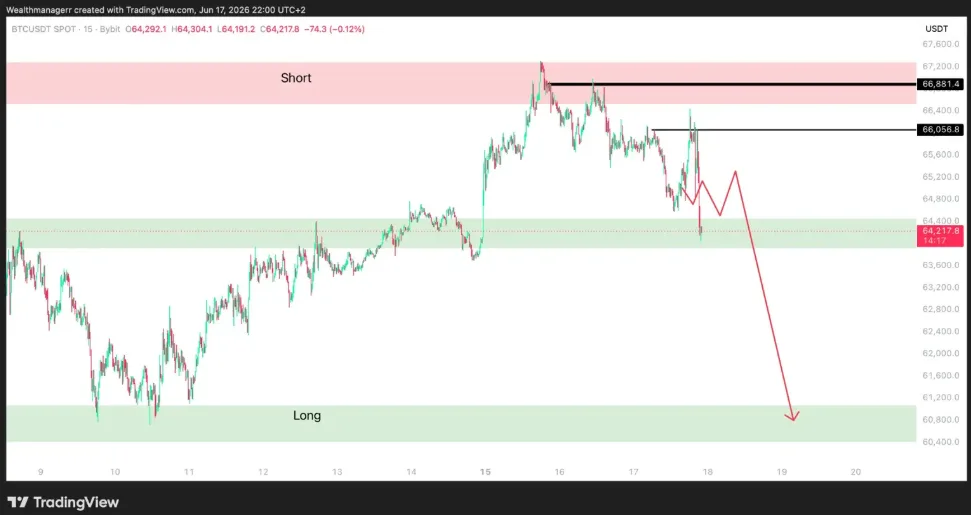
A sustained breakdown below it could expose lower liquidity zones near $63,000. Further weakness may open the path toward $61,500–$62,000.
On the upside, Bitcoin faces heavy resistance between $65,000 and $67,000. These levels also contain large liquidation clusters that could attract price if buying returns.
Technical Indicators Still Bearish
Technical signals continue to favor sellers.
The Relative Strength Index sits around 37, below the neutral 50 level. This shows weak buying pressure.
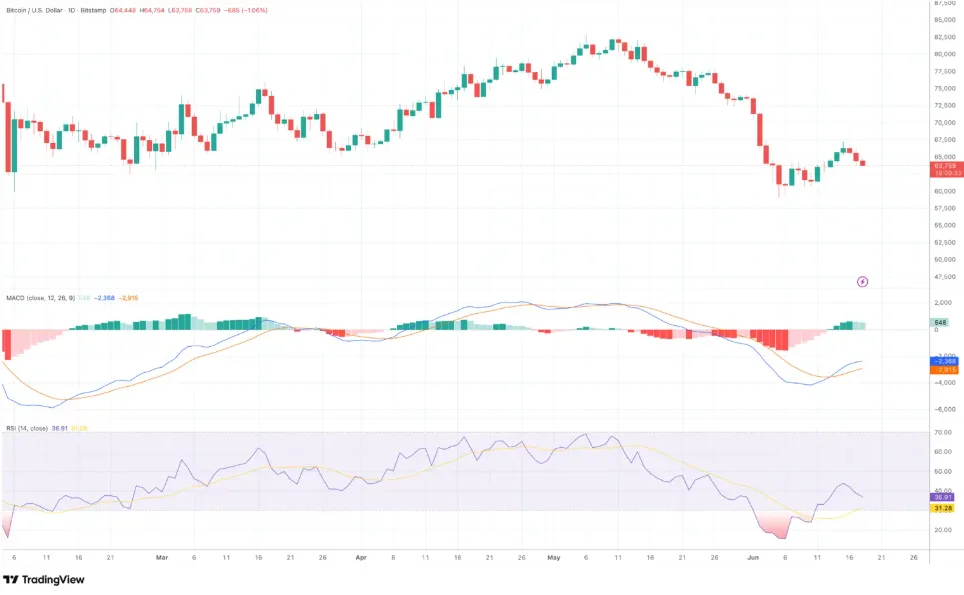
MACD readings have improved slightly from earlier lows. However, histogram strength is fading again, suggesting the recovery is losing traction.
Data from TradingView supports the view of a weakening structure. Lower highs have formed since the May peak near $82,000.
Downside Risk Toward 60,000 Remains
If selling pressure continues, Bitcoin could revisit the $60,000 region. This area now acts as a psychological and technical target. A clean break below $64,000 would increase downside risk. It could also trigger more liquidations in leveraged positions.
Data from Coinglass shows dense liquidity clusters below current prices. These zones often attract price during sharp moves.
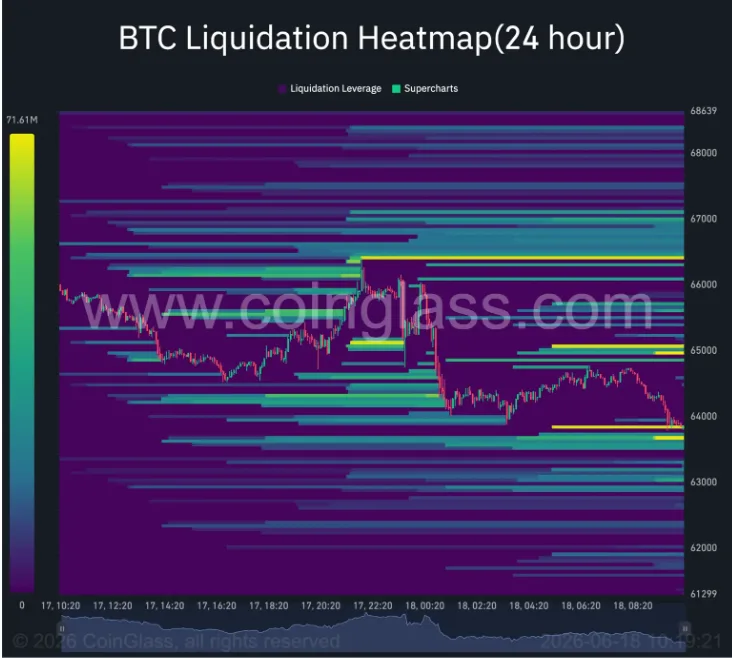
For now, Bitcoin remains in a corrective phase. The market is waiting for stronger macro signals before the next major trend forms.
ALSO READ: Terra Classic LUNC Drops 4% After 34% Rally on Profit Taking
DISCLAIMER:
The views and opinions expressed herein are solely those of the author and do not necessarily reflect the views of the publisher. The publisher does not endorse or guarantee the accuracy of any information presented in this article. Readers are encouraged to conduct further research and consult additional sources before making any decisions based on the content provided.
About the Author