- Bitcoin climbed above $63,000 after weaker US economic data, ETF inflows, and short liquidations lifted prices.
- Traders are now watching whether Bitcoin can hold $62,600 support and extend its recovery toward $65,200.
Bitcoin climbed above $63,000 over the weekend, reaching its highest level in two weeks before giving back a small portion of its gains. The latest recovery came as weaker US economic data, renewed spot Bitcoin ETF inflows, and a wave of short liquidations helped push prices higher.
Despite the rebound, analysts believe Bitcoin still faces several technical hurdles before confirming a stronger recovery. Traders are now watching whether support above $62,600 can hold as the market looks toward higher price targets.
Weaker US Data and ETF Inflows Support Bitcoin
Bitcoin’s latest rally followed disappointing US employment data that showed the economy added just 57,000 jobs in June, far below market expectations. The weaker report reduced expectations of further interest rate hikes, creating a more supportive environment for risk assets such as Bitcoin.
Market participants now expect the Federal Reserve to leave interest rates unchanged at its July meeting. Lower interest rate expectations often increase demand for alternative investments by reducing the appeal of fixed-income assets.
Institutional demand also showed signs of improvement. US spot Bitcoin ETFs recorded $224 million in net inflows, ending a six-session streak of withdrawals. Although this marked a positive shift, previous outflows remain significant, suggesting many large investors are still taking a cautious approach.
Short Squeeze Helped Drive the Rally
Another major factor behind Bitcoin’s rise was the liquidation of bearish positions.
After spending much of June trading between $58,000 and $60,000, Bitcoin reclaimed the important $62,000 level. That move forced many traders who had bet against the market to close their positions, creating additional buying pressure.
More than $450 million worth of crypto positions were liquidated during the holiday weekend. These forced purchases accelerated Bitcoin’s climb toward nearly $63,900 before the rally slowed.
However, analysts note that buying driven by short liquidations is often temporary. The next phase of the rally will depend on genuine spot demand rather than on traders closing losing positions.
Bitcoin Faces Key Resistance Levels
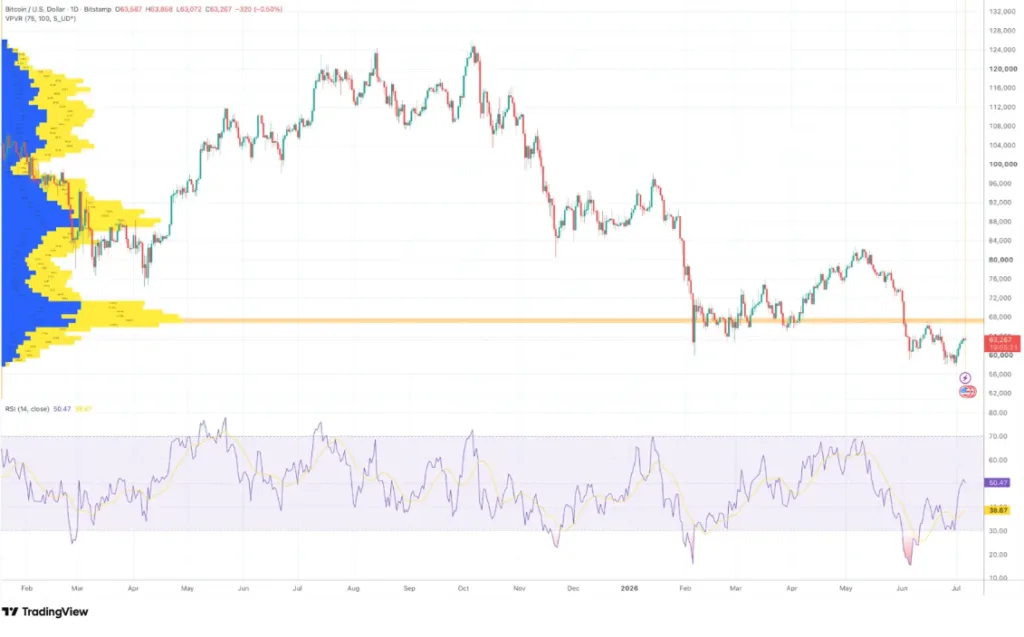
Bitcoin has recovered above its 20-day EMA near $62,400, improving the short-term technical picture.
The RSI has also returned to around 50, showing that selling pressure has eased without pushing the market into overbought territory.
The first important resistance sits near $63,600, which aligns with the 0.618 Fibonacci retracement level.
If buyers break above that level, Bitcoin could target:
- $65,200 as the next resistance.
- $67,300 near the previous swing high.
- $69,000 to $75,000, where several long-term moving averages are located.
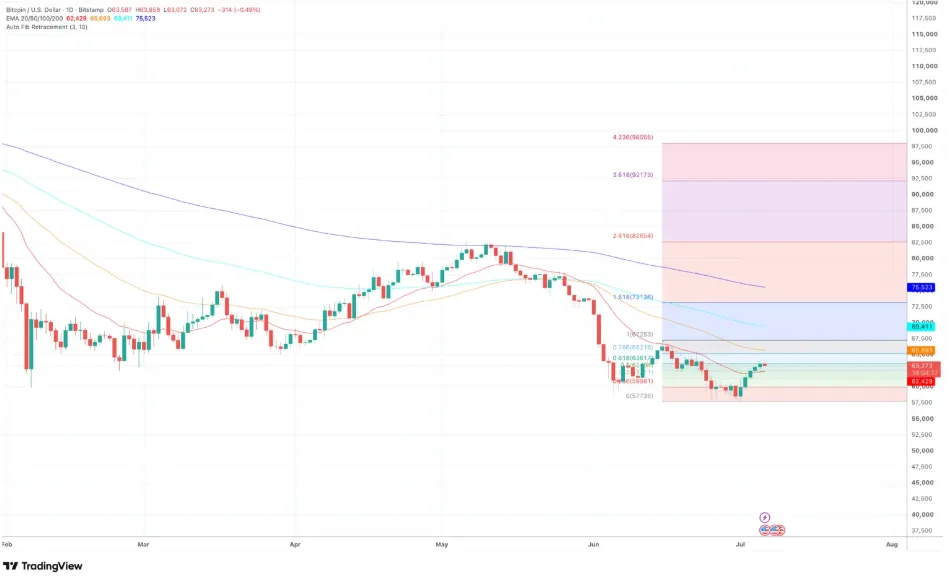 BTC/USD 1-day price chart. Source: TradingView.
These levels could attract fresh selling if buyers fail to maintain enough demand.
Support Around $62,600 Remains Critical
Holding above the current support zone is becoming increasingly important. Bitcoin is trading above its 200-week simple moving average near $62,600, a level many analysts consider an important long-term support area.
If Bitcoin loses this level, the market could revisit $60,000. A deeper correction could then bring prices back toward the $57,700 to $58,000 region, where buyers recently stepped in. For now, the market remains focused on whether this support can withstand renewed selling pressure.
Derivatives Data Shows Balanced Market Positioning
Unlike previous rallies fueled by aggressive leverage, current derivatives data suggest traders remain cautious.
Open interest has changed very little, increasing by only 0.18% over the past day to approximately $21 billion. This indicates that new leveraged positions have not increased significantly despite Bitcoin’s recent gains.
The long-to-short ratio also remains nearly balanced, with long positions accounting for just over half of all open trades. This balanced positioning suggests traders have not yet reached a clear consensus on Bitcoin’s next move.
Institutional Outlook Remains Mixed
While ETF inflows improved during the week, some institutions remain cautious about Bitcoin’s longer-term outlook.
Several Wall Street firms have lowered their 12-month Bitcoin price forecasts. Some analysts have also reduced expectations for future ETF inflows after substantial withdrawals from spot Bitcoin funds during June.
Another concern is that investment capital continues to flow into artificial intelligence-related technology stocks instead of crypto markets. Reduced liquidity could make Bitcoin more vulnerable to sudden price swings.
At the same time, new European regulations under the Markets in Crypto-Assets (MiCA) framework have prompted several exchanges to suspend certain services for EU customers, adding another layer of uncertainty to the market.
Can Bitcoin Extend the Recovery?
Bitcoin has regained important support above $63,000 after a strong weekly recovery, but the next few trading sessions could determine whether the rally continues.
A move above $63,600 would strengthen the bullish outlook and bring $65,200 into focus. A successful break above that level could allow Bitcoin to challenge $67,300 next.
On the other hand, losing support around $62,600 could increase the risk of another decline toward $60,000.
For now, Bitcoin remains at an important technical crossroads as traders wait to see whether genuine buying demand can replace the short-covering that fueled the latest rally.
ALSO READ: Uniswap Launches URC to Open Protocol Development to the Community
DISCLAIMER:
The views and opinions expressed herein are solely those of the author and do not necessarily reflect the views of the publisher. The publisher does not endorse or guarantee the accuracy of any information presented in this article. Readers are encouraged to conduct further research and consult additional sources before making any decisions based on the content provided.
About the Author