


- UNI would need an 11x rally to reach $50, making the target highly ambitious for 2026.
- Growing revenue, burns and Robinhood Chain activity support UNI, but $6–$12 remains the more realistic base case.
UNI would need an 11x rally from around $4.40 to reach $50 in 2026. The target looks ambitious, even as Uniswap gains new revenue streams and expands across additional networks.
The fee switch, accelerating UNI burns and Robinhood Chain deployment have strengthened the case for UNI. However, current revenue, holder growth and valuation data still suggest that $50 is a high-end scenario rather than the base case.

What Would UNI Need to Reach $50?
At around $4.40, UNI would need to rise roughly 11.4 times to reach $50.

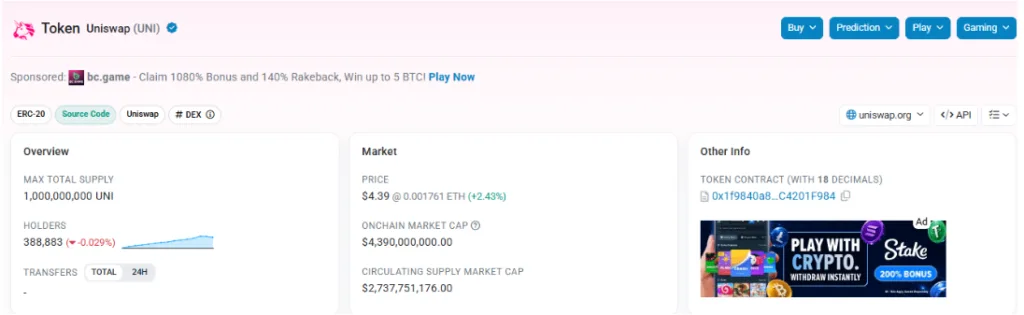
With about 623 million UNI in circulation, a $50 price would give UNI a market capitalization of about $31.2 billion. Its fully diluted valuation would reach roughly $50 billion based on the 1 billion token ceiling.
That would put UNI above its previous all-time high of about $44.97. A move to $50 would therefore be more than a recovery toward its 2021 peak. It would establish a new valuation level for UNI.
For context, UNI’s circulating market cap is around $2.7 billion. A move to $50 would place it above $30 billion, a market cap range Uniswap has never sustained.
Does Protocol Growth Translate Into UNI Value?
This is one of the biggest questions behind the 2026 UNI outlook.
For much of Uniswap’s history, strong protocol activity did not directly benefit UNI holders. Most swap fees went to liquidity providers, leaving limited value flowing back to the token. That changed partially with the UNIfication proposal and its protocol fee mechanism.
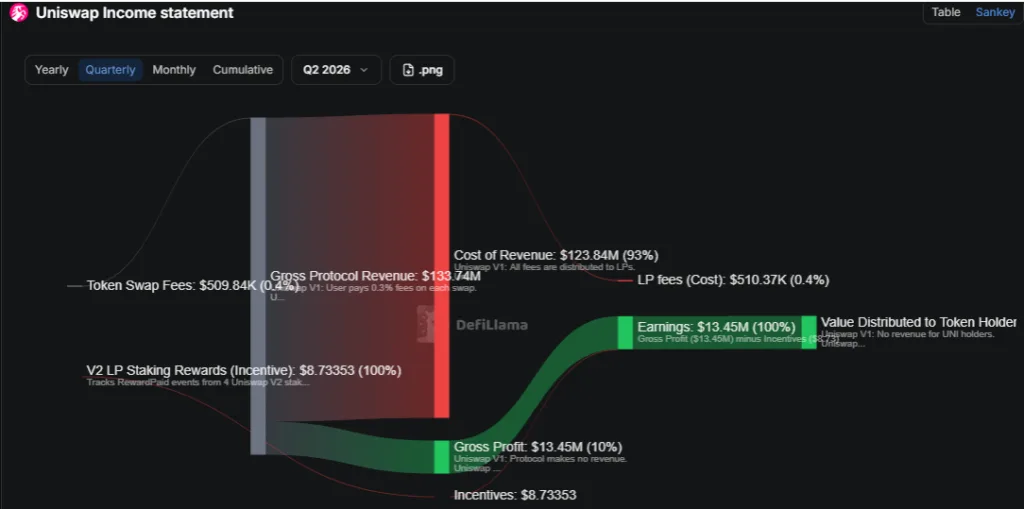
Uniswap generated $133.74 million in gross protocol revenue during Q2 2026. Around 93% still went toward liquidity provider fees, leaving about $13.45 million in gross profit earmarked for token holders.

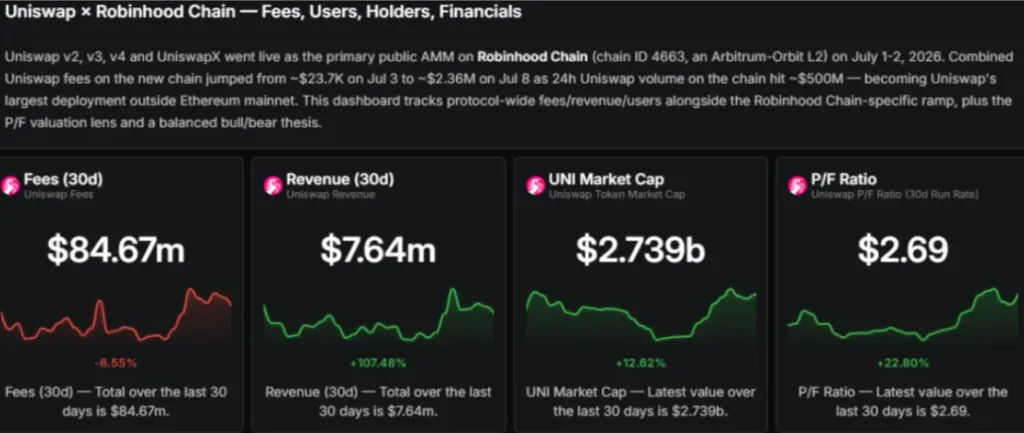
The recent valuation data is also notable. Uniswap’s 30-day P/F ratio stands at 2.69, up 22.8% over the past month. Meanwhile, 30-day protocol revenue reached $7.64 million, up 107%.
If revenue continues growing faster than the market cap, UNI could receive a higher valuation. However, the current figures still do not support assuming an immediate move toward $50.
Robinhood Chain Adds a New Revenue Source
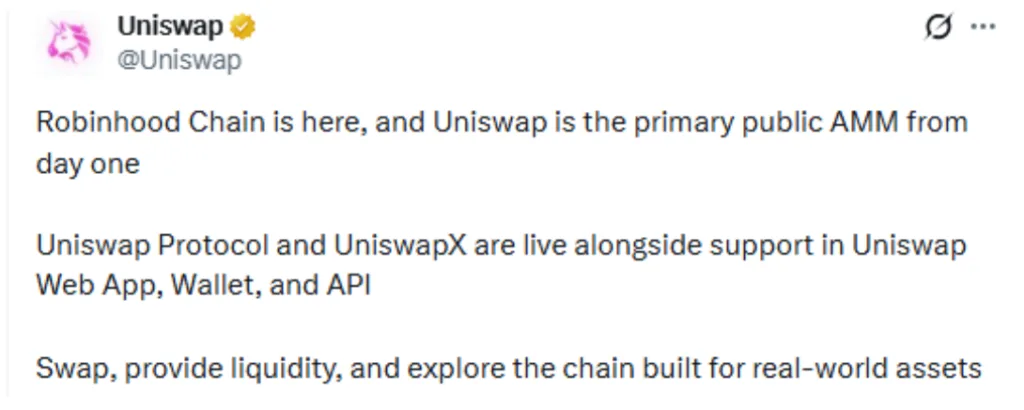
Uniswap launched v2, v3, v4 and UniswapX on Robinhood Chain in early July 2026.

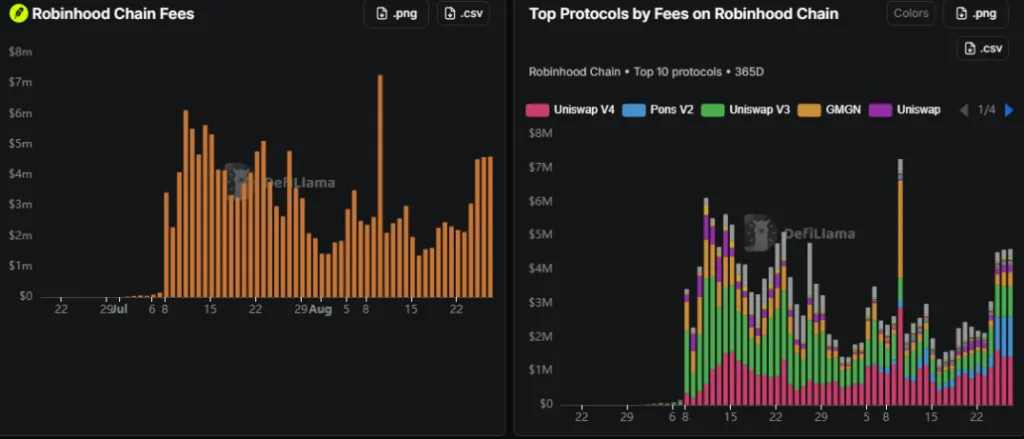
The deployment recorded rapid growth in its first week. Combined fees rose from about $23,700 on July 3 to $2.36 million by July 8. Daily volume also reached roughly $500 million.

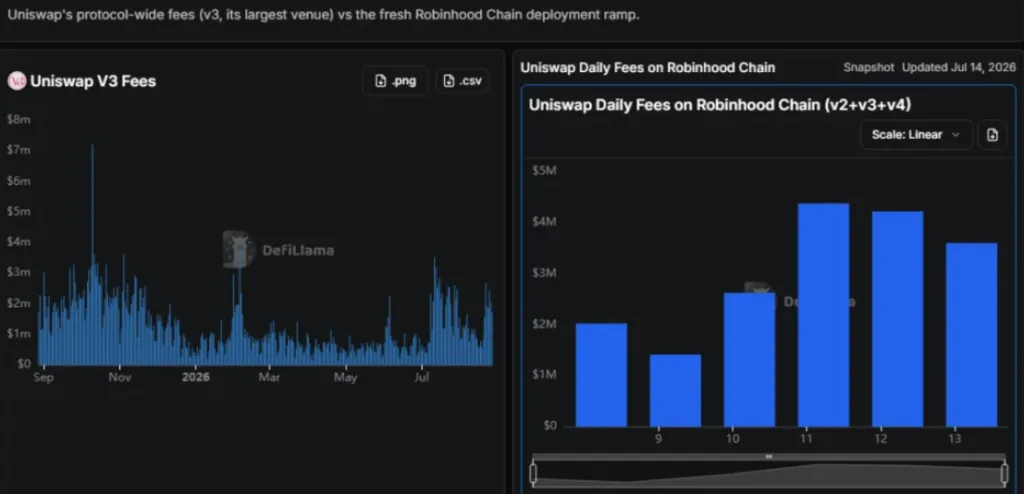
The early growth is significant, but it started from a very low base. Uniswap’s overall 30-day fees stood at about $84.67 million, down 6.55% over the trailing month even as protocol revenue increased. This suggests that Robinhood Chain’s early growth still needs to prove sustainable.

If the network becomes a durable venue for trading and tokenized assets, it could become an important additional source of protocol fees.
UNI Burns Are Increasing
The burn mechanism provides another potential catalyst for UNI. More than 109.89 million UNI had been permanently removed, worth roughly $629 million cumulatively. The annualized burn rate also increased from $52.6 million on a 365-day basis to $67.4 million on a 90-day basis.
A 106,000 UNI single-day burn also represented an annualized pace of about $170 million at that day’s price. Robinhood Chain activity and the v4 proposal contributed to the increase.
Higher burns can reduce supply over time. Yet even a $170 million annualized burn remains small compared with the roughly $28 billion increase in circulating market value needed for UNI to reach $50.
The Bear Case Cannot Be Ignored
UNI’s holder count does not yet show the type of growth that an 11x rally would normally require. On-chain data puts total UNI holders at 388,883, down slightly by 0.029% over the tracked period. A flat or declining holder base makes the $50 case harder to support because the token would need significantly stronger demand.
The fee distribution is another limitation. Around 90% of Uniswap’s gross protocol revenue still goes to liquidity providers, meaning only a relatively small share currently accrues to the protocol or UNI holders.
For UNI to justify a $30 billion-plus market cap, a much larger share of Uniswap’s economic activity may need to reach token holders.
UNI Price Prediction for 2026
The technical setup remains mixed. UNI is forming a large descending triangle on the weekly chart, with support near $2.33.

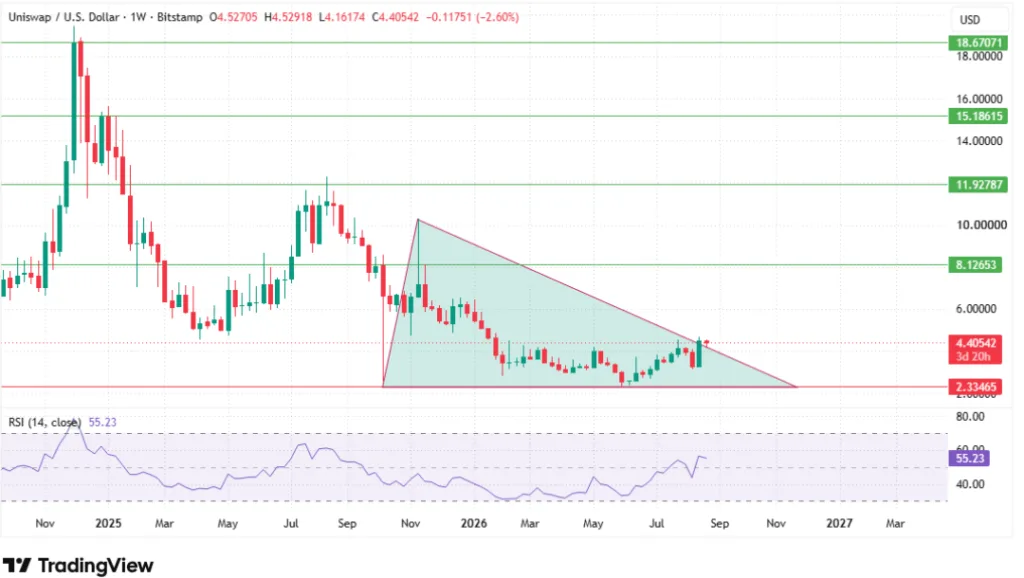
The 14-period RSI is around 55.23, leaving the indicator in neutral territory. UNI is also testing the upper boundary of the triangle. A confirmed weekly close above resistance could open the way toward $18.67. That would still leave UNI more than 60% below $50.
The four potential scenarios are:
- Bear case: $2–$4 — Support at $2.33 breaks, Robinhood Chain activity fades, burns slow and holder numbers decline.
- Base case: $6–$12 — UNI confirms a breakout, revenue continues improving and the burn rate rises.
- Bull case: $15–$20 — The $18.67 technical target holds, revenue keeps growing, Robinhood Chain scales and holder growth turns positive.
- $50+ case — Uniswap increases the share of revenue reaching UNI holders, adds major deployments and benefits from a sustained crypto market rally.
Can UNI Reach $50 in 2026?
UNI can reach $50, but the current evidence does not make it the most likely outcome. UNI needs an approximately 11-fold increase from $4.40. Uniswap would also need stronger demand, continued revenue growth, faster burns and a larger share of protocol revenue flowing to UNI holders.
The $6–$12 range looks closer to the base case, while $15–$20 would require several bullish conditions to continue.
A $50 UNI price would require the bull case to develop on multiple fronts at the same time. For now, it is better viewed as a high-end 2026 scenario rather than the central price target.
ALSO READ: IOTA Is Finally Becoming a Conventional Smart-Contract Chain
DISCLAIMER:
The views and opinions expressed herein are solely those of the author and do not necessarily reflect the views of the publisher. The publisher does not endorse or guarantee the accuracy of any information presented in this article. Readers are encouraged to conduct further research and consult additional sources before making any decisions based on the content provided.