


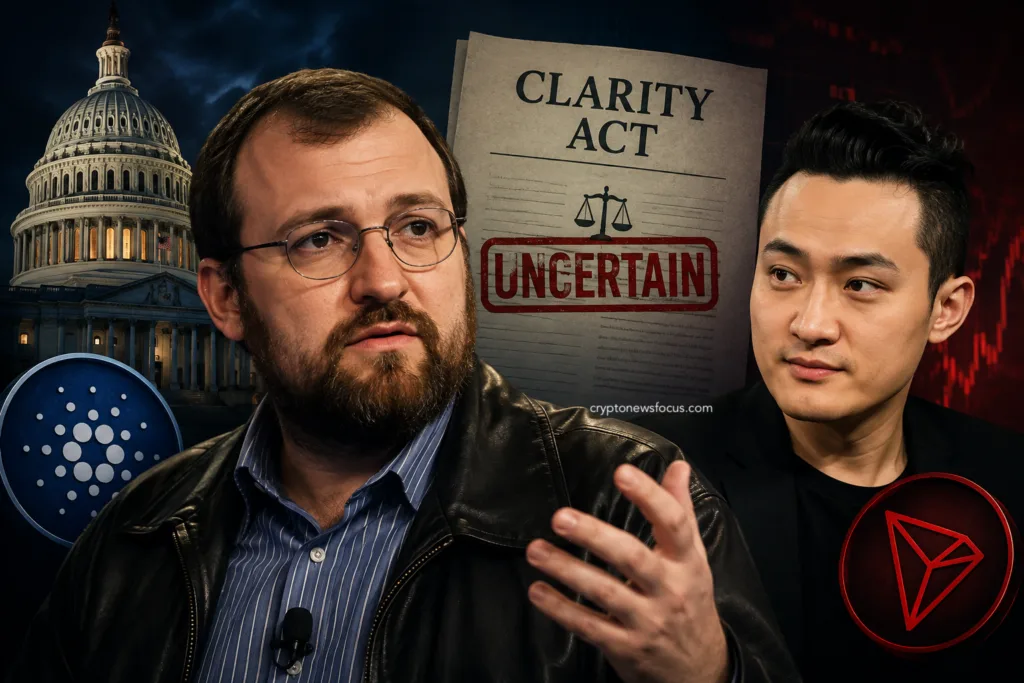
Cardano founder Charles Hoskinson has cast doubt on the future of the U.S. crypto market structure bill, saying the CLARITY Act will “probably not” pass amid continuing disagreements in Washington.
Hoskinson made the comments while discussing developments across the crypto industry, including Cardano, Justin Sun and Monad. His remarks come as lawmakers remain divided over several provisions of the legislation. CryptoNews report on Hoskinson’s comments
The CLARITY Act is designed to establish clearer rules for digital assets in the United States, including defining the regulatory responsibilities of the Securities and Exchange Commission (SEC) and the Commodity Futures Trading Commission (CFTC).
As of now, voting on the US Clarity ACT has expected to happen on September 15th 2026.
The bill has already made significant progress. The Senate Banking Committee advanced the legislation in May by a 15-9 vote, but negotiations have continued over issues including decentralized finance, consumer protection, ethics and illicit finance. Senate Banking Committee announcement
Also Read: Cardano ETF Demand Surpasses TRON as ADA Inflows Top $44M
Why the CLARITY Act Matters for Cardano
For Cardano and other major blockchain networks, clearer U.S. regulation could make it easier for exchanges, institutions and businesses to interact with digital assets.
The legislation is particularly important for the broader altcoin market because it could provide greater clarity around how different digital assets are classified and which regulators oversee them.
A failure to pass the bill would not automatically be negative for ADA. However, it could extend the regulatory uncertainty that has affected crypto businesses and token projects in the United States.
For Cardano, the question is therefore bigger than the price of ADA.
Will the U.S. eventually provide a regulatory framework that gives large blockchain networks a clearer path toward institutional adoption?
DeFi Remains a Major Disagreement
One of the biggest sticking points is decentralized finance.
Republican lawmakers have argued that the bill protects software developers while maintaining regulatory oversight of businesses that control customer assets. Senate Banking Committee CLARITY Act explanation
Democratic lawmakers have raised concerns about potential gaps involving consumer protection, anti-money-laundering requirements and decentralized financial services. Senate Democrats’ CLARITY Act concerns
Those disagreements have made it harder for lawmakers to reach a final compromise.
RELATED: Cardano Price Collapse Raises Questions Over Real Value or Value Trap
Hoskinson Also Discussed Justin Sun
Hoskinson’s comments weren’t limited to regulation.
He also spoke positively about Justin Sun, saying he has no issue with the TRON founder. He also said he has “no issue with Monad,” highlighting the increasingly competitive nature of the blockchain industry. Original report on Hoskinson’s comments
However, the CLARITY Act comments are arguably the more important part of the discussion.
If the legislation stalls, the consequences could extend well beyond Cardano to Ethereum, Solana, XRP, stablecoins, DeFi protocols and other digital assets operating in the U.S.
What Happens Next?
Hoskinson’s prediction does not mean the CLARITY Act is dead.
The legislation has already passed the House and advanced through the Senate Banking Committee. Lawmakers can still revise the bill and attempt to build enough support for passage.
For crypto investors, the key question is whether Congress can resolve the disagreements surrounding DeFi, consumer protection, ethics and regulatory jurisdiction.
Until then, Hoskinson’s warning highlights a major uncertainty facing the U.S. crypto industry.
The crypto market may be waiting for clarity. Washington still has to agree on what that clarity should look like.
This article is for informational purposes only and is not financial advice. Crypto assets remain highly volatile and carry significant risk.