- Chainlink has added 16 integrations across seven blockchain networks, expanding the use of CCIP, Data Streams, CRE and Data Feeds.
- The expansion comes as LINK ETFs record fresh inflows and the Chainlink Reserve grows to about $70.5 million.
Chainlink has added 16 new integrations across seven blockchain networks, expanding the use of its oracle services for data, cross-chain transfers and automated workflows. The latest update also comes as spot LINK ETFs record fresh inflows and the Chainlink Reserve grows to about $70.5 million.
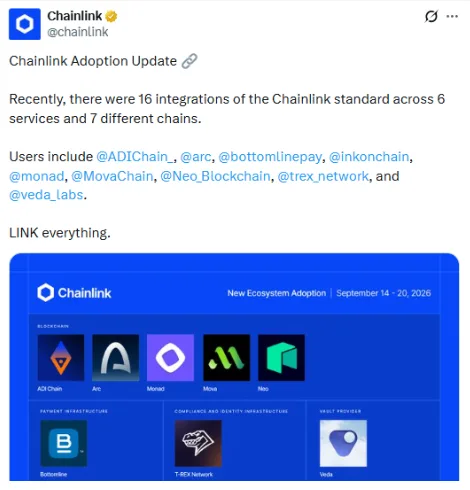
The integrations involve six Chainlink services and projects including ADI Chain, Arc, Bottomline Pay, Ink, Monad, MOVA Chain, Neo, T-REX Network and Veda Labs. However, the 16 integrations do not represent 16 new customers, since one project can use multiple Chainlink services across different networks.
Chainlink Expands CCIP, Data Streams and CRE
Chainlink’s latest adoption update covers several parts of its infrastructure.
The Cross-Chain Interoperability Protocol (CCIP), which allows tokens and messages to move between blockchains, expanded to Arc and MOVA Chain. Data Streams, which provides fast market data, also reached Arc.
Chainlink’s Runtime Environment (CRE) added integrations with ADI Chain, Ink and Monad. Data Feeds, which provide standard price data to blockchain applications, expanded to Arc and Tempo.
The rollout came in a short period. According to the developer changelog, Data Streams went live on Circle’s Arc mainnet on September 15, followed by CCIP on September 16.
Bottomline Pay also launched its Global Pay Connect platform on September 17. The platform serves more than 600 banks and uses both CCIP and CRE.
Chainlink says its infrastructure has enabled more than $34 trillion in transaction value. CCIP alone has processed more than $24 billion in transfers.
LINK ETFs Record Fresh Inflows
The latest adoption figures come alongside continued activity in the LINK ETF market.
Spot LINK ETFs recorded $2.19 million in net inflows on September 18. Weekly inflows stood at about $2.62 million, marking the fifth multi-million-dollar week since August.
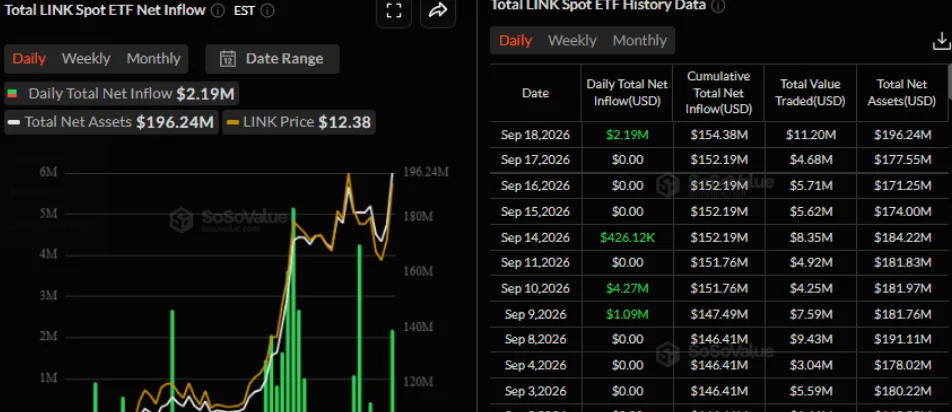
Total cumulative ETF net inflows reached $154.38 million, while total ETF net assets stood at about $196.24 million.
The Chainlink Reserve also continued to add LINK. The Reserve added about $1.1 million worth of LINK, taking its value to roughly $70.5 million. Launched in August 2025, the Reserve has not reported any token sales.
The Reserve receives funding through Payment Abstraction, which converts part of Chainlink’s service revenue into LINK.
These developments are happening at the same time, but the available data does not establish that the new integrations caused ETF inflows or any change in LINK’s price.
What the New Integrations Mean for Chainlink
The latest expansion gives Chainlink a broader presence across blockchain networks and financial applications. It also shows that different projects are using different parts of Chainlink’s infrastructure rather than relying on a single service.
The more important figures to watch next are usage and revenue. The current data does not show how much revenue the new integrations generate, how much LINK the Reserve purchases from that revenue, or whether the new users will maintain their integrations over time.
ETF flows will also remain an important figure to monitor. Continued inflows could show sustained demand for LINK investment products, while a slowdown would provide a different picture.
For now, the 16 integrations provide a snapshot of Chainlink’s expanding infrastructure footprint. The next adoption updates should offer more clues about whether that expansion is translating into higher usage and revenue.
This version keeps the article factual and avoids suggesting that adoption automatically leads to higher LINK demand or price gains.
ALSO READ: Solana Just Tripled Its Transaction Size. Here’s What It Actually Changes
DISCLAIMER:
This article reflects the author’s views and is provided for informational purposes only. While we strive for accuracy, the publisher does not guarantee that all information is complete or current. Readers should verify important information and consult appropriate sources before making decisions based on this content.
About the Author