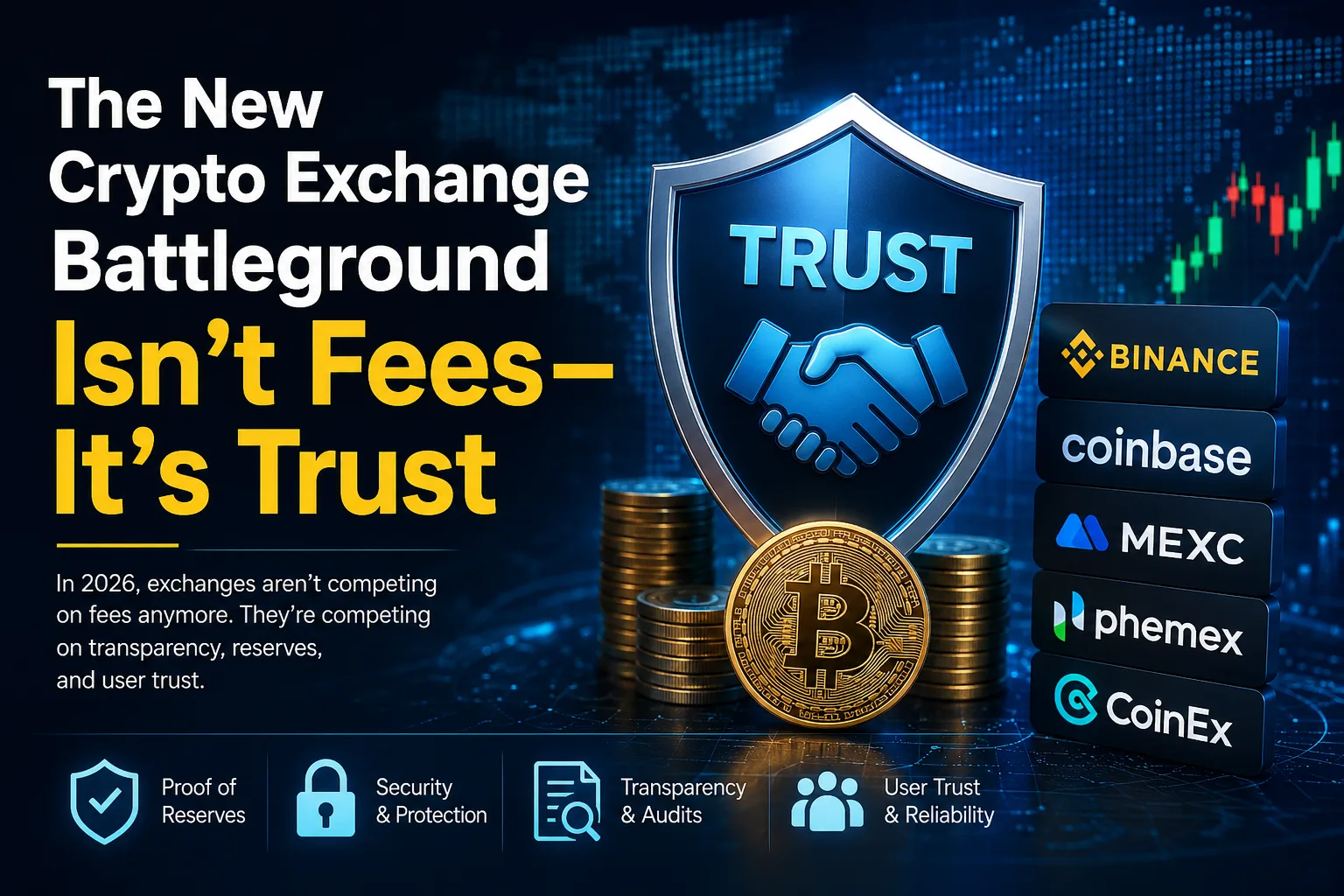
For years, crypto exchanges competed aggressively on low trading fees, leverage, token listings, and signup bonuses. But in 2026, the competitive landscape is shifting rapidly.
Today, the biggest differentiator among exchanges is no longer cost — it is trust.
From proof-of-reserves updates to massive reserve funds and institutional-grade transparency initiatives, exchanges are increasingly positioning themselves around security, solvency, and user protection as traders become more cautious following years of market collapses and liquidity crises.
One of the clearest examples came this month when MEXC announced plans to expand its Guardian Fund from $100 million to $500 million while simultaneously acquiring 1,000 Bitcoin as part of a broader reserve management strategy.
Rather than focusing purely on trading incentives, the exchange framed the move around resilience, transparency, and long-term user protection.
Exchanges Are Competing on Transparency
The crypto industry has changed dramatically since the collapse of major platforms like FTX. Traders today increasingly evaluate exchanges based on:
- reserve transparency
- withdrawal reliability
- security history
- operational stability during volatility
- proof-of-reserves reporting
- long-term solvency
This shift is becoming visible across the industry.
Earlier this year, CoinEx published updated proof-of-reserve data showing reserve ratios above 100% for major assets including BTC, ETH, and USDT, while emphasizing transparency as a core operational principle.
Meanwhile, Phemex also released updated reserve reports in May 2026, reporting reserve ratios exceeding 129% across major assets.
These announcements reflect a larger industry trend: exchanges are increasingly marketing themselves as secure financial infrastructure rather than simply high-volume trading venues.
Proof-of-Reserves Is Becoming a Standard Expectation
Proof-of-reserves (PoR) was once considered an optional transparency feature. Today, many users see it as essential.
Community discussions across crypto forums show traders increasingly prioritizing reserve verification, solvency transparency, and withdrawal performance over promotional incentives or fee discounts.
One Reddit user summarized the current market sentiment clearly:
“Trust is the real currency now.”
Another user noted that exchange behavior during periods of extreme volatility matters more than marketing campaigns or bonus offers.
The growing importance of PoR reflects a broader change in crypto user psychology. Many traders no longer assume exchanges are safe by default. Instead, they increasingly expect continuous verification, on-chain transparency, and clear reserve disclosures before depositing significant funds.
Institutional Pressure Is Changing the Industry
Institutional adoption is also accelerating the industry’s trust-focused evolution.
As regulatory frameworks develop globally, exchanges are under growing pressure to demonstrate operational maturity and financial stability. This has become especially important as more institutional investors, funds, and traditional financial firms enter digital assets.
Recent developments surrounding Coinbase and proposed U.S. crypto legislation further highlight how regulation and institutional participation are reshaping the market structure.
At the same time, companies are adapting operationally. Coinbase recently announced workforce restructuring tied partly to AI-driven efficiency initiatives amid ongoing market pressure and changing industry dynamics.
Elsewhere, institutional-focused exchange platforms are pushing deeper into traditional finance infrastructure. Crypto exchange Bullish recently announced a $4.2 billion acquisition deal involving transfer agent Equiniti as part of its broader tokenization and capital markets strategy.
These developments suggest exchanges increasingly view themselves as long-term financial institutions rather than speculative trading apps.
Bitcoin Is Becoming a Strategic Reserve Asset
Another major trend emerging in 2026 is the growing use of Bitcoin as a treasury and reserve asset by exchanges themselves.
MEXC’s acquisition of 1,000 BTC as part of its reserve strategy reflects this evolution.
Instead of relying entirely on stablecoin liquidity, some exchanges are now building dual-reserve structures combining Bitcoin holdings with stable assets to strengthen balance sheet resilience across market cycles.
This mirrors broader corporate treasury trends already visible among public companies and institutional Bitcoin holders.
The Era of “Security Marketing”
The crypto exchange industry appears to be entering what many analysts now describe as a “security-first” era.
In previous cycles, exchanges primarily competed using:
- low fees
- leverage products
- meme coin listings
- referral bonuses
- aggressive promotions
Today, the messaging is increasingly centered around:
- transparency
- reserve verification
- compliance
- institutional-grade infrastructure
- insurance funds
- user protection mechanisms
The transition signals a maturing crypto market where trust may ultimately become more valuable than temporary trading incentives.
As competition intensifies in 2026, exchanges that can consistently demonstrate solvency, stability, and operational reliability may gain a major advantage in attracting both retail and institutional users.
About the Author