
- Ethereum remains under pressure as weak institutional demand and bearish technical indicators keep sellers in control.
- A break below the key $1,611 support level could trigger further losses, while buyers need to reclaim higher resistance levels to signal a recovery.
Ethereum has come under renewed selling pressure after losing more than 7% over the past week. ETH is now trading near $1,660, with technical indicators suggesting that sellers remain firmly in control.
The recent decline has erased much of Ethereum’s mid-June recovery and placed a crucial support zone between $1,611 and $1,650 under the spotlight. If buyers fail to defend this area, the market could face another wave of downside pressure.
Ethereum Struggles as Multiple Headwinds Weigh on Price
Ethereum’s latest drop was accompanied by a sharp increase in market liquidations. Around $170 million worth of bullish leveraged ETH positions were wiped out as prices fell, highlighting growing weakness among buyers.
Market sentiment has also been affected by developments within the Ethereum ecosystem. The Ethereum Foundation recently completed a multi-month restructuring process that included reducing its workforce by approximately 20%.
Ethereum co-founder Vitalik Buterin stated that the organization plans to reduce annual spending by 40% and maintain a sustainable budget strategy in the years ahead. While the move is aimed at long-term efficiency, the timing raised concerns among traders as Ethereum already faces declining network activity.
Data from decentralized finance platforms shows that total value locked (TVL) across Ethereum-based applications has fallen significantly over the past three months. Lower blockchain activity has weakened one of Ethereum’s strongest investment narratives.
Despite these challenges, Ethereum continues to dominate the decentralized finance sector. The network still controls roughly 53% of the DeFi market and remains the leading blockchain for decentralized exchange activity.
Weak Institutional Demand Adds Pressure
Institutional sentiment has also deteriorated in recent weeks. US-listed spot Ether ETFs have recorded six consecutive weeks of net outflows, with hundreds of millions of dollars leaving the products since mid-May. This trend suggests that large investors are becoming increasingly cautious toward Ethereum amid uncertain market conditions.
At the same time, broader macroeconomic concerns continue to influence risk assets. Ongoing geopolitical tensions, inflation worries, and uncertainty surrounding future interest rate decisions have encouraged investors to favor traditional yield-generating assets over cryptocurrencies.
Corporate exposure to Ethereum has also drawn attention. Reports of significant unrealized losses among large ETH holders have added another layer of concern, even though there have been no indications of forced selling.
Ethereum Price Analysis Shows Bears Remain in Control
From a technical perspective, Ethereum remains in a bearish structure.
ETH is currently trading below all major moving averages, including the 20-day, 50-day, 100-day, and 200-day EMAs. This setup typically indicates that sellers maintain control of the broader trend. RSI remains below the neutral 50 level, signaling that buying strength is still limited despite recent attempts at recovery.
Short-term indicators paint a similar picture. On the 4H chart, key moving averages continue to favor the downside, while price remains below important trend indicators.
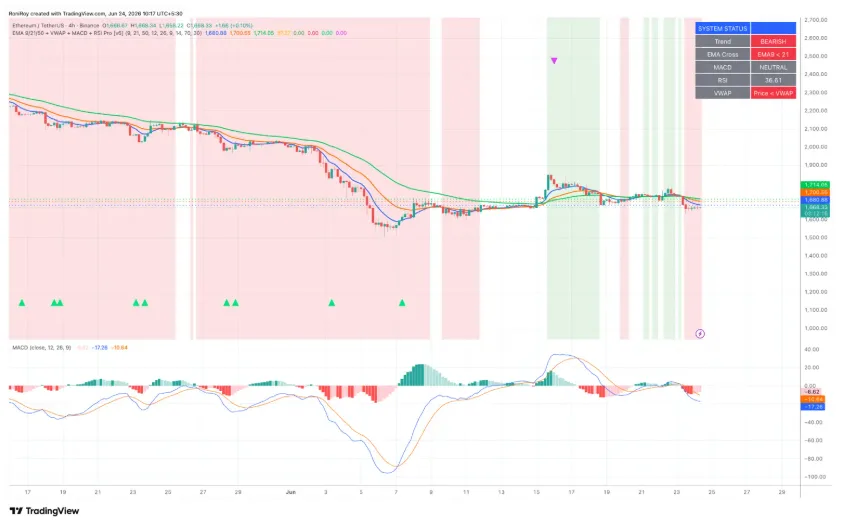
The first support area sits near $1,650. If that level breaks, attention will shift to the critical $1,611 support zone.
A decisive move below $1,611 could trigger additional liquidations and accelerate selling pressure as traders exit long positions and bearish traders increase their exposure.
On the upside, Ethereum must reclaim the $1,680 to $1,715 range before any meaningful recovery can develop. Beyond that, a move above the 20-day EMA near $1,745 would be needed to improve the current outlook.
Can Ethereum Defend the $1,611 Support Zone?
Ethereum’s long-term fundamentals remain supported by its dominant position in decentralized finance and the upcoming Glamsterdam upgrade, which aims to improve security and transaction efficiency.
However, the short-term picture remains fragile. Weak institutional demand, declining network activity, and bearish technical signals continue to weigh on sentiment.
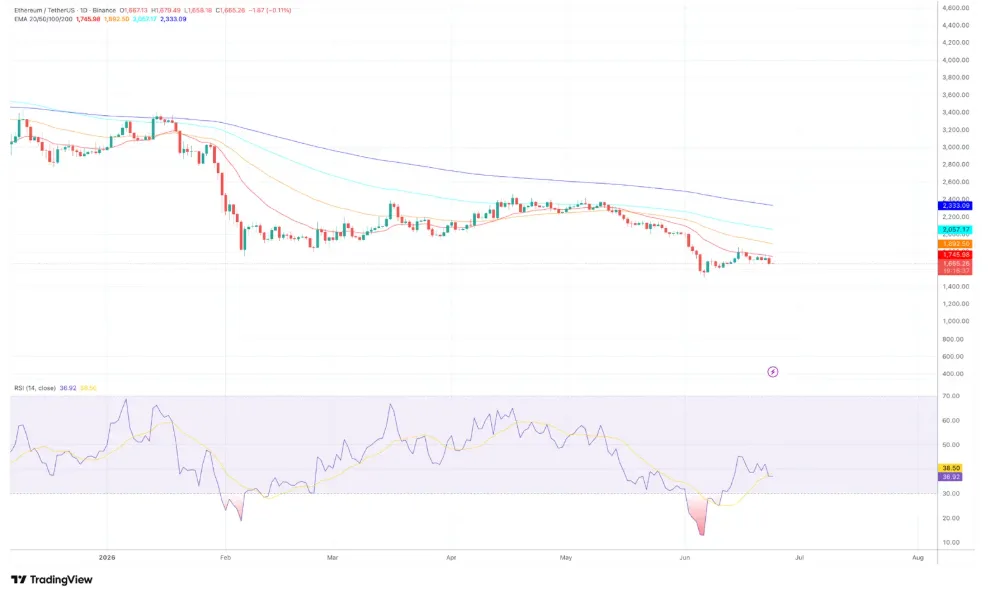
For now, the $1,611 to $1,650 support zone remains the most important area to watch. A successful defense could provide a foundation for recovery, while a breakdown may open the door to deeper losses in the weeks ahead.
ALSO READ: Pi Network Launches Updated Ecosystem Directory Staking to Boost App Visibility
DISCLAIMER:
The views and opinions expressed herein are solely those of the author and do not necessarily reflect the views of the publisher. The publisher does not endorse or guarantee the accuracy of any information presented in this article. Readers are encouraged to conduct further research and consult additional sources before making any decisions based on the content provided.
About the Author