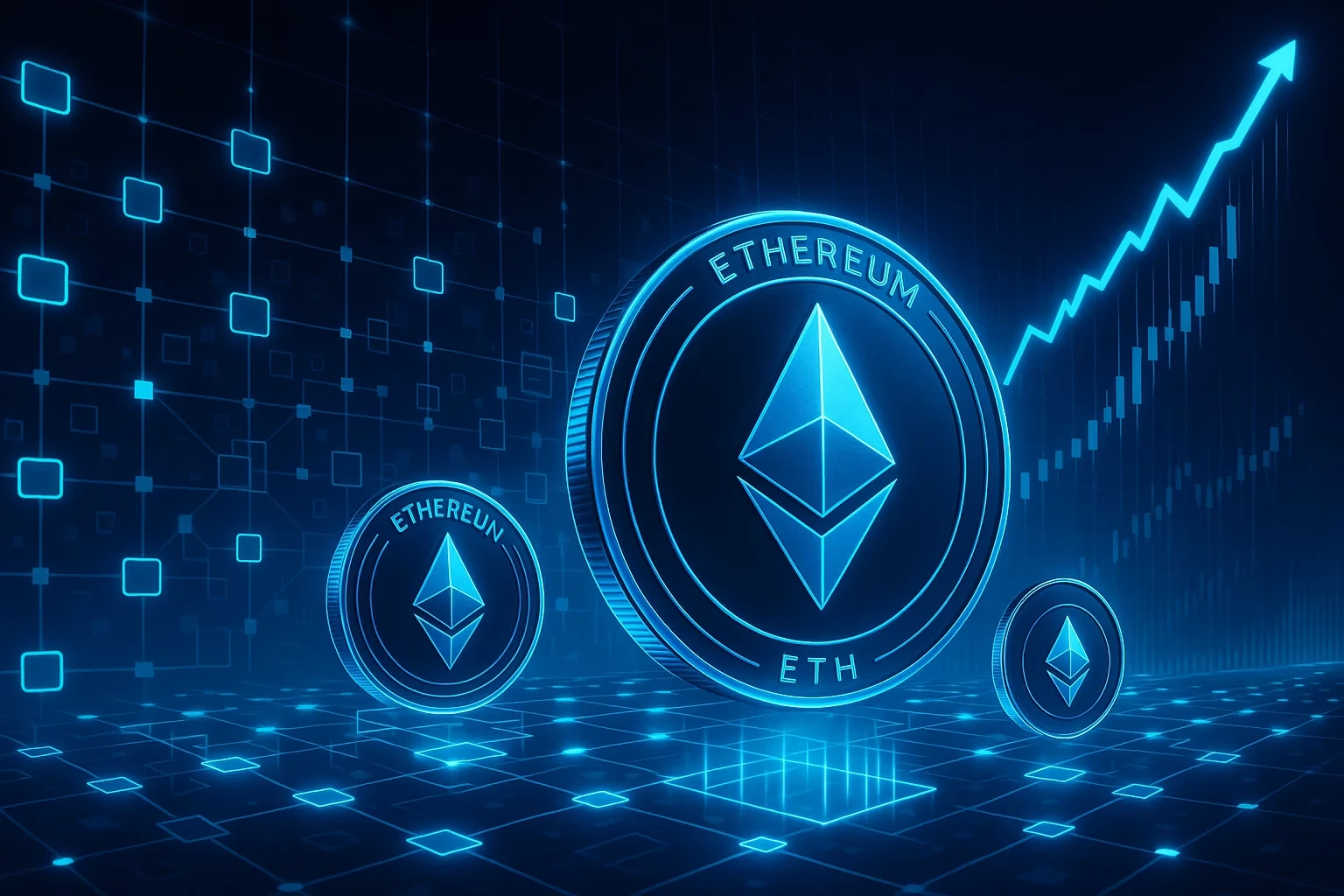
- Ethereum scaling upgrades are reducing gas fees and improving transaction speed across the network.
- These upgrades include Layer 2 rollups, Proto-Danksharding, and future sharding developments that increase Ethereum’s efficiency.
- Together, they help lower congestion and make Ethereum more scalable for users and developers.
Ethereum remains the leading smart contract blockchain, powering decentralized finance, NFTs, and a wide range of Web3 applications. However, one persistent issue has shaped user experience for years: high gas fees during periods of heavy network activity.
To address this, Ethereum has introduced a series of scaling upgrades designed to increase throughput, reduce congestion, and lower transaction costs. These changes are already reshaping how users interact with the network and will continue to influence fees in the years ahead.
Why Ethereum Gas Fees Become Expensive
Ethereum processes transactions on a shared global network where every transaction competes for limited block space. When demand increases, users bid higher fees to get priority inclusion.
This creates:
- High gas fees during peak activity
- Slower transaction confirmations
- Unpredictable costs for users and developers
For example, during NFT minting events or sudden DeFi surges, fees can spike significantly because thousands of users are competing for the same block space.
At this point, many users often wonder: why doesn’t Ethereum simply increase capacity instead of charging higher fees?
The answer lies in Ethereum’s design. Increasing capacity too aggressively could weaken decentralization, which is one of the network’s core principles.
Layer 2 Solutions: The First Major Breakthrough
One of the most important developments in Ethereum scaling is the rise of Layer 2 networks. These systems are built on top of Ethereum and handle transactions separately while still relying on Ethereum for security.
Instead of processing every transaction on the main chain, Layer 2 solutions bundle multiple transactions together and submit them as a single proof. This significantly reduces congestion and lowers costs.
A common question users ask is: how exactly do Layer 2 networks reduce fees so much?
The answer is simple—multiple users share the cost of a single batch transaction instead of paying individually on the Ethereum mainnet.
Types of Rollups
Optimistic Rollups
These assume transactions are valid by default and only check them if fraud is suspected. This reduces computation and keeps fees low.
Zero-Knowledge (ZK) Rollups
These use cryptographic proofs to verify transactions instantly and securely. They are more advanced and highly efficient.
Both technologies are already reducing Ethereum gas fees for users interacting with decentralized applications.
Proto-Danksharding and Data Cost Reduction
Ethereum’s Proto-Danksharding (EIP-4844) introduces a major improvement in how data is stored using temporary “blobs.”
Instead of permanently storing all data on Ethereum, Layer 2 networks can now use cheaper temporary storage.
This leads to:
- Lower data costs for rollups
- Reduced congestion on the Ethereum mainnet
- Cheaper transaction fees overall
Naturally, this raises another question: Does this mean Ethereum transactions will always be cheap now?
Not exactly. Fees will still depend on demand, but spikes are expected to be less extreme than before.
Full Danksharding: Ethereum’s Long-Term Vision
Ethereum’s long-term scaling plan includes full Danksharding, which will divide the blockchain into smaller parts to process transactions in parallel.
This leads many to ask: Will Ethereum eventually eliminate high gas fees?
While no blockchain can guarantee zero congestion forever, Danksharding is designed to make fees far more stable and predictable.
Expected benefits include:
- Massive increase in transaction throughput
- Reduced network congestion even during peak demand
- Lower and more stable transaction fees
How These Upgrades Reduce Fees in Practice
The combined effect of Layer 2 systems and protocol upgrades is already changing Ethereum’s fee structure.
Here is how costs are reduced:
- Less congestion on the mainnet reduces bidding wars
- Cheaper data availability lowers rollup costs
- Batch processing spreads fees across many users
- Improved efficiency increases total transactions per block
As a result, users are already seeing more stable and lower transaction fees compared to previous years.
What Lower Fees Mean for Users and Developers
For users, lower fees mean:
- Cheaper DeFi transactions like swapping and staking
- More affordable NFT trading and minting
- Smoother experience using decentralized applications
For developers, it means:
- Easier scaling of applications
- Lower infrastructure costs
- Ability to support more users without congestion issues
This strengthens Ethereum’s competitiveness against other blockchain networks offering lower fees.
Challenges Still Remaining
Even with progress, Ethereum scaling is not fully solved.
Some challenges include:
- Fragmentation across multiple Layer 2 networks
- Confusion for new users switching between systems
- Gradual rollout of upgrades over time
- Coordination across a large ecosystem
These issues are being actively addressed, but they take time to fully resolve.
Future Outlook for Ethereum Fees
Ethereum is moving toward a modular system where Layer 2 networks handle most transactions while the main chain provides security.
As adoption increases:
- Fees are expected to become more stable
- Network congestion will be reduced significantly
- Average transaction costs should decline over time
This shift is gradual, but the long-term direction is clear.
Conclusion
Ethereum’s scaling upgrades represent a major shift in blockchain infrastructure. Through Layer 2 rollups, Proto-Danksharding, and future Danksharding, the network is steadily improving efficiency and reducing transaction costs.
While challenges remain, Ethereum is clearly evolving toward a more scalable and cost-effective system for users and developers.
ALSO READ: How to Bridge Ethereum to Arbitrum (Step-by-Step Beginner Guide)
Disclaimer
This article is for informational purposes only and should not be considered financial, investment, or trading advice. Cryptocurrency markets are highly volatile, and users should conduct their own research before making any financial decisions.
About the Author