


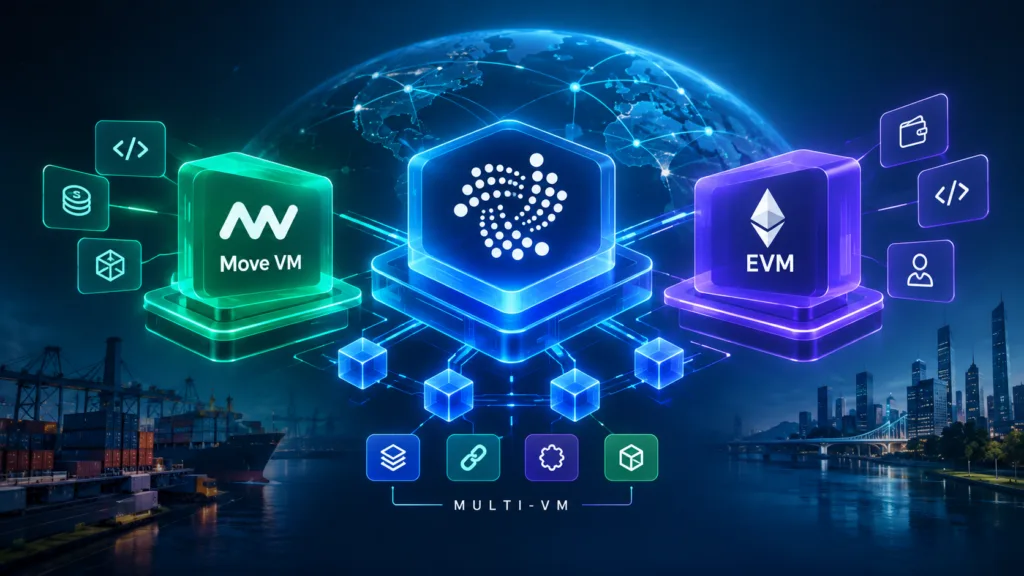
king a different approach to smart-contract development after rebuilding its Layer 1 around Move.
The network now operates a Move-based mainnet with an object-centric architecture, while IOTA also maintains EVM infrastructure for developers building with Ethereum-compatible tools. The longer-term goal is to bring multiple execution environments closer together, potentially allowing different virtual machines to operate directly within the IOTA Layer 1.
That would make IOTA less dependent on a single programming environment and could give developers more flexibility over how applications are built.
But the multi-VM vision is still a work in progress.
IOTA’s Move-Based Mainnet
The foundation of IOTA’s current architecture is the Rebased mainnet, which launched in May 2025.
Rebased moved IOTA to a Move-based Layer 1 and introduced a new object-centric ledger architecture. The change gave developers native smart-contract functionality at the base layer rather than relying entirely on a separate smart-contract network.
IOTA’s current website describes its mainnet as a Move-based Layer 1 with an object-centric architecture, with parallel transaction processing and support for composable on-chain assets.
This is an important departure from the architecture that defined IOTA before Rebased.
Move is now central to how applications interact with the IOTA Layer 1.
But IOTA Is Not Limiting Developers to Move
The other part of the equation is EVM compatibility.
The Ethereum Virtual Machine is one of the most widely used smart-contract environments in crypto. Developers working with Solidity, Ethereum wallets and familiar Web3 tooling already have an established development stack.
IOTA has maintained EVM infrastructure alongside its Move-based Layer 1.
This means the IOTA ecosystem can support developers coming from two different technical backgrounds: developers building natively with Move and developers working with Ethereum-compatible applications.
IOTA’s current developer materials explicitly present both Move and EVM as ways to build on the network.
That gives the network a potentially useful combination.
What Is a Multi-VM Blockchain?
A virtual machine is the environment that executes smart-contract code.
Ethereum uses the EVM. IOTA’s Rebased Layer 1 uses MoveVM.
A multi-VM blockchain goes a step further by allowing more than one execution environment to operate within the same underlying network.
The idea is not simply to have two separate blockchains.
Instead, different execution environments could use the same underlying Layer 1 security and infrastructure while allowing developers to use different programming languages and execution models.
IOTA has previously outlined a plan to move in this direction.
Its technical roadmap described a future in which multiple VMs could eventually execute directly within the Layer 1, with the EVM specifically identified as one of the environments IOTA wanted to bring to the base layer. At the time, IOTA described this work as being in the early research stage.
That distinction remains important.
IOTA has a multi-VM strategy. It does not mean the full multi-VM Layer 1 architecture is already live.
Why Would IOTA Want Multiple VMs?
The main argument is developer choice.
Different smart-contract environments have different strengths.
Move was designed around resource-oriented programming and provides a programming model suited to digital assets and on-chain applications.
The EVM, meanwhile, gives developers access to the enormous ecosystem built around Ethereum-compatible applications, wallets and development tools.
Forcing every developer into one environment can create friction.
A multi-VM approach could allow IOTA to maintain its native Move architecture while also making the network more accessible to developers who prefer other environments.
That could become increasingly important as IOTA attempts to expand beyond its traditional identity as a data and supply-chain project.
The EVM Connection Is Already Useful
IOTA’s EVM infrastructure has already provided the ecosystem with access to Ethereum-compatible development.
That matters because developers do not necessarily need to start from zero when considering IOTA.
At the same time, IOTA’s current mainnet has been moving in a different direction with Move.
The result is an ecosystem with two distinct development paths.
The first is the native Move environment on IOTA’s Layer 1.
The second is EVM-based development through IOTA’s EVM infrastructure.
The longer-term multi-VM idea is about reducing the separation between these environments and making different execution models more closely integrated with the Layer 1.
IOTA Is Still Developing the Infrastructure Around It
The multi-VM strategy is also taking place alongside broader changes to the IOTA protocol.
In 2026, IOTA has been working on improvements to consensus, synchronization, account abstraction and developer infrastructure.
Its Q1 2026 progress report said Starfish consensus had reached the testnet, while Account Abstraction features were running across IOTA’s development and testing environments. The report also highlighted improvements to the network’s indexers and node APIs.
Then, in April 2026, Starfish moved onto IOTA Mainnet.
The upgrade introduced protocol version 24 and replaced the previous consensus mechanism with Starfish. IOTA’s research team described the change as an effort to improve the way information is disseminated between validators and to make the network more resilient under real-world conditions.
That matters for the multi-VM discussion because execution environments still depend on the underlying network.
Supporting multiple VMs is only useful if the Layer 1 underneath them can provide the performance, reliability and security required by applications.
The 2026 IOTA Strategy Is Bigger Than Smart Contracts
There is another important development that changes how IOTA should be viewed in 2026.
The Foundation has increasingly positioned IOTA as infrastructure for global trade rather than simply another general-purpose blockchain.
Its Q1 2026 report said the project was shifting toward becoming infrastructure for global trade, with the Trade Worldwide Information Network, or TWIN, moving into operational phases. The same report highlighted deployments involving Kenya, the UK and other trade-related initiatives.
IOTA’s current website reflects the same direction.
Its technology stack now includes the Move-based mainnet alongside identity, tokenization, notarization, audit-trail and gas-station products. The network is being positioned as infrastructure for applications involving real-world assets, identity and trade.
That gives the multi-VM strategy a broader purpose.
The goal is not simply to attract another wave of DeFi applications.
IOTA is attempting to build infrastructure that can support different types of applications, from decentralized finance and tokenization to identity and digital trade.
The Real Test Is Developer Adoption
This is where the strategy becomes more difficult.
Having multiple execution environments does not automatically create a successful ecosystem.
Developers still need reasons to build.
Users need reasons to use those applications.
And applications need sufficient liquidity, infrastructure and network activity to remain useful.
IOTA’s 2026 progress report shows that the Foundation is investing heavily in this part of the problem, including developer programs, infrastructure improvements, interoperability and real-world deployments. More than 60 teams submitted concepts to the MasterZ × IOTA hackathon, with many projects focused on trade, real-world assets and identity.
That suggests IOTA is trying to move the conversation beyond simply upgrading its technology.
The question now is whether that technology can produce a larger ecosystem.
IOTA’s Multi-VM Bet
IOTA’s multi-VM strategy is therefore better understood as a long-term architectural direction rather than a completed upgrade.
The current network already has a Move-based Layer 1 and EVM infrastructure for Ethereum-compatible development.
The next step is potentially bringing more execution environments directly into the Layer 1 while preserving the security and performance of the underlying network.
If IOTA succeeds, developers could have more freedom to choose how they build without necessarily leaving the IOTA ecosystem.
That could become an important advantage as blockchain networks compete for developers and real-world applications.
But the technology is only one part of the equation.
IOTA has spent the last several years rebuilding its underlying infrastructure. In 2026, the focus is increasingly shifting toward performance, interoperability and actual deployment.
The next question for IOTA is no longer simply whether it can build a new architecture.
It is whether developers, businesses and users will find enough value in that architecture to build the ecosystem around it.