- Pi Network faces bearish pressure ahead of its November summit as market sentiment and technical indicators weaken.
- PI risks falling to $0.053 if support at $0.0622 breaks.
Pi Network (PI) price remains under pressure ahead of the project’s first ecosystem summit, scheduled for November 17–19. Despite the upcoming event and its potential announcements, three bearish signals suggest that a sustained recovery could remain difficult.
PI traded at $0.0689 on November 13, down 1.45% over the day. The decline comes as Bitcoin falls below $70,000 and Ethereum trades under $2,000, reflecting growing weakness across the broader cryptocurrency market.
Although the summit could attract renewed interest in Pi Network, weak market sentiment, declining risk-adjusted returns and bearish technical indicators continue to weigh on its price outlook.
1. Extreme Fear in the Crypto Market Could Limit PI’s Recovery
The broader cryptocurrency market is showing signs of growing uncertainty ahead of the Pi Network summit. The Crypto Fear and Greed Index has fallen to 20, placing market sentiment firmly in the Extreme Fear zone and marking its lowest reading in a month.
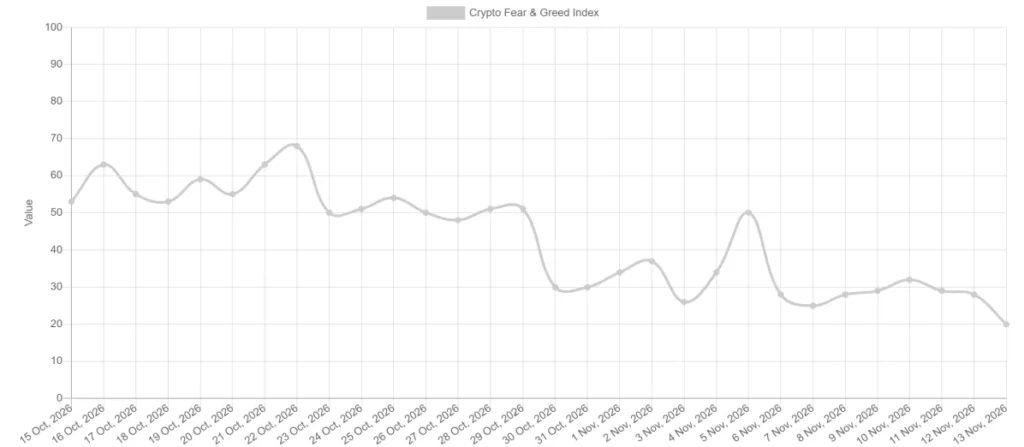
This suggests that investors are becoming increasingly cautious as cryptocurrency prices decline. Some traders are staying out of the market, while others are selling their holdings to reduce potential losses.
This environment could make it difficult for PI to attract enough buyers to sustain a recovery, even if the upcoming summit generates positive attention.
The event may trigger short-term buying if the team announces important ecosystem developments. However, investors could quickly take profits if broader market conditions remain weak, limiting the chances of a lasting rally.
2. Pi Network’s Sharpe Ratio Signals Growing Investor Losses
Another concern for Pi Network is its declining Sharpe ratio, which measures investment returns relative to the risk taken by holders.
Data shows that PI’s 90-day average Sharpe ratio has fallen to -2, while its one-year average stands at -1.4. Both readings indicate that investors have received poor risk-adjusted returns from holding the token.
The decline follows a difficult period for PI. The token recently dropped to an all-time low of $0.0625 on November 9 before recovering by approximately 10%. However, it remains about 97% below its all-time high of $2.98.
Sharpe ratio data and price performance described in the source material.
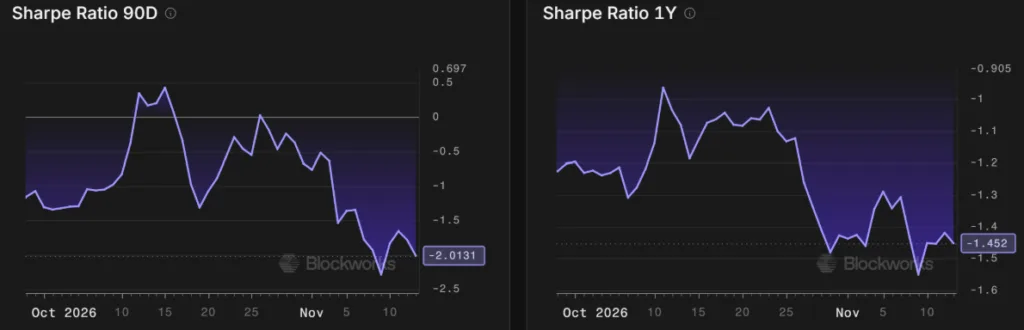
Negative Sharpe ratio readings suggest that holding PI has not rewarded investors for the risk involved. This could increase selling pressure as holders look for opportunities to exit their positions.
Consequently, even if the November summit triggers a price rebound, some investors may use the opportunity to sell rather than hold out for a longer recovery.
3. Pi Network Technical Indicators Remain Bearish
Pi Network’s technical indicators also point to further downside risks. On the daily chart, the Relative Strength Index (RSI) stands at 34. Although the indicator previously reached the oversold level of 30, it remains below the neutral level of 50, suggesting that bearish momentum is still dominant.
The On-Balance Volume (OBV) indicator has also declined to -3.28 billion. This suggests that selling pressure continues to outweigh buying activity, making it harder for PI to establish a sustained upward move.
Both indicators would need to improve to strengthen the recovery outlook. In particular, a rising RSI and OBV would suggest improving momentum and renewed buying interest.
The November 17–19 summit could provide a catalyst for such a shift if the team announces developments that attract new investors. However, positive announcements alone may not be enough to reverse the current technical weakness.
Pi Network Price Prediction: Key Support and Resistance Levels to Watch
Pi Network’s daily chart shows that the downtrend that began in September remains intact. PI is still trading within a descending channel, leaving buyers with several important levels to defend.
On the downside, the recent all-time low around $0.0622 is the first major support to watch. This level also aligns with the lower boundary of the descending channel.
A break below this support could expose PI to further losses, with the next downside target sitting around $0.053, corresponding to the 123.6% Fibonacci extension.
However, a recovery ahead of or during the summit could shift attention toward nearby resistance levels.
Potential upside levels
- $0.0743: The middle Bollinger Band and first recovery target.
- $0.076: The 61.8% Fibonacci level and an important resistance area.
- $0.084: A key level PI needs to break above to strengthen the bullish reversal case.
Potential downside levels
- $0.0622: Recent all-time low and immediate support.
- $0.053: Potential downside target if the all-time-low support breaks.

A move above $0.084 would provide stronger evidence that buyers are regaining control. Until then, any recovery could remain a temporary bounce within the broader downtrend.
Can the Pi Network Summit Trigger a Lasting Price Recovery?
The November 17–19 ecosystem summit gives Pi Network an opportunity to attract renewed attention through new announcements and ecosystem developments. However, the token faces several challenges heading into the event.
Extreme Fear across the crypto market could limit buying interest, while negative Sharpe ratio readings suggest that holders have little incentive to maintain their positions. Meanwhile, bearish RSI and OBV readings indicate that selling pressure remains stronger than demand.
Although the summit could support a short-term rebound toward $0.0743 and $0.076, PI needs to reclaim $0.084 to provide stronger confirmation of a trend reversal.
For now, the $0.0622 support level remains critical. If buyers fail to defend it, Pi Network could face another decline toward $0.053 despite the upcoming ecosystem event.
ALSO READ: How Tom Lee Turned BitMine Into the World’s Largest Ethereum Treasury
DISCLAIMER:
This article reflects the author’s views and is provided for informational purposes only. While we strive for accuracy, the publisher does not guarantee that all information is complete or current. Readers should verify important information and consult appropriate sources before making decisions based on this content.
About the Author