- RLUSD supply hits a record $2.442 billion as adoption grows.
- XRP, however, continues to lag despite steady ETF inflows.
Ripple’s RLUSD stablecoin has reached a fresh all-time high of $2.442 billion in circulating supply, extending its steady growth through 2026. RLUSD supply stood at about $1.7 billion in mid-August before crossing $2 billion later that month and rising to roughly $2.32 billion in early September.
The latest increase comes as XRP continues to lag, with the price down about 27% year to date. The divergence shows that RLUSD’s growing use for settlement and liquidity is not translating directly into stronger XRP price performance.
RLUSD Growth Continues as XRP Struggles
XRP is down roughly 27% year to date, while RLUSD’s market capitalization has increased more than tenfold during the same period.
The difference is important because RLUSD and XRP serve different purposes within the broader Ripple ecosystem. RLUSD can be used for payments, settlement and treasury activity without requiring XRP’s price to rise at the same time.
Growing RLUSD supply can therefore point to higher liquidity and greater use of Ripple-related infrastructure without acting as a direct signal for XRP’s next price move.
The XRP Ledger has also been cited as one of the larger stablecoin networks by native supply as RLUSD continues to expand.
XRP ETFs Continue to Attract Capital
Spot XRP ETFs provide another measure of institutional interest in XRP. Recent daily inflows have generally been in the low single-digit millions, although cumulative inflows have continued to build since the funds launched.
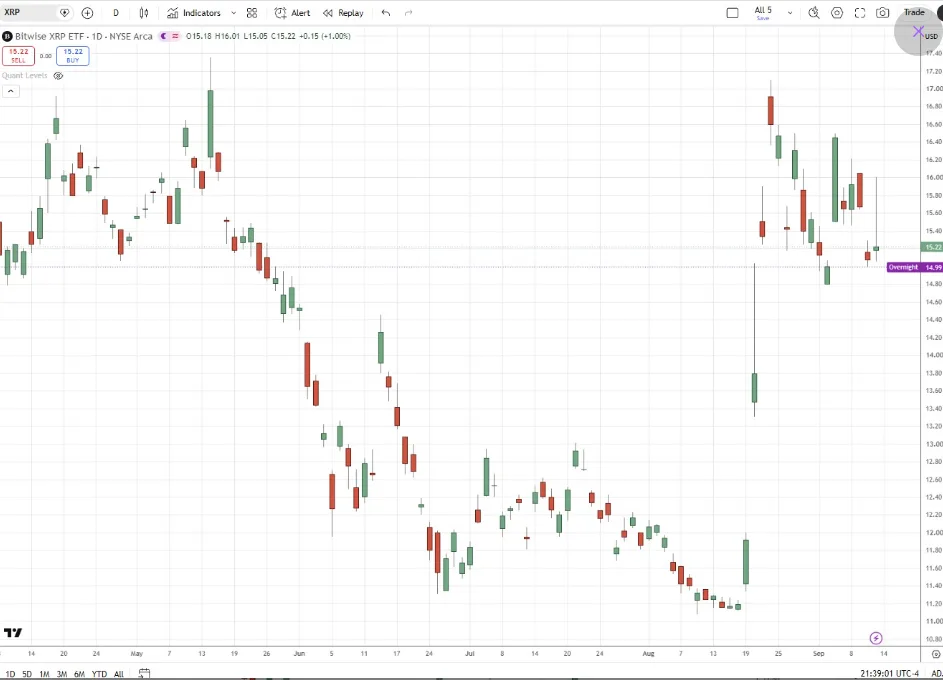
The ETF market has also become an important part of XRP’s recent price story. Bitwise’s XRP ETF has led the group in both trading volume and assets, with roughly $22 million to $28 million in daily volume and about $520 million in assets under management based on the figures cited in the source.
Franklin Templeton’s XRPZ has ranked second, with daily volume of around $7 million to $8 million and approximately $388 million in assets. Its 0.19% expense ratio is lower than Bitwise’s 0.34%, giving investors a different trade-off between cost and liquidity.
Canary Capital, Grayscale and REX-Osprey have remained smaller by both volume and assets.
XRP Staged a Sharp Rebound in August
XRP’s recent price action has not been entirely weak. XRP fell to a yearly low of $0.98 on August 14 before beginning a strong reversal around August 19.
The rebound pushed XRP about 56% higher in a single week. It was the strongest weekly move since the rally that followed the SEC settlement in August 2025.
Several factors helped fuel the recovery. Short interest in XRP perpetual contracts had reached its highest level since April, leaving the market vulnerable to short liquidations once buying pressure increased.
Bitcoin also broke above $77,000 during the same period, helping lift the wider crypto market. XRP benefited from that broader move while its own ETF market was also seeing stronger activity.
Spot XRP ETFs recorded $110.49 million in inflows during the week, taking cumulative inflows above $1.66 billion since launch, according to the figures cited in the source.
RLUSD Adoption Adds a Different Layer to the Story
The growth of RLUSD gives the XRP ecosystem another fundamental development beyond price speculation.
Ripple has increasingly positioned RLUSD as a settlement and treasury tool, while developments such as the Hidden Road integration have added to the potential use cases surrounding the ecosystem.
This creates an important distinction between XRP and RLUSD. XRP can experience price pressure even when activity involving RLUSD is increasing.
For investors, that means RLUSD’s record supply should not automatically be interpreted as evidence that XRP is about to rise. Instead, it provides a separate measure of how stablecoin liquidity and settlement activity are developing around Ripple’s infrastructure.
What to Watch for XRP and RLUSD
The next major question is whether RLUSD can maintain its recent pace of supply growth. Continued expansion would strengthen the case that demand for Ripple’s stablecoin infrastructure is increasing.
XRP ETF flows will also remain important. A sustained increase in daily inflows would provide stronger evidence of accelerating institutional demand for XRP.
For now, the two trends remain partly separated. RLUSD is showing consistent growth in supply, while XRP’s price continues to depend on ETF demand, broader market conditions and trading activity.
The divergence makes RLUSD’s record supply an adoption story in its own right rather than a direct indicator of XRP price strength.
ALSO READ: Crypto Security Report Finds $3.63 Billion Lost in Security Incidents
DISCLAIMER:
This article reflects the author’s views and is provided for informational purposes only. While we strive for accuracy, the publisher does not guarantee that all information is complete or current. Readers should verify important information and consult appropriate sources before making decisions based on this content.
About the Author