Quick take: Smart contracts are self-executing programs on blockchain networks that automatically enforce agreements once conditions are met, removing intermediaries, reducing costs, and enabling decentralized applications.
Smart contracts are one of the most important technologies powering modern blockchain networks. They enable digital agreements to execute automatically, without relying on intermediaries, paperwork, or manual enforcement. Today, smart contracts power everything from DeFi platforms and NFTs to real-world enterprise applications.
In this guide, we explain what smart contracts are, how they work step by step, and where they are already being used in the real world. This article is written for beginners and intermediate readers looking to understand the technology behind smart contracts — not price speculation.
Table of Contents
- What Are Smart Contracts?
- How Smart Contracts Work (Step by Step)
- Core Technologies Behind Smart Contracts
- Why Smart Contracts Are Considered Trustless
- Real-World Uses of Smart Contracts
- Benefits of Smart Contracts
- Limitations and Risks
- Smart Contract Security & Audits
- The Future of Smart Contracts
- Final Thoughts
1. What Are Smart Contracts?
A smart contract is a computer program stored on a blockchain or distributed ledger that automatically executes predefined actions when specific conditions are met.
Unlike traditional contracts, smart contracts do not rely on intermediaries such as banks, lawyers, or platforms. Instead, they use cryptography and decentralized consensus to ensure agreements are enforced exactly as written.
Smart contracts are a foundational component of programmable blockchain networks and decentralized applications.
In simple terms, a smart contract is like a digital agreement that runs automatically once its rules are met, without needing a middleman.
Related reading: Blockchain Networks Explained
2. How Smart Contracts Work (Step by Step)
Smart contracts are like digital “if-then” agreements. They follow a set of rules written into code, and once the conditions are met—like receiving a payment or completing a task—they automatically carry out the agreed actions without needing anyone to manually enforce them. This is the step-by-step of hw that goes:
- Contract creation: Developers write the contract using a blockchain-compatible programming language.
- Deployment: The contract is deployed to the blockchain, becoming immutable.
- Verification: Network nodes validate the contract code and record it on-chain.
- Condition monitoring: The contract waits for predefined triggers, such as payments or events.
- Automatic execution: Once conditions are met, the contract executes instantly.
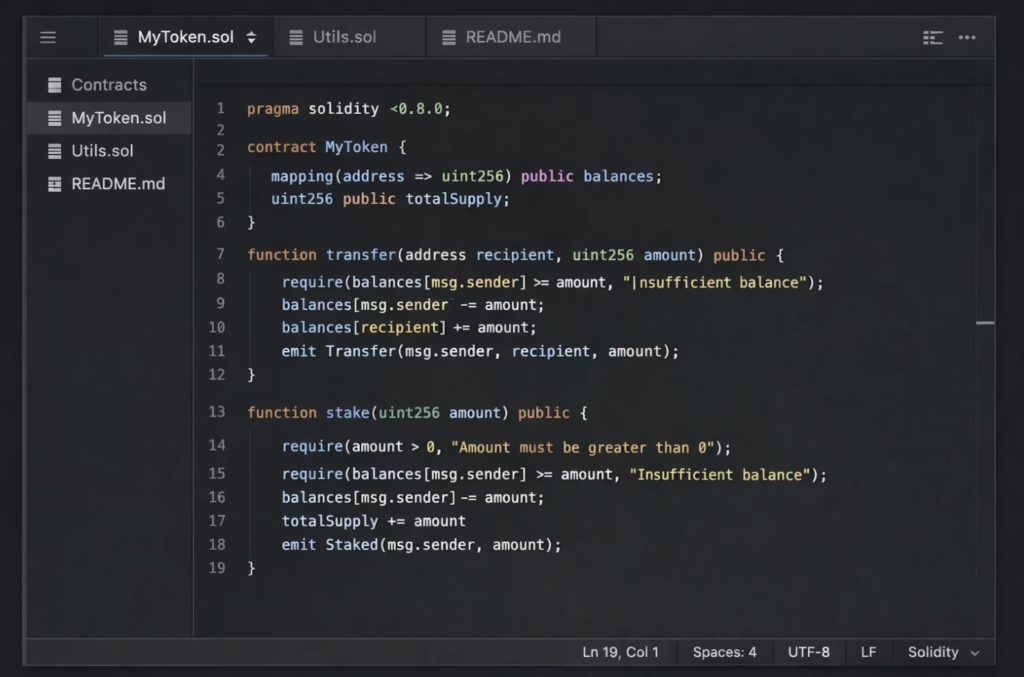
3. Core Technologies Behind Smart Contract
Every smart contract relies on a few key technologies to run smoothly. Blockchain ensures the rules are tamper-proof, virtual machines execute the code consistently, cryptographic signatures verify identities, and oracles bring in trusted data from the real world.
- Blockchain or DLT: Provides immutability and transparency.
- Virtual machines: Ensure consistent execution across nodes.
- Cryptographic signatures: Authenticate users and transactions.
- Oracles: Supply off-chain data such as prices or timestamps.
External reference: Ethereum Smart Contract Documentation
Also related: How Cardano Blockchain Works, A Complete Guide
4. Why Smart Contracts Are Considered Trustless
Smart contracts are described as trustless because participants do not need to trust each other or a central authority.
- Rules are enforced by code, not humans
- Execution is transparent and verifiable
- Contracts cannot be altered once deployed
- Transactions settle automatically
Trust is shifted from institutions to cryptography and decentralized networks.
Its important to note the difference between blockchain and smart contracts. Blockchain is a secure digital ledger, while smart contracts are the automated rules that live on it. In short, Blockchain stores the data, and smart contracts make things happen automatically based on that data.
5. Real-World Uses of Smart Contracts
Decentralized Finance (DeFi)
Smart contracts power lending, borrowing, trading, and staking platforms without intermediaries.
Example: Staking Crypto Assets
NFTs and Digital Ownership
NFT smart contracts define ownership, transfers, and royalty rules.
Example: Bridging Ethereum NFTs
Payments and Settlements
Smart contracts automate escrow, conditional payments, and revenue sharing.
Supply Chain and Enterprise Systems
They enable automated verification, tracking, and settlement across supply chains.
6. Benefits of Smart Contracts
Smart contracts have proven to be a better way of executing agreements automatically and securely. They improve on traditional methods such as:
- Paper contracts enforced by lawyers
- Manual processes in banks or businesses
- Third-party intermediaries handling payments, escrow, or verification
To solve this, smart contacts have proven to be better for their:
- Automated execution
- Lower operational costs
- Faster settlement times
- Improved transparency
- Reduced counterparty risk
7. Limitations and Risks
Despite the advantanges they also have their limitations such as:
- Code vulnerabilities or bugs
- Irreversibility of on-chain errors
- Dependence on external oracles
- Regulatory uncertainty
- Limited upgradeability
External reading: Smart Contract Security Risks
8. Smart Contract Security & Audits
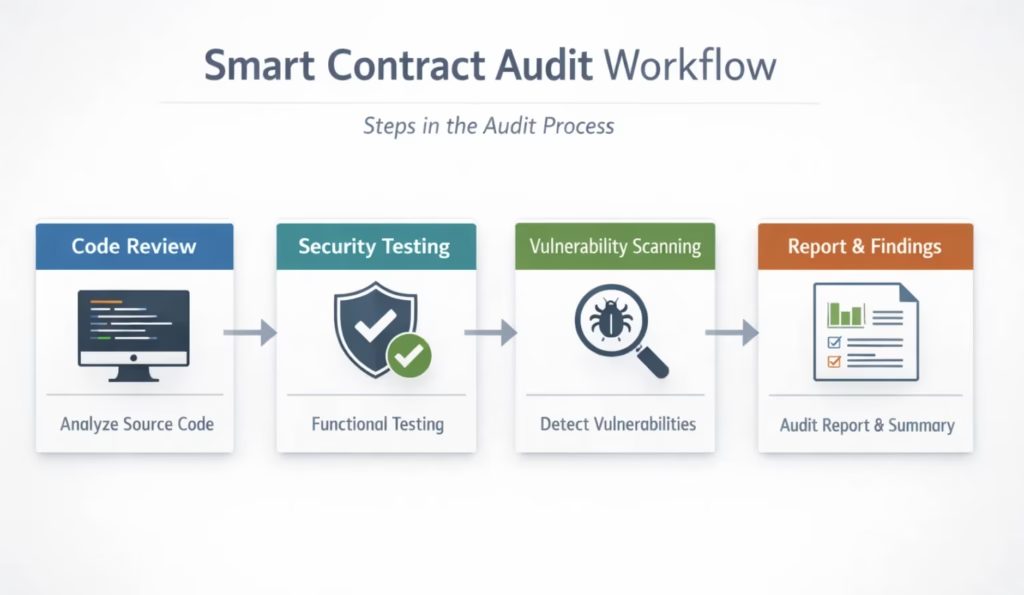
Many smart contracts undergo independent security audits before deployment. Audits review code for vulnerabilities, logic errors, and exploit risks.
While audits do not guarantee absolute safety, they significantly reduce risk when combined with best development practices and ongoing monitoring.
Audits typically analyze logic flaws, attack vectors, and economic exploits. While not a guarantee, audits significantly reduce risk when combined with best practices.
9. The Future of Smart Contracts
Smart contract technology continues to evolve, with key developments including:
- Cross-chain smart contracts
- Account abstraction for better usability
- AI-assisted contract execution
- Increased enterprise and institutional adoption
Smart contracts are expected to become a core layer of global digital infrastructure.
10. Conclution
The idea behind smart contracts is to transforming how digital agreements are created, executed, and enforced. Through combining automation, transparency, and cryptographic security, they remove intermediaries while enabling entirely new business models.
Smart contracts have the potential to continue to power the next generation of decentralized and enterprise applications.
Updated December 2025.
About the Author