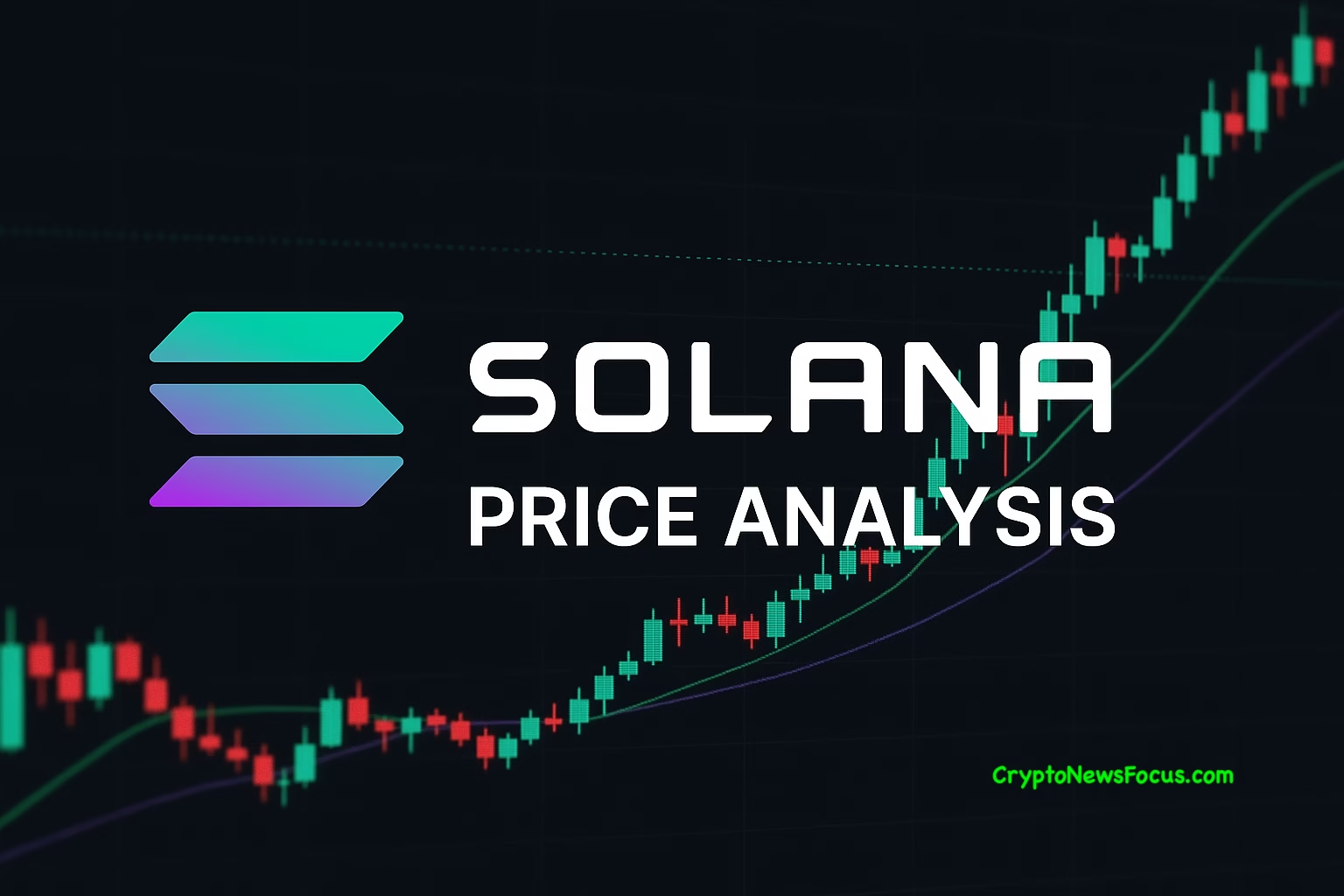
- Solana trades near the $83 support level as market tension and a major DeFi exploit increase selling pressure.
- A break below this level could trigger liquidations, while recovery depends on reclaiming $86.
The price of Solana is under pressure this week as global tensions and a major DeFi exploit weigh on sentiment. Traders are watching the $83 level closely, as a break below it could trigger a wave of liquidations.
Market Uncertainty Pushes Solana Toward Critical Support
Solana price has declined alongside the broader crypto market. Rising geopolitical tension, especially after Iran closed the Strait of Hormuz on April 19, has reduced risk appetite across global markets.
The coin dropped by about 1.77% over 24 hours, trading near $83.95. This move mirrored losses in Bitcoin and the overall crypto market cap, showing that the decline is not isolated.
At the same time, a major DeFi exploit has added extra selling pressure specific to Solana.
Key Price Levels Signal Potential Breakdown or Recovery
Analysts highlight two important liquidity zones. One lies above $90, while another sits below $85. Current price action suggests the lower zone could be tested first before any recovery attempt.
Solana has 2 decent liquidity clusters right now.
On the upside, there's one liquidity cluster above the $90 level.
On the downside, there's a liquidity cluster below the $85 level.
With the US-Iran situation intensifying again, $SOL could sweep the downside liquidity first. pic.twitter.com/u6oMMAhh1X
— Ted (@TedPillows) April 19, 2026
The 30-day simple moving average at $85.29 is acting as resistance. A move above $86.15, which aligns with the 23.6% Fibonacci retracement level, is needed to shift short-term sentiment.
If Solana fails to hold above $83, the next downside targets could appear near $80 or lower. Rising futures open interest, up roughly 20%, increases the likelihood of sharp liquidation moves in either direction.
On a broader timeframe, analysts note that Solana remains inside a descending channel. This structure could still support a long-term reversal, but only if key levels are reclaimed.
DeFi Exploit Sends Shockwaves Across the Ecosystem
A major exploit involving KelpDAO has intensified pressure across decentralized finance. The attacker used a cross-chain bridge to drain 116,500 rsETH.
Due to the KelpDAO exploit, the attacker deposited $RSETH into #Aave to borrow $ETH, creating bad debt on #Aave.
Many whales have already rushed to withdraw their $ETH from #Aave.$ETH Utilization Rate on Aave has now reached 100%. pic.twitter.com/TvxxHHDTBi
— Lookonchain (@lookonchain) April 19, 2026
The stolen assets were then used as collateral on Aave, allowing the attacker to borrow around $236 million in WETH. This left the protocol with significant bad debt.
The impact spread quickly. Aave’s ETH pool reached full utilization, prompting investors to rush to withdraw funds and resulting in billions in outflows.
On the Solana network, platforms like Kamino Finance also faced extreme pressure. USDC utilization hit 100% in key pools, raising concerns about liquidity risks.
Strong Network Growth Contrasts Price Weakness
Despite the recent drop, Solana’s network activity remains strong. In the first quarter of 2026, the network processed over $1.1 trillion in transactions and recorded 25.3 billion total transactions.
Daily active addresses reached 3.78 million, showing continued user engagement. In addition, spot Solana ETFs have attracted more than $1 billion in cumulative inflows, with strong weekly demand in mid-April.
However, Solana is still down over 30% this year and remains far below its September 2025 high of $247.
Outlook Depends on Market Stability
The short-term outlook for Solana depends heavily on external factors. Continued geopolitical tension could keep pressure on risk assets.
If conditions stabilize, investor confidence may return and support a recovery. For now, the $83 level remains the key support to watch, as a break below it could accelerate losses.
ALSO READ: TRON Launches Post-Quantum Crypto Upgrade on Mainnet to Boost Security
DISCLAIMER:
The views and opinions expressed herein are solely those of the author and do not necessarily reflect the views of the publisher. The publisher does not endorse or guarantee the accuracy of any information presented in this article. Readers are encouraged to conduct further research and consult additional sources before making any decisions based on the content provided.
About the Author