


- Ethereum remains below $1,600 as ETF outflows, weak network activity, and regulatory uncertainty continue to weigh on demand.
- A break above key resistance could improve the outlook, while failure may lead to another decline.
Ethereum has continued to trade below the key $1,600 level despite signs of stabilization across broader financial markets. While lower oil prices have improved expectations for interest rate cuts, ETH has failed to attract enough buying pressure to sustain a breakout.
Persistent ETF outflows, declining on-chain activity, and ongoing regulatory uncertainty in the United States have remained the biggest obstacles. At the time of writing, Ethereum is trading near $1,590 after recovering from recent lows around $1,510.
ETF Outflows Continue to Pressure Ethereum
Institutional demand has remained weak in recent weeks, limiting Ethereum’s recovery.
Since June 17, U.S. spot Ethereum ETFs have recorded net outflows of about $345 million. Those withdrawals have outweighed corporate purchases made by BitMine Immersion and SharpLink, which accumulated approximately $182 million worth of ETH during the same period.
As a result, institutional selling has continued to offset fresh buying interest.
Ethereum has also underperformed the broader crypto market. The price has dropped roughly 31% since May, while the overall cryptocurrency market has fallen by a smaller margin. Over the past seven days, ETH has declined nearly 5%, extending its monthly losses beyond 20%.
Weak Network Activity Reduces Demand
Ethereum’s network activity has slowed considerably over the past two months.
Network fees fell to $10.7 million in June from $24.4 million in April. At the same time, decentralized application revenue declined from $6.5 million to $5.2M.
Several major protocols continued to generate revenue during June. Sky, formerly known as Maker, recorded approximately $1.3 million, while Titan Builder generated $7.2 million and Chainlink produced about $4.6 million.
However, overall activity across the network has remained weak.
Lower fee generation has also kept Ethereum’s supply inflationary. Meanwhile, staking yields have stayed around 2.7%, reducing the appeal for long-term holders seeking higher returns.
Regulatory Delays Add More Uncertainty
Regulation has remained another factor weighing on investor confidence.
The Digital Asset Market CLARITY Act has been awaiting action in the U.S. Senate since May. The proposed legislation aims to define which digital assets should be classified as securities while reducing regulation through enforcement actions.
However, disagreements over stablecoin yield rules, anti-money laundering requirements, and ethics concerns have delayed progress.
Although many industry participants believe the legislation could benefit decentralized finance if approved, the prolonged uncertainty has discouraged larger institutional investors from increasing their Ethereum exposure.
Artificial Intelligence Creates More Competition
Ethereum is also facing stronger competition outside the blockchain sector.
Technology companies have increasingly focused on artificial intelligence infrastructure instead of blockchain solutions for enterprise applications.
Cloud providers are expanding AI services built around autonomous agents, while enterprise software firms are integrating AI tools into multi-cloud environments. This shift has attracted investment that previously flowed toward blockchain development.
Ethereum Price Faces Major Technical Resistance
Technical indicators suggest Ethereum is attempting to stabilize, but buyers have yet to regain control.
ETH is currently trading inside a high-volume area between $1,560 and $1,590, showing that both buyers and sellers remain active at these prices. The RSI has recovered to the neutral 50 level after previously entering oversold territory. While this indicates that selling pressure has eased, it does not yet confirm a bullish reversal.

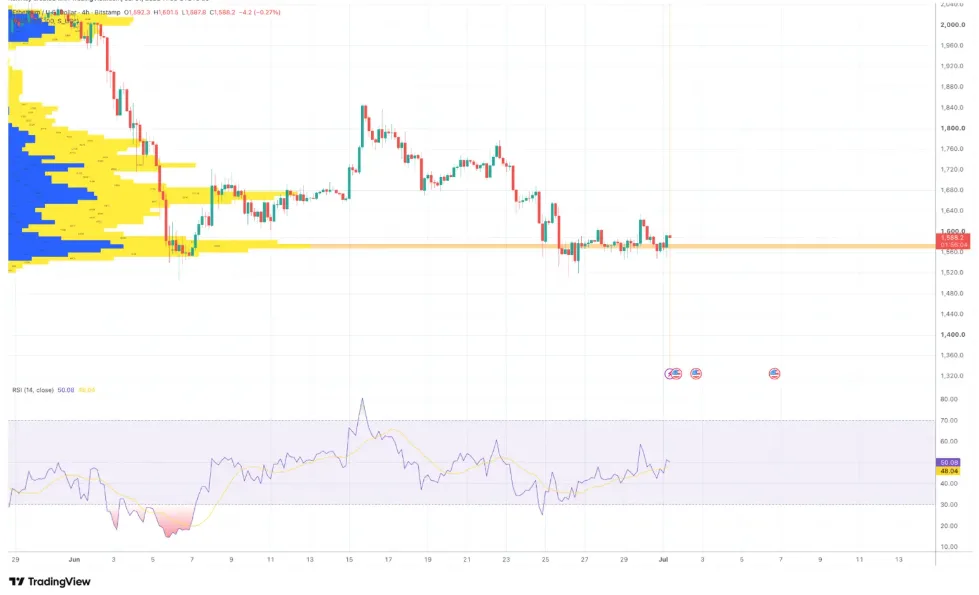
Ethereum also remains below its 20, 50, 100, and 200 exponential moving averages. The first resistance sits near the 50 EMA around $1,607. A stronger resistance level appears around $1,650, while the 200 EMA near $1,742 continues to define the longer-term bearish trend.
Fibonacci retracement levels also identify the $1,600-$1,605 region as a critical breakout zone. If Ethereum closes above that area, buyers could target the next resistance between $1,610 and $1,620 before attempting a move toward $1,650.
Support Levels Remain Critical
Failure to break above resistance could place Ethereum under fresh selling pressure. The nearest support sits between $1,545 and $1,550. Another important support zone lies around $1,525 to $1,535.
If those levels fail, Ethereum could revisit its recent low near $1,510. A deeper decline may expose downside targets around $1,433 and even $1,309.
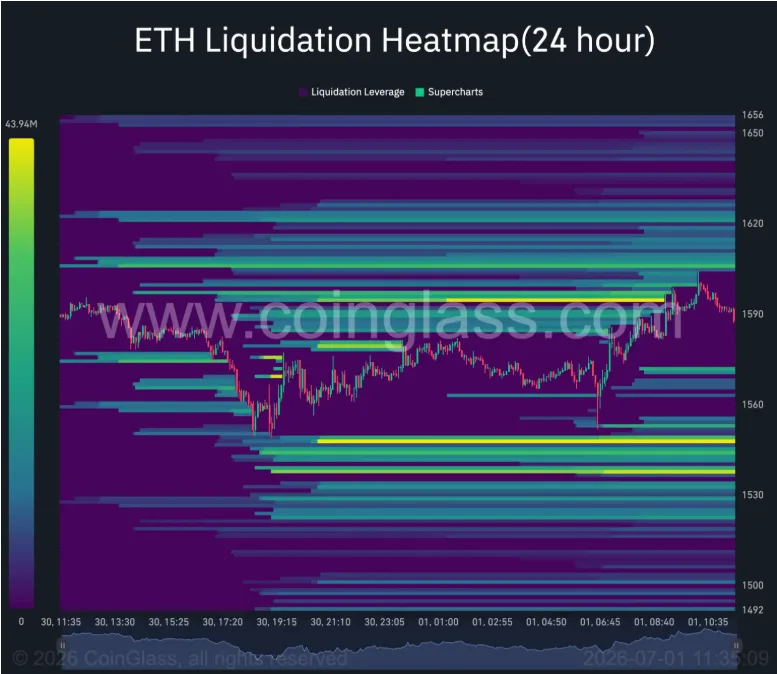
Liquidation data also highlights a large concentration of short positions around $1,595 to $1,600. A successful breakout above that level could force short sellers to close their positions, adding fuel to a stronger rally.

Can Ethereum Finally Reclaim $1,600?
Ethereum still benefits from its leadership in real-world asset tokenization, with more than half of tokenized assets built on its network. Supporters believe that broader adoption of tokenized assets could strengthen Ethereum’s long-term outlook.
For now, however, that narrative has not translated into stronger network activity or sustained buying demand.
Until ETF flows improve, on-chain usage recovers, and buyers push the price above the $1,600 resistance zone, Ethereum may continue trading inside its current range while remaining vulnerable to another move lower.
ALSO READ: Pi Network Price Hits New All-Time Low Despite Pi2Day Updates
DISCLAIMER:
The views and opinions expressed herein are solely those of the author and do not necessarily reflect the views of the publisher. The publisher does not endorse or guarantee the accuracy of any information presented in this article. Readers are encouraged to conduct further research and consult additional sources before making any decisions based on the content provided.