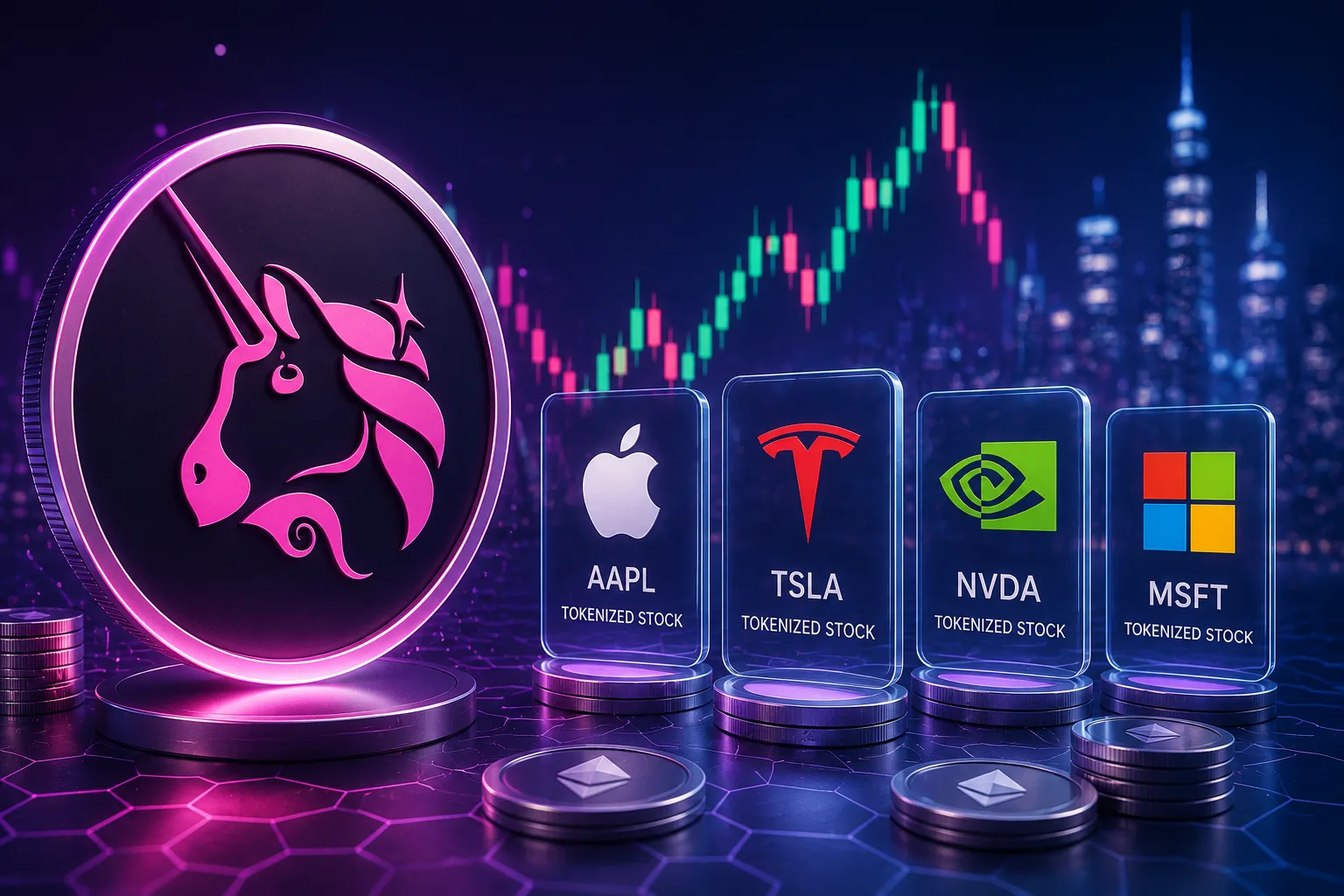
For years, cryptocurrency exchanges have focused on digital assets like Bitcoin, Ethereum, and thousands of altcoins. But a new trend is beginning to blur the line between traditional finance and decentralized finance (DeFi): tokenized stocks.
Instead of buying shares through a traditional brokerage, investors may soon be able to trade digital representations of publicly listed companies directly on blockchain networks.
If that vision becomes mainstream, Uniswap could become one of the biggest beneficiaries.
As the world’s largest decentralized exchange (DEX), Uniswap is well-positioned to provide the liquidity and infrastructure needed for tokenized equities, potentially changing how millions of people invest.
What Are Tokenized Stocks?
Tokenized stocks are blockchain-based digital tokens that represent shares—or exposure to the value of shares—in publicly traded companies.
Rather than relying entirely on traditional stock exchanges and brokers, these assets can be traded on blockchain networks using crypto wallets.
For investors, that could mean:
- 24/7 trading instead of limited market hours.
- Faster settlement times.
- Lower transaction costs.
- Greater accessibility for global investors.
- Integration with decentralized finance applications.
Although the sector is still in its early stages, many industry leaders believe tokenized securities could become one of blockchain’s largest real-world use cases.
Why Uniswap
Uniswap has already proven it can facilitate billions of dollars in decentralized trading volume without relying on a central intermediary.
Its automated market maker (AMM) model allows users to trade directly from their wallets while liquidity providers supply the assets needed for swaps.
If tokenized stocks become widely available on public blockchains, decentralized exchanges like Uniswap could become an important marketplace for these assets.
Instead of visiting multiple brokers or exchanges, investors could potentially trade tokenized equities alongside cryptocurrencies, stablecoins, and other digital assets—all within the same ecosystem.
The Rise of On-Chain Finance
Wall Street is increasingly exploring blockchain technology.
Banks, asset managers, and fintech companies are investing in tokenization projects covering everything from government bonds and money market funds to real estate and private credit.
Stocks appear to be the next logical step.
Tokenization could remove many of the inefficiencies associated with traditional financial markets, including lengthy settlement periods and geographic barriers.
This broader movement toward on-chain finance creates new opportunities for decentralized trading platforms.
Why Investors Are Paying Attention To Uniswap
One reason tokenized stocks have generated excitement is accessibility.
Millions of people around the world face restrictions when trying to access U.S. or European equity markets.
Blockchain-based assets could make investing more accessible by allowing users to participate through compatible wallets and digital asset platforms, subject to applicable regulations.
The combination of fractional ownership, continuous trading, and global accessibility has the potential to reshape how investors think about financial markets.
Uniswap’s Competitive Advantage
Unlike centralized exchanges, Uniswap operates through smart contracts.
Users maintain control of their assets throughout the trading process, reducing reliance on intermediaries.
The protocol also benefits from:
- Deep liquidity.
- A large developer ecosystem.
- Integration across multiple Ethereum Layer-2 networks.
- Strong brand recognition within decentralized finance.
- Continuous innovation through governance and community development.
These advantages could make Uniswap a natural venue for tokenized asset trading as the market matures.
Challenges Still Remain
Despite the optimism, several hurdles must be overcome before tokenized stocks become mainstream.
Regulatory frameworks continue to evolve, and securities laws differ across jurisdictions.
Issuers must ensure that tokenized equities comply with applicable financial regulations, while decentralized platforms may face additional scrutiny as governments develop rules for digital asset markets.
Liquidity, custody, and investor protection will also play critical roles in determining how quickly adoption occurs.
Could This Be Uniswap’s Biggest Opportunity Yet?
Uniswap helped pioneer decentralized token trading.
The next phase of its evolution may involve much more than cryptocurrencies.
If stocks, bonds, real estate, and other financial assets increasingly move on-chain, decentralized exchanges could become essential infrastructure for the global financial system.
Rather than competing only with other crypto platforms, Uniswap could eventually find itself competing with traditional exchanges and brokerages.
That would represent one of the biggest shifts in financial markets since online investing became mainstream.
Anyways…
Tokenized stocks are still in the early stages of adoption, but momentum is building as financial institutions embrace blockchain technology.
For Uniswap, the opportunity extends beyond trading cryptocurrencies.
Its decentralized infrastructure, global accessibility, and deep liquidity position it to play an important role in the future of on-chain finance.
Whether tokenized equities become a niche product or a mainstream investment vehicle remains to be seen. But if the financial world continues moving toward blockchain-based assets, Uniswap may not simply be a decentralized exchange—it could become one of the foundations of the next generation of global investing.
About the Author