- Ripple Labs is building a native oracle to connect bank data directly to the blockchain, challenging Chainlink’s dominance.
- The oracle targets the $25 billion real-world asset market and leverages XRP’s ISO 20022 compatibility for SWIFT integration.
- Regulatory uncertainty may slow adoption, but the move positions Ripple as a key data layer for global finance.
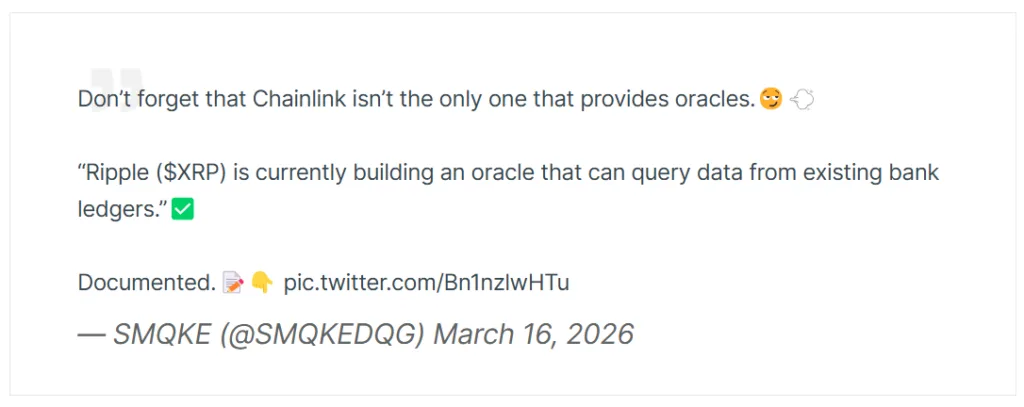
Ripple Labs is quietly building a native oracle to connect traditional banking data directly to the blockchain, aiming to rival Chainlink. This development could give XRP a stronger role in the $25 billion real-world asset (RWA) market and position it as a critical bridge for global financial institutions.
Targeting the Real-World Asset Market
Tokenization is rapidly growing, with major firms like BlackRock expanding into blockchain-based assets. Ripple’s new oracle seeks to provide high-precision on-chain data by querying bank ledgers directly. This approach offers more accurate pricing of tokenized real-world assets, giving XRP a competitive edge in institutional adoption.
ISO 20022 and SWIFT Integration
Ripple’s infrastructure supports the ISO 20022 messaging standard, allowing seamless integration with SWIFT payment systems. Since 2025, the XRP Ledger has been testing interoperability with SWIFT rails, positioning XRP as a bridge currency for faster, more efficient cross-border settlements.
Competing with Chainlink
While Chainlink remains a leading oracle provider through its Cross-Chain Interoperability Protocol (CCIP), Ripple’s solution differs by enabling XRP-focused payment and settlement. By providing real-world data directly from banks, Ripple’s oracle could become the preferred choice for financial institutions seeking transparency, precision, and integration.
Regulatory Challenges Ahead
Despite Ripple’s promising technology, adoption may face delays due to regulatory uncertainties, including the proposed Clarity Act. Financial institutions are likely to take a cautious approach until clearer guidelines are established. These regulatory questions could impact how quickly XRP is integrated into banking systems, slowing the rollout of Ripple’s oracle and its potential to reshape real-world asset tokenization.
Ripple’s Strategic Evolution
This oracle marks a turning point for Ripple, transforming it from a payment network into a critical data layer for global finance. If successful, XRP could play a central role in value transfer and on-chain data access. This development may cement XRP’s position in the future of tokenized financial systems.
ALSO READ: What Could Trigger the Next Bitcoin Rally in 2026
DISCLAIMER:
The views and opinions expressed herein are solely those of the author or advertiser and do not necessarily reflect the views of the publisher. The publisher does not endorse or guarantee the accuracy of any information presented in this article. Readers are encouraged to conduct further research and consult additional sources before making any decisions based on the content provided.
About the Author