


- XRP dropped below $1.30 as bearish pressure and weak momentum persist.
- XLM rose after a DTCC tokenization deal, though sentiment remains mixed.
XRP extended its decline on Thursday after slipping below the crucial $1.30 support level, a move that confirms growing weakness in its short-term structure. The coin is now trading at around $1.28, reflecting sustained selling pressure as buyers fail to defend key technical zones.
Market structure remains firmly bearish as XRP continues to trade below the 50-day, 100-day, and 200-day exponential moving averages, which are clustered between approximately $1.39 and $1.66. This positioning highlights strong overhead resistance and limited recovery strength in the near term. Momentum indicators also reinforce this outlook, with the RSI hovering near 33, suggesting conditions are edging toward oversold territory while the MACD remains in negative alignment.
XLM Surges Following DTCC Partnership Announcement
XLM moved sharply higher following a major institutional development involving the Depository Trust & Clearing Corporation and the Stellar Development Foundation. The two organizations announced plans to enable the tokenization of DTC-custodied assets on the Stellar network, a move widely seen as a step toward integrating traditional financial markets with blockchain infrastructure.
The announcement triggered a strong market reaction, with XLM surging more than 11% on Wednesday and extending gains into Thursday with an additional upside move of over 5%. The token is now holding above key short-term moving averages, reflecting improving investor confidence driven by the new adoption narrative.
Derivatives Data Shows Mixed Market Sentiment
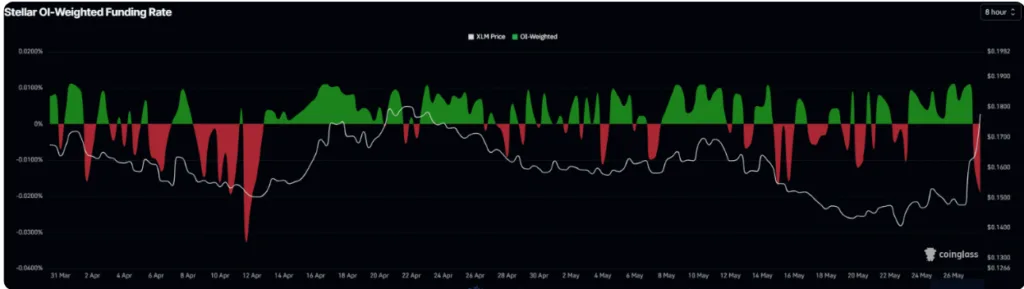
Despite divergent price action, derivatives data for both XRP and XLM continue to show cautious and mixed sentiment. Long-to-short ratios for both assets remain below 1, indicating that traders are still slightly tilted toward bearish positioning in leveraged markets.

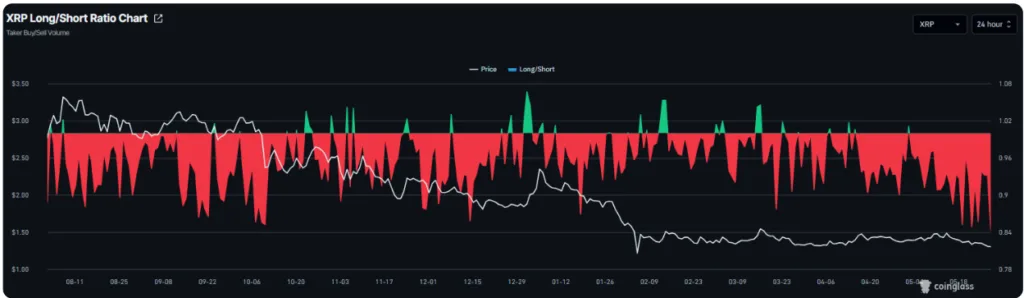

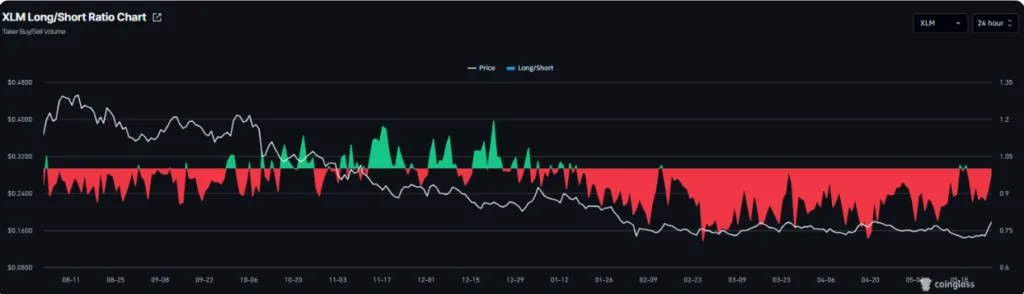
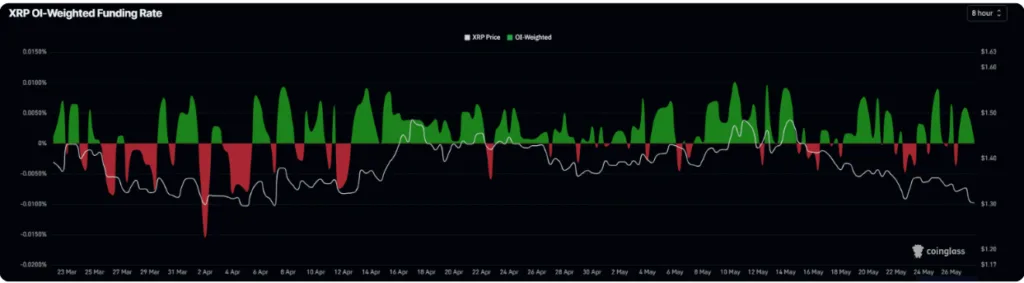
Funding rates are also showing early signs of weakening, with XRP approaching negative territory and XLM trending in the same direction. This suggests that short positions are gaining influence, and overall market conviction remains limited despite recent price movements.


XRP Technical Outlook Remains Weak
XRP’s break below $1.30 has reinforced its bearish structure, especially as the price continues to trade under key exponential moving averages. Any recovery attempt is likely to face immediate resistance at $1.30, followed by stronger barriers at $1.38 and $1.39, where the channel resistance and 50-day EMA converge.

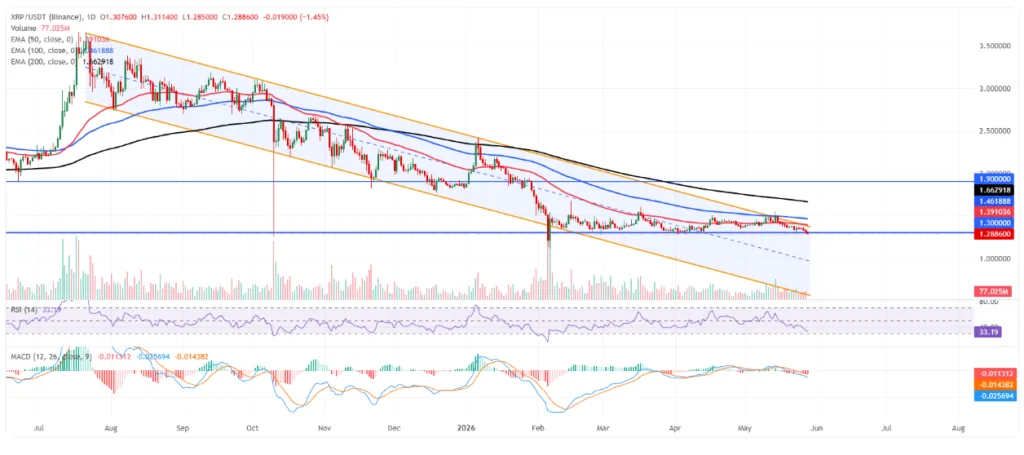
Beyond that, XRP faces resistance at $1.46 and $1.66, and buyers must reclaim these levels to shift the broader trend back toward neutrality. Until then, sellers maintain control as weak momentum and a lack of strong bullish catalysts continue to drive downside pressure.
XLM Technical Outlook Shows Relative Strength
In contrast, XLM maintains a more constructive technical setup as it holds above both the 50-day and 100-day exponential moving averages. Momentum indicators have improved, with RSI near 65 suggesting sustained buying interest and the MACD turning positive, both of which indicate short-term strength.

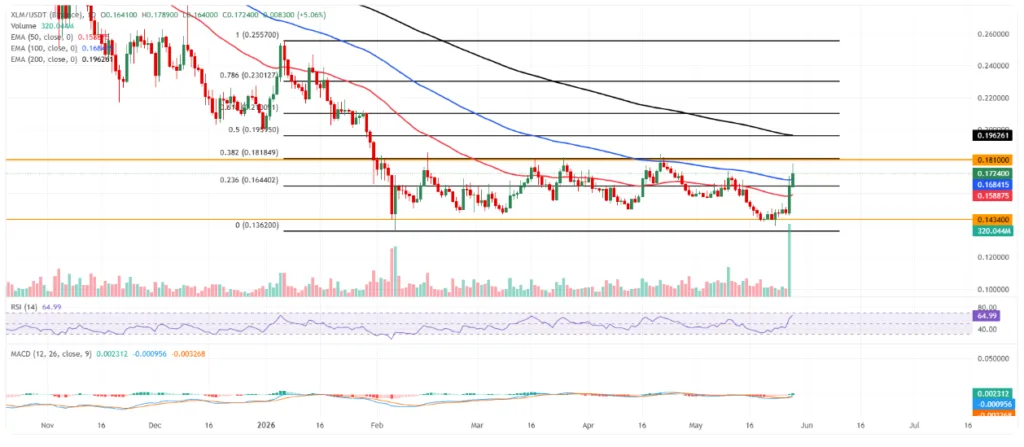
Immediate resistance is located around $0.181, and a breakout above this level could open the path toward $0.195 and $0.196, where the 200-day EMA sits. On the downside, support is found at $0.168, followed by $0.164, and a break below these levels would weaken the current bullish structure.
Conclusion
XRP continues to face pressure after breaking a key support level, with technical signals pointing to continued weakness unless buyers regain control. XLM, on the other hand, is benefiting from strong institutional narrative support tied to the DTCC partnership, helping it outperform in the short term. However, broader derivatives data show hesitation across both assets, suggesting traders remain cautious about the next major move.
ALSO READ: What Is Threatening Ethereum’s Dominance in the Crypto Market by 2030
DISCLAIMER:
The views and opinions expressed herein are solely those of the author and do not necessarily reflect the views of the publisher. The publisher does not endorse or guarantee the accuracy of any information presented in this article. Readers are encouraged to conduct further research and consult additional sources before making any decisions based on the content provided.